

Egg Carton Labels Explained: Cage-Free vs Free-Range vs Organic vs Pastured
Where do supermarket eggs come from? Are brown eggs better? Is free-range better than pastured? We help you sift through all the terms.
Quick Reference: Egg Carton Labels
- How many eggs Americans eat: more than 80 billion a year, per the American Egg Board and USDA Economic Research Service.
- Where they come from: per United Egg Producers, 99% of US retail eggs are laid by hens in about 186 companies, each with 75,000 or more birds.
- Most trustworthy label: USDA Certified Organic + Pasture-Raised. Least meaningful: “Farm Fresh”, “Hormone-Free”, and “Naturally Pasteurized”.
- Cage-Free share: 5.5% of US market. Organic share: 4.5%.
- Nutrition per large egg: 70 calories, 6 g protein, 4.5 g fat, 213 mg cholesterol (22% less than the 1989 study).
- Related tool: the Almanac’s guide to raising backyard chickens.
Americans purchase and eat more than 80 billion eggs per year, per the American Egg Board and USDA Economic Research Service. Darting into the grocery store for a carton of eggs is no longer a simple task. There are so many categories of eggs to choose from, with many new terms and changes in labeling introduced as consumer demands to know exactly what they are buying have increased. So how do you know what you are getting when you are purchasing eggs from the supermarket or farmers market? We help you sift through all the terms.
Where Do Supermarket Eggs Come From?

It is essential to first consider where the bulk of our eggs are produced, and how they are raised. According to the United Egg Producers US stats, 99% of the eggs sold in stores come from approximately 186 egg-producing companies with flocks consisting of 75,000 laying hens or more. And 63 of these companies have one million or more laying hens, with 17 companies having more than 5 million laying hens.
Read: How fresh are those supermarket eggs?
When Buying Eggs, What Do All the Terms Mean?
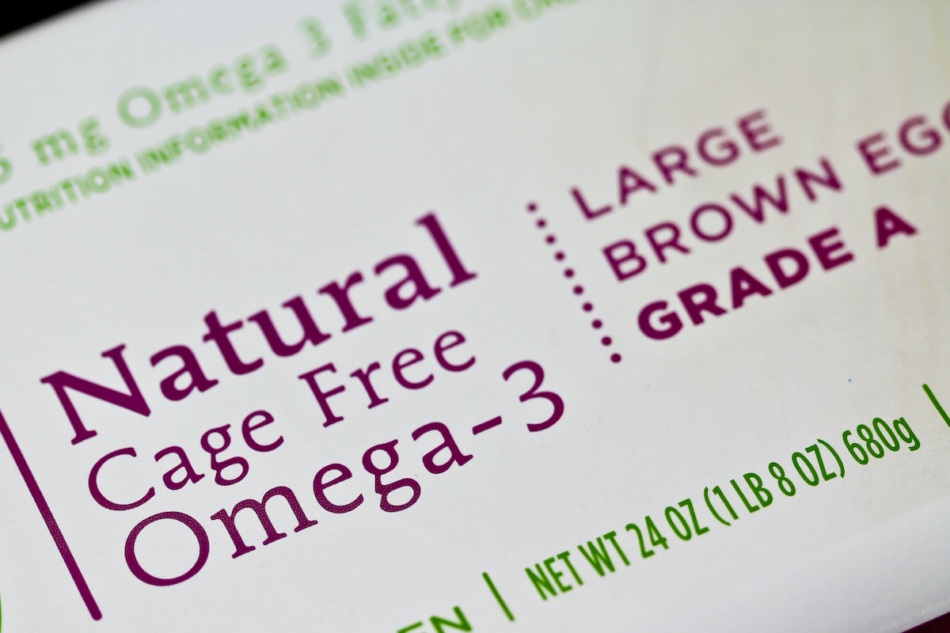
Here is a breakdown of what each of the labeling terms actually means on egg cartons.
Farm Fresh: The traditional egg farm with fewer than 400 egg-producing hens gave way to large commercial egg operations. While the eggs produced are generally fresh, they are not from a “farm” in the traditional sense. The chickens were most likely conventionally raised, in “battery cages” (the name given to rows and columns of identical cages connected together, in a unit) without access to the outdoors, unless the carton also specifies pasture-raised.
Hormone-Free: In the US, industry regulations forbid the use of hormones in raising chicks and egg-laying hens. Since all eggs sold in the supermarket are hormone-free, it is not necessary to note this on the packaging. When you see the phrase on a carton, treat it as marketing rather than a distinguishing claim.
Vegetarian-Fed: Vegetarian-fed chickens have a diet limited to grains and soy protein. These eggs appeal to consumers on a Lacto-Ovo Vegetarian diet. But chickens “in the wild” are omnivores and eat grass, seeds, and insects. This labeling term ensures they were not fed animal by-products.
Naturally Pasteurized: This term means the eggs were pasteurized through a warm water process to eliminate the risk of consumers getting sick from possible salmonella. Unfortunately, this term is often used to mislead consumers about egg-laying conditions when, in fact, it is unrelated.
Cage-Free: 5.5% of table eggs sold in the US market are labeled “cage-free” which means they were raised free of cramped cages, but the chickens are raised indoors in overcrowded production facilities.
Free-Range: Free-range simply means the hens have access to the outdoors. There are no regulations specifying the frequency of their outside access or the size of the space. Unless you are purchasing eggs from a sustainable farm, it is not likely that the chickens ever roam outdoors.
Organic: 4.5% of table eggs sold in the US market are labeled organic. To qualify for this labeling, USDA Certified Organic egg producers must not use genetically modified feed or antibiotics in their operations.
Pastured: Chickens are allowed to forage naturally outdoors on grass, seeds, and insects during the day in addition to receiving feed. Organic pasture-raised is by far the healthiest way to raise chickens, which produce the healthiest, most nutritious eggs. This is the preferred method used by sustainable farmers. Pastured eggs still retain the bloom, the protective coating on the outside of eggs.
Egg Label Cheat Sheet: What Actually Means Something
Ranked from most meaningful to least, based on USDA labeling rules and Cornell Small Farms Program guidance:
- USDA Certified Organic + Pasture-Raised (Certified Humane or AWA): the strictest tier. Outdoor access, organic feed, no antibiotics or GMO feed.
- Pasture-Raised (Certified Humane): at least 108 sq ft of pasture per bird.
- USDA Certified Organic: organic feed, no antibiotics, some outdoor access. Housing rules are less strict than the pastured tier.
- Free-Range: outdoor access, but time and space are not regulated. Look for a third-party humane seal to add teeth.
- Cage-Free: no battery cages, but often indoor overcrowding.
- Vegetarian-Fed: a diet claim, not a welfare claim.
- Farm Fresh, Natural, Hormone-Free, Naturally Pasteurized: marketing language. None guarantee welfare, feed, or outdoor access.

All Eggs Are Not Created Equal
The quality and nutritional value of the eggs you select is determined by the feed and environment the chickens were raised in. Restricting chickens of their natural foraging for food outdoors and placing them in an unhealthy, crowded building makes them prone to disease. The best way to ensure you get quality eggs is to do your research. Ask your grocer or local egg producer what the chickens are fed and how they are raised. Shopping at the farmers’ market or a local sustainable farm gives you the opportunity to ask questions and speak directly to the producer. If zoning and location permit, treat yourself to the freshest eggs ever and consider raising a small flock of laying hens in your fenced yard.
Nutritional Value of Eggs
Eggs contain the highest quality protein available, and they also contain almost every essential vitamin and mineral needed by humans, except vitamin C. The big concern about eggs used to be the link between their cholesterol content and heart disease. Recent studies (Harvard T.H. Chan School of Public Health) show one large egg contains:
- 70 calories
- 1 gram of carbohydrate
- 4.5 grams of fat (with only 1.5 grams saturated)
- 6 grams of protein
- 213 milligrams of cholesterol, 22% less than the 1989 estimate
Per the American Heart Association’s 2020 dietary advisory, healthy adults can safely eat one whole egg a day as part of a heart-healthy diet.
Eggs: Making the Size and Grade
Size: Eggs are available as jumbo, extra-large, large, medium, and small.
Grade: In the grading process, eggs are examined for both interior and exterior quality, and are sorted according to weight (size). Grade quality and size are not related. In descending order of quality, grades are AA, A, and B. There is no difference in nutritive value. In many egg-packing plants, the USDA provides a grading service for shell eggs. Its official grade shield certifies that the eggs have been graded under federal supervision, according to USDA standards and regulations. The grading service is not mandatory. Other eggs are packed under state regulations that must meet or exceed federal standards. Because production and marketing methods have become very efficient, eggs now move so rapidly from laying house to market that you will find very little difference in quality.
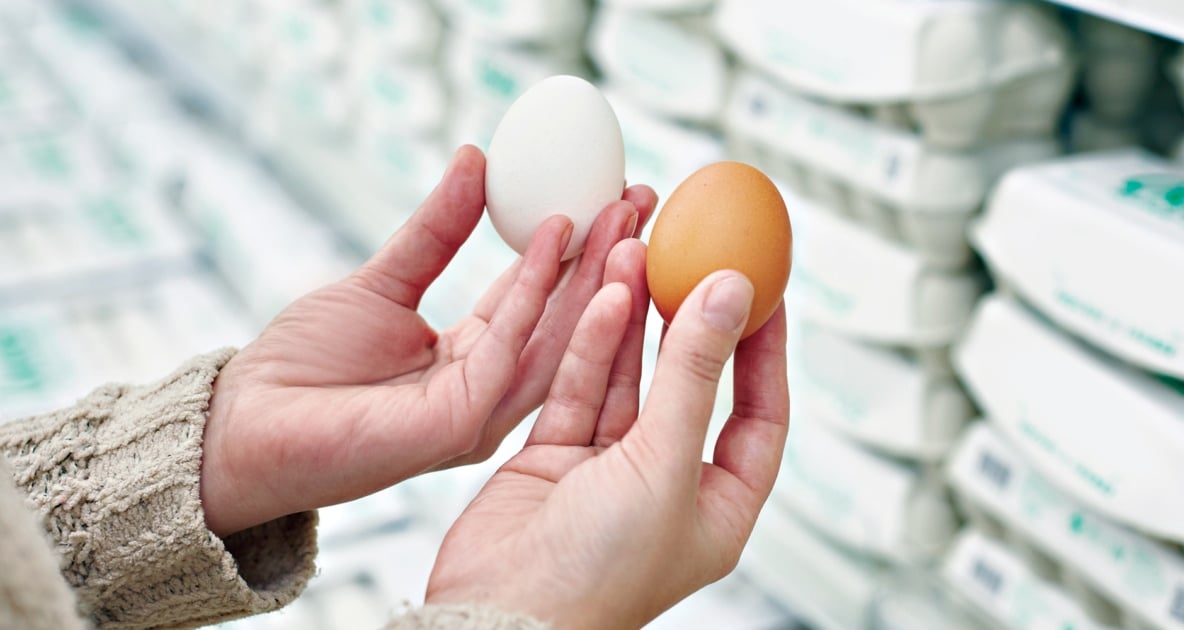
Color: Most supermarket eggs are either white or brown, and there are no nutritional differences between them. Shell color is a breed trait: Leghorns lay white, Rhode Island Reds and Plymouth Rocks lay brown, Ameraucanas lay blue, Marans lay chocolate.
Myth Busting
According to Lisa Steele at Fresh Eggs Daily, finding a blood spot in an egg does not mean it has been fertilized.
“A blood spot in an egg is simply a ruptured blood vessel that broke while the egg was being formed. In order to determine if an egg has been fertilized, you need to look for a white bulls-eye on the egg yolk.”
Got Any Egg Questions? Share them with us in the comments below.

Eggs FAQ
Are brown eggs healthier than white eggs?
No. Shell color is a breed trait, not a nutrition marker. A pastured brown egg and a pastured white egg have identical nutritional value. The color of the bird’s ear lobe predicts the color of the shell: red lobes lay brown, white lobes lay white.
Do free-range eggs actually come from hens that go outside?
Not necessarily. The USDA “free-range” label only requires that the hens have access to the outdoors. It does not set a minimum time or space. Look for “Pasture-Raised” plus a third-party certification (Certified Humane, Animal Welfare Approved) for real outdoor access.
How can I tell if a supermarket egg is still fresh?
The float test. In a bowl of cool water: a fresh egg sinks and lays flat; a week-old egg stands up on one end; a stale egg floats. Fresh eggs are safe to eat up to 5 weeks past the pack date if stored at 45 degree F or colder, per USDA Food Safety and Inspection Service.
Is one egg a day safe for cholesterol?
For most healthy adults, yes. The American Heart Association’s 2020 dietary advisory concludes that one whole egg a day fits a heart-healthy pattern. People with diabetes, heart disease, or elevated LDL should check with their doctor.
What does “cage-free” actually mean?
Cage-free hens are not confined in battery cages, but are usually raised indoors in a large barn. There is no requirement for outdoor access. About 5.5% of US table eggs carry this label.
Do I need to refrigerate eggs?
In the US, yes. Commercial eggs are washed at the plant, which strips off the natural bloom, so refrigeration below 45 degree F is required to keep salmonella risk low. In Europe, eggs are unwashed and are sold at room temperature. If you keep backyard chickens and do not wash the eggs, the bloom keeps them shelf-stable for 2 to 3 weeks.
Is it worth paying more for pasture-raised eggs?
If animal welfare or nutrition is your priority, yes. Pasture-raised eggs (Certified Humane, at least 108 sq ft of pasture per bird) tend to have deeper orange yolks and small measurable increases in vitamin D and omega-3 fatty acids. Blind taste tests consistently prefer them.


Deborah Tukua
Deborah Tukua is a natural living, healthy lifestyle writer and author of 7 non-fiction books, including Pearls of Garden Wisdom: Time-Saving Tips and Techniques from a Country Home, Pearls of Country Wisdom: Hints from a Small Town on Keeping Garden and Home, and Naturally Sweet Blender Treats. Tukua has been a writer for the Farmers' Almanac since 2004.
- Deborah Tukua

- Deborah Tukua
- Deborah Tukua
- Deborah Tukua





So basically from what I’m seeing is buy from a farmer.
For pastured eggs to be sold off the farm grounds they must be washed and refrigerated as soon as possible after lay and meet all labeling and packaging rules also. These are state and USDA rules. So the bloom is washed off the eggs. Only eggs bought by the consumer on the farm grounds that have not been washed can claim they still have the bloom. We are Wamego Valley Farm selling pasture raised brown eggs in compliance with state and federal egg production and sale rules in the state of Mississippi. Also the outdoors element of free range production does not place a requirement for pasture, or other vegetation to be present. Free range outdoor access can be asphalt, sand, gravel, bare dirt, concrete, or wooden porch.