

Natural Itch Relief: 15 Home Remedies for Bug Bites
Try these home remedies to soothe summer itches!
Quick Reference: Natural Itch Relief for Bug Bites
- Cool it fast: an ice pack or cold washcloth, or a dab of cooled mint or chamomile tea.
- From the pantry: a baking soda paste, an oatmeal or cornstarch bath, or a squeeze of lemon.
- From the garden: aloe vera gel, basil, thyme, or witch hazel.
- Do not scratch: broken skin can let in infection, so calm the itch instead.
- See a doctor if: the spot turns red, hot, and swollen, or you have trouble breathing.
The warm months bring cookouts, garden time, and bare feet, and they bring the bugs right along with them. Just when the summer of 2026 heats up and you get ready to spend more time outside, the mosquitoes, gnats, and no-see-ums seem to turn extra hungry. A bug bite can hurt and cause endless itching. Before you reach for the drugstore aisle, the pantry, garden, and spice rack hold a good number of home remedies that may help soothe bug bites and other skin irritations.
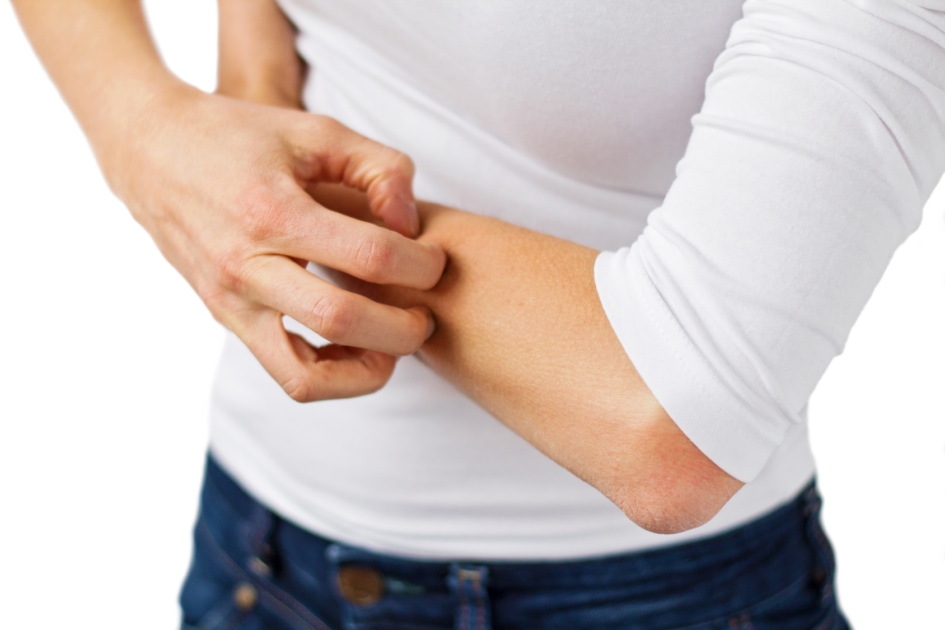
While scratching may feel good in the moment, it can also break the skin and leave you open to infection. That is reason enough to calm the itch another way. Here are the natural itch remedies folks have leaned on for generations, sorted by where you are likely to find them.
Cool the Itch Down First
The quickest relief is often the simplest. Cold numbs the nerve endings that carry the itch and takes the swelling down at the same time.
Cold compress: Apply an ice pack or cold washcloth to any itchy areas, as needed. A few minutes on and a few minutes off is easier on the skin than leaving ice in one spot for a long stretch.
Pantry and Bath Remedies
The kitchen is the first place to look. These four are likely already on your shelves, and each one has soothed itchy skin for generations.
Baking soda: Add one cup of baking soda to a tub of warm water, soak for half an hour, and air dry. For smaller areas, you can make a paste by mixing three parts baking soda to one part water. Apply this directly onto the affected area, but not over broken skin.
Oatmeal: Add up to two cups of oatmeal, ground into a fine powder, to warm bath water. The fine grind lets the oatmeal stay suspended in the water so it can coat and calm the skin, which is why a colloidal oatmeal soak is a long-standing remedy for widespread itch.
Cornstarch: You can pour some into your bath water, or rub it dry onto the affected areas. Keep cornstarch away from broken skin, since it can feed bacteria on an open wound.
Lemon: Lemon oil has anti-inflammatory properties, which can relieve itching. Squeeze the juice from a lemon wedge directly onto itchy skin and allow it to dry. Skip this one if the skin is broken, and stay out of direct sun afterward, since citrus juice on the skin can make it more sensitive to sunlight.

Herbs and Plants That Calm the Itch
The garden and the spice rack hold some of the oldest itch remedies of all. Several of these herbs carry the same numbing and anti-inflammatory compounds you will find in modern creams. If you grow your own, our Gardening by the Moon Calendar shows the Best Days to get herbs like basil, mint, and thyme in the ground.
Aloe vera: Cut a leaf from an aloe vera plant, slice it down the middle, and rub the gooey gel inside directly onto the itch. A potted aloe on the windowsill doubles as a first-aid kit for bites and small burns alike.
Basil: This popular herb contains a substance called eugenol, which numbs the nerve endings that cause itching. Place a tablespoon of dried basil leaves in 16 ounces of boiling water, keeping the pan covered. Allow it to cool before applying to itchy skin. Reserve the rest in a mason jar to use later.
Mint: Menthol, the same component that gives mint its characteristic kick, is what makes it effective at fighting itches. Menthol is an anti-inflammatory that can be absorbed into the skin. Place two tablespoons of dried mint leaves in 16 ounces of boiling water. Cover and allow to cool before applying to itchy skin. Reserve the rest in a mason jar to use later.
Thyme: Like basil and mint, thyme also has anti-inflammatory properties, and is also a numbing agent. Place a tablespoon of dried thyme leaves in 16 ounces of boiling water. Allow it to cool before applying to itchy skin. Reserve the rest in a mason jar to use later.
Chamomile tea: Instead of drinking it, rub a little cold or lukewarm chamomile tea onto rashes with a cotton ball. The same cup that settles you at bedtime can settle an angry patch of skin.
Burdock root: Apply the oil from the plant directly to the affected area. Burdock has a long place in folk medicine as a skin soother, and the oil is sold at most health-food stores if you are not digging your own root.
Witch hazel: This inexpensive drugstore astringent can help relieve itchy skin. It comes from the bark of the witch hazel shrub, and can be made at home, if you have access to the plant. Just boil about a pound of the twigs in two gallons of water.
An Old Juniper and Clove Salve
Juniper berries and cloves: This is an ancient Native American remedy. Juniper berries have anti-inflammatory properties and, like basil, cloves contain eugenol. To make a remarkably effective natural itch salve, melt two tablespoons of beeswax in a saucepan, add about 1/3 cup unsalted butter, 1/3 cup ground juniper berries, and a tablespoon of ground cloves and stir. Allow the salve to cool before applying to itchy skin, as needed.
Poured into a small tin while it is still warm, this salve keeps on the shelf and travels well in a day pack or a tackle box. A little goes a long way, so dab it on rather than slathering it.
Foods and Vitamins for Healthy Skin
Not every remedy goes on the skin. A couple of them work from the inside out, helping your body settle a rash and heal faster.
Vitamin C: Eat foods rich in this nutrient to help your body fight off a rash. (Did you know there are many wild sources of vitamin C growing all around us?)
Vitamin E: Rub some vitamin E oil on your skin, and take a supplement, too, for healthier skin. Vitamin E oil is a favorite for easing the look of the small scars a scratched-open bite can leave behind.
Which Bug Bit You?
Knowing what bit you helps you pick the right remedy and tells you when a bite is more than a nuisance. Here is a quick field guide to the summer’s usual suspects. To cut down on the bites in the first place, a few mosquito-repelling plants around the porch go a long way.
| Bug | Appearance of bite or sting | Timing of itch | Common location on body | Distinguishing feature |
|---|---|---|---|---|
| Mosquito | Round, raised, red or pink wheal; soft and puffy center; may have a tiny puncture point at center | Immediate: itching and wheal appear within minutes of bite | Any exposed skin: arms, legs, neck, ankles | Bites are scattered and random, not clustered in rows. Reaction is near-instant. (CDC; American Academy of Dermatology) |
| Flea | Small, hard, red bumps surrounded by a reddish halo; may appear in groups of 2-3 | Immediate to within 1 hour; intensely itchy from the start | Predominantly lower legs, ankles, and feet; waist if sleeping with pets | Cluster pattern at ankle height; red halo around each bite; intense itch disproportionate to wound size. (American Academy of Dermatology; Cleveland Clinic) |
| Chigger (harvest mite, Trombicula spp.) | Small, intensely red papules or welts; may develop a raised center as skin reacts to the stylostome (feeding tube) left in skin | Delayed: itch onset 1-3 hours after contact; peaks at 24-48 hours; the mite itself is rarely still present when itch begins | Belt line, waistband, behind knees, sock lines, armpits, groin; anywhere clothing fits tightly | Chiggers do not burrow. They pierce the skin surface, inject digestive enzymes, and fall off after feeding. By the time itching starts, the mite is usually gone. Bites concentrate where clothing constricts. (UF/IFAS Entomology; Texas A&M AgriLife Extension) |
| Tick (embedded) | Often no initial visible bite wound; later may show a red spot or expanding ring (bull’s-eye rash, erythema migrans, associated with Lyme disease) | Little to no itch while tick is attached; itch or pain may develop after removal; Lyme rash typically appears 3-30 days post-bite | Scalp, behind ears, neck, armpits, groin, backs of knees | Tick may still be visibly attached and engorged with blood. Bull’s-eye rash (erythema migrans) is a key indicator of Lyme disease. Seek medical attention if rash appears. (CDC; American Academy of Dermatology) |
| Bed bug (Cimex lectularius) | Small, flat, red welts with a darker red center; often arranged in linear rows of 3-5 bites (the ‘breakfast, lunch, and dinner’ pattern) | Varies: some people react within hours; others do not react for 1-3 days; first-time victims may show no reaction at all | Exposed skin during sleep: face, neck, arms, hands, shoulders | Linear or clustered row pattern on skin that was uncovered during sleep. No pain during the bite due to anesthetic in saliva. (CDC; Cleveland Clinic) |
| Fire ant (Solenopsis invicta) | Immediate red wheal at each sting; within 24 hours, sterile white or yellow-white pustules form on a red base | Immediate burning pain; pustules develop over 8-24 hours; itch persists as pustule matures over 3-8 days | Feet, ankles, and lower legs most commonly; wherever the nest was disturbed | Sterile pustule on a red base is nearly diagnostic for fire ant. Multiple stings in a tight cluster are common because ants sting repeatedly. (NCBI Bookshelf NBK470576; Merck Manual; Mississippi State University Extension) |
| Bee, wasp, or hornet | Immediate painful wheal approximately 0.5-2 inches across; red, swollen, warm; may enlarge over 2-3 days in large local reactions | Immediate sharp pain; itch and swelling peak within hours; large local reactions may worsen over 24-72 hours | Any exposed area, especially hands and arms; wherever the insect was disturbed | Single sting is typical unless a nest is disturbed. Honeybee leaves a barbed stinger embedded in skin; remove by scraping (not squeezing). Wasps and hornets do not leave stingers. Watch for systemic allergic reaction. (Merck Manual; American Academy of Dermatology) |
| No-see-um (biting midge, Culicoides spp.) | Tiny pinpoint red dot at the bite center; surrounding wheal forms within minutes; wheal may fade after 1-2 hours, then returns as a larger itchy papule lasting days | Immediate burning or stinging sensation, often more intense than mosquito bites; secondary itch and raised papule develop over hours and can persist for a week or more | Any exposed skin, especially ankles, forearms, neck; coastal and marshy areas at dawn and dusk | Insect is 1-3 mm, effectively invisible. Bites cause burning rather than just itching; people sensitive to no-see-ums develop pronounced welts. Most active at dawn and dusk in low-wind conditions near mangroves, salt marshes, or freshwater edges. (UF/IFAS Entomology) |
For the everyday itch of a mosquito or chigger bite, the pantry and garden remedies above do the job. A tick bite is worth a closer watch, since ticks can carry disease, and a sting that spreads fast can signal an allergy. That is where good judgment comes in.

When to See a Doctor
Most bug bites are a nuisance and nothing more, but use your judgment. See a doctor if a bite becomes red, hot, swollen, or starts oozing, which can be signs of infection, or if the redness spreads outward in a ring. Get help right away for signs of a serious allergic reaction, such as trouble breathing, swelling of the lips or throat, dizziness, or hives spreading across the body. Consumer health guidance from the National Library of Medicine’s MedlinePlus notes that a tick bite followed by a rash or fever, or any bite that keeps getting worse, is worth a call to your doctor. While you are stocking the home remedy shelf, a few of our other natural household remedies are worth keeping on hand. Do what is best for you and your family.
Natural Itch Relief: Frequently Asked Questions
What is the fastest home remedy for an itchy bug bite?
Cold is the quickest fix. Hold an ice pack or a cold washcloth on the bite as needed to numb the itch and bring down the swelling. For longer relief, follow it with a baking soda paste of three parts baking soda to one part water, or a dab of cooled mint or chamomile tea.
Does baking soda really stop bug bite itching?
Many people find it helps. For a single bite, mix three parts baking soda to one part water into a paste and apply it directly, but not over broken skin. For itching over a larger area, add one cup of baking soda to a tub of warm water, soak for half an hour, and air dry.
Which herbs help soothe itchy skin?
Basil, mint, and thyme all work well. Basil and cloves contain eugenol, a compound that numbs the nerve endings behind the itch, and mint’s menthol is an anti-inflammatory the skin absorbs. Steep a tablespoon or two of the dried herb in 16 ounces of boiling water, let it cool, and dab it on. Aloe vera gel and witch hazel are two more garden favorites.
Why should I not scratch a bug bite?
Scratching may feel good, but it can break the skin and leave you open to infection. It also releases more of the histamine that drives the itch, so a scratched bite often itches worse. Calm it with a cold compress or one of the remedies above instead.
Can I make my own natural itch salve?
Yes. An old Native American remedy uses juniper berries and cloves. Melt two tablespoons of beeswax in a saucepan, add about 1/3 cup unsalted butter, 1/3 cup ground juniper berries, and a tablespoon of ground cloves, and stir. Let it cool, then dab it on itchy skin as needed. Poured into a small tin, it keeps well on the shelf.
When is a bug bite serious enough to see a doctor?
See a doctor if the bite turns red, hot, swollen, or oozing, if the redness spreads in a ring, or if a tick bite is followed by a rash or fever. Seek help right away for trouble breathing, swelling of the lips or throat, dizziness, or spreading hives, which can signal a serious allergic reaction.


Jaime McLeod
Jaime McLeod is a longtime journalist who has written for a wide variety of newspapers, magazines, and websites, including MTV.com. She enjoys the outdoors, growing and eating organic food, and is interested in all aspects of natural wellness.
- Jaime McLeod

- Jaime McLeod
- Jaime McLeod
- Jaime McLeod





‘Ancient Native American” using butter? Lol, no can’t believe that one. Sorry.
I am sure the Native Americans would have used some animal fat over unslated butter. And if you prefer the stinky animal fat, you do you.
Yep
My father suffers desperately from itchy skin he is 93 / we have tried so many things – any thoughts ?
Hi Deirdre, Have him keep a food log of what’s he’s been eating and record if the itching gets better or worse after meals. Sometimes dairy products can cause itchy skin or other food sensitivities. Also, pure coconut oil straight from the jar is a known itchy skin reliever.
Does he eat a lot of sugar? Sugar feeds candida which can cause severe itching.
My face is really itchy
But my face is not dry it’s oily
Asmita, we recommend getting tests to see if you have food allergies.
The basil does work really well. It takes about 10 minutes to stop the itching and lasts about 2 hours. Then just apply some more. It keeps well so no need to make more each time.
my allergies were caused by fabric–all my clothes, bedding, must be 100% cotton-
all polyester and any synthetic fabric cause rashes went to holistic allergy
practitioner and treated for food allergies also –no medications used.
google for one in your area–it is a life save
Rub on plain old table salt. May need second applicatiin, but that usually tajes care of bug bites. I’ve used it on animals as well.
My friend got a tick bite, now he has a bad itchy rash, what wud help heal that up an stop the itching???
I give my dog grain free dry food & a can of good canned dog food. I melt coconut oil, mixed it with a probiotic and a supplement for joint care. And MUX that all together. I have Newfoundland and Pyrmese. And she’s 10 yrs old. I think she’s in good shape.
I have been using ammonia on itchy bites for many years. Only needs to be applied once. Very effective at preventing welts, and works fast to relieve itching.