Farmers’ Almanac 2026 Summer Weather Forecast
Quick Reference: Farmers’ Almanac Summer Forecast
- Issued: annually each March for the coming summer.
- Forecast period: June through August (meteorological summer).
- Method: 200-year-old formula combining sunspot cycles, lunar position, tidal pull, and historical patterns.
- Published accuracy: 80-85% by the Almanac’s own self-tracking.
- Format: 7-zone US map plus 5-zone Canadian map, by month and region.
- 2026 summer outlook: see the latest long-range forecast page.
The Farmers’ Almanac summer weather forecast comes out each spring and predicts conditions for June through August across the United States and Canada. It is built using a math-based formula that has been refined and used in continuous publication since 1818. Here is what goes into the formula, how to read the regional outlook for your zone, and what the 2026 summer signals look like.
How the Formula Works
The Almanac’s long-range formula is not publicly published, but the editors describe four main inputs:
- Sunspot cycles: the 11-year solar activity cycle correlates loosely with northern hemisphere temperature patterns.
- Lunar position: the moon’s gravitational influence on tides also tugs slightly on the atmosphere.
- Tidal pull: long-period tidal patterns track multi-year weather oscillations.
- Historical patterns: the Almanac maintains a 200-year database of regional weather, and the formula weights similar historical years.
How to Read the Regional Forecast
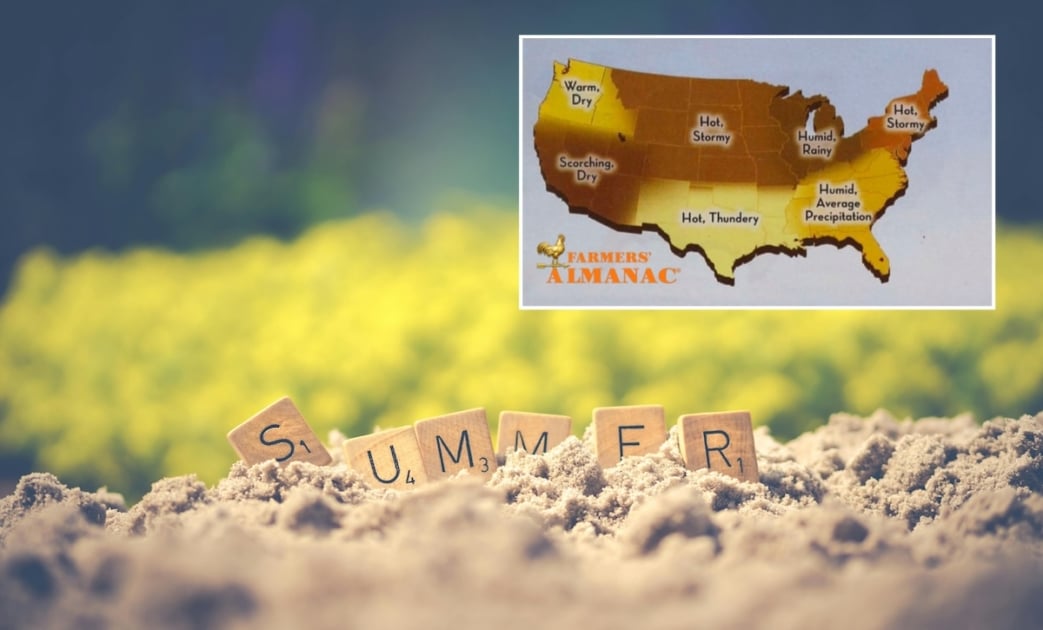
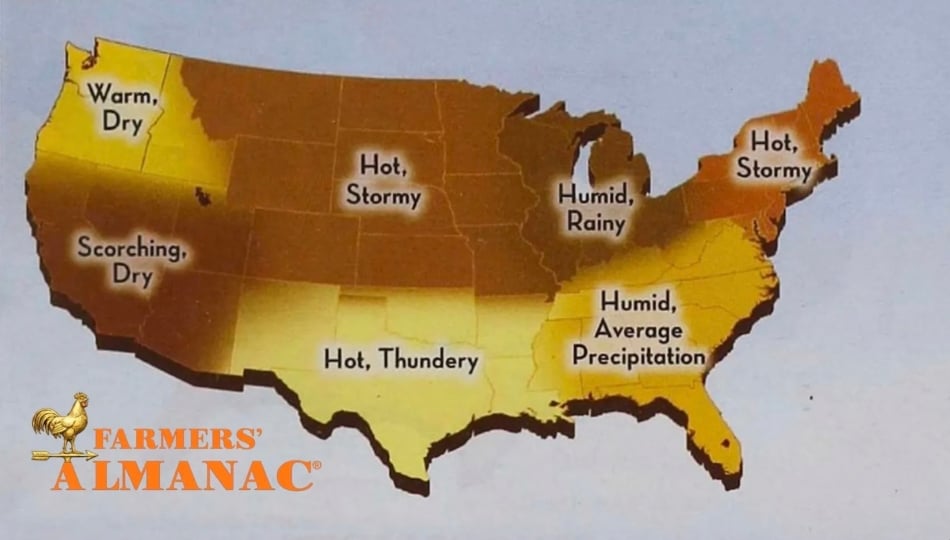
The summer forecast is published as a 7-zone US map and a 5-zone Canadian map. Each zone gets a month-by-month outlook describing expected average temperatures (relative to the climate normal), precipitation pattern, and any notable weather events (heat waves, drought, tropical activity for coastal zones).
Summer 2026 Regional Forecast: Zone by Zone
The Farmers’ Almanac 2026 summer outlook divides the United States into seven zones plus Alaska, and Canada into five zones. Here is what our long-range formula projects for each region across June, July, and August. Detailed month-by-month narratives appear in the printed edition and the members’ long-range weather forecast.
Zone 1 – Northeast & New England
Headline: hot and stormy. Expect above-normal temperatures from Boston through the Mid-Atlantic, with the wettest stretches falling in mid-June and again in the first half of August. Thunderstorm risk elevated for coastal metros. Tropical activity should be monitored from mid-July onward.
Zone 2 – Great Lakes & Ohio Valley
Headline: warm and wet. Above-normal rainfall totals for Ohio, Indiana, Michigan, and western Pennsylvania. Severe-weather potential is highest in late June through mid-July. Lake-effect thunderstorms will pepper the eastern Great Lakes shoreline.
Zone 3 – Southeast & Florida
Headline: hot, humid, and stormy. Consistent above-normal heat across Georgia, the Carolinas, and Florida, with heat indices peaking in the third week of July. Hurricane and tropical-storm activity is above-average risk for the Gulf Coast and Florida Peninsula from mid-August through the seasonal peak in September.
Zone 4 – Deep South & Gulf Coast
Headline: intense heat and localized flooding. Louisiana, Mississippi, Alabama, and East Texas can expect long heat-wave stretches, especially in late July. Tropical downpours possible from mid-July into August. Overnight lows staying above 75°F on many nights.
Zone 5 – North Central & Northern Plains
Headline: warm with pockets of drought. The Dakotas, Minnesota, and Wisconsin should see near- to above-normal temperatures with below-normal precipitation across much of July. Severe thunderstorm potential ramps up along the I-29 and I-35 corridors during mid-July.
Zone 6 – South Central & Southern Plains
Headline: hot with sporadic downpours. Central and eastern Texas, Oklahoma, and Kansas are set for above-normal heat, with the hottest stretches in late June and again in the last week of July. Severe-storm outbreaks likeliest in the first two weeks of June.
Zone 7 – Rockies, Southwest & Pacific Northwest
Headline: variable. The Southwest (Arizona, New Mexico, southern Nevada) can expect above-normal heat and an active monsoon by mid-July. The Pacific Northwest will be cooler than 2025, with more marine-layer days along the Oregon and Washington coasts. Wildfire risk remains elevated in the interior Rockies.
Alaska
Headline: warm and wet in the south, cool and dry in the interior. Anchorage and the southeast panhandle should see above-normal rainfall. Interior zones (Fairbanks) trend cooler than last year.
Canada – five-zone summary
- Atlantic Canada: warm and wet, with tropical-storm remnant risk in August.
- Southern Ontario & Quebec: hot and humid, above-normal thunderstorm days.
- Prairies: above-normal heat, below-normal precipitation, elevated wildfire risk.
- Pacific Canada (BC coast): cooler than 2025 with more marine cloud cover.
- Yukon & Northwest Territories: mixed, with above-normal precipitation in the north.
Want the exact daily outlook for your zone? The printed 2026 Farmers’ Almanac and the members’ long-range weather forecast break every zone down day by day, from June 1 through August 31.
Pair the summer outlook with the Best Days calendar for planting, watering, and outdoor project timing.
Self-Reported Accuracy
The Almanac tracks its own forecast against the actual season and reports 80 to 85 percent accuracy on its regional outlooks, judged year by year against NOAA temperature and precipitation normals. Independent reviews place the actual accuracy somewhat lower, but still above pure chance.

Frequently Asked Questions
When is the summer forecast published?
Each March, for the coming June-July-August summer. The print Almanac comes out in late August with the winter forecast and other long-range guidance for the next 12 months.
How accurate is it?
The Almanac reports 80-85 percent accuracy by its own measure. Independent reviews put it closer to 60-65 percent, which is still meaningfully above chance for a seasonal outlook.
How is this different from NOAA’s seasonal outlook?
NOAA publishes a 1-month and 3-month outlook each month based on real-time atmospheric and oceanographic data. The Almanac publishes a full-summer outlook based on a fixed formula. The two complement each other.
Can I see the summer forecast online?
Yes. The latest forecast is on the Almanac’s long-range weather forecast page, free to read.


This article was published by the Staff at FarmersAlmanac.com. Any questions? Contact us at [email protected].
- Farmers' Almanac Staff

- Farmers' Almanac Staff

- Farmers' Almanac Staff

- Farmers' Almanac Staff