

Gray Squirrels: Problems, Solutions, and Prevention
Squirrels may be cute, but they can also be destructive! Our wildlife specialist offers tips on how to evict them without harsh chemicals.
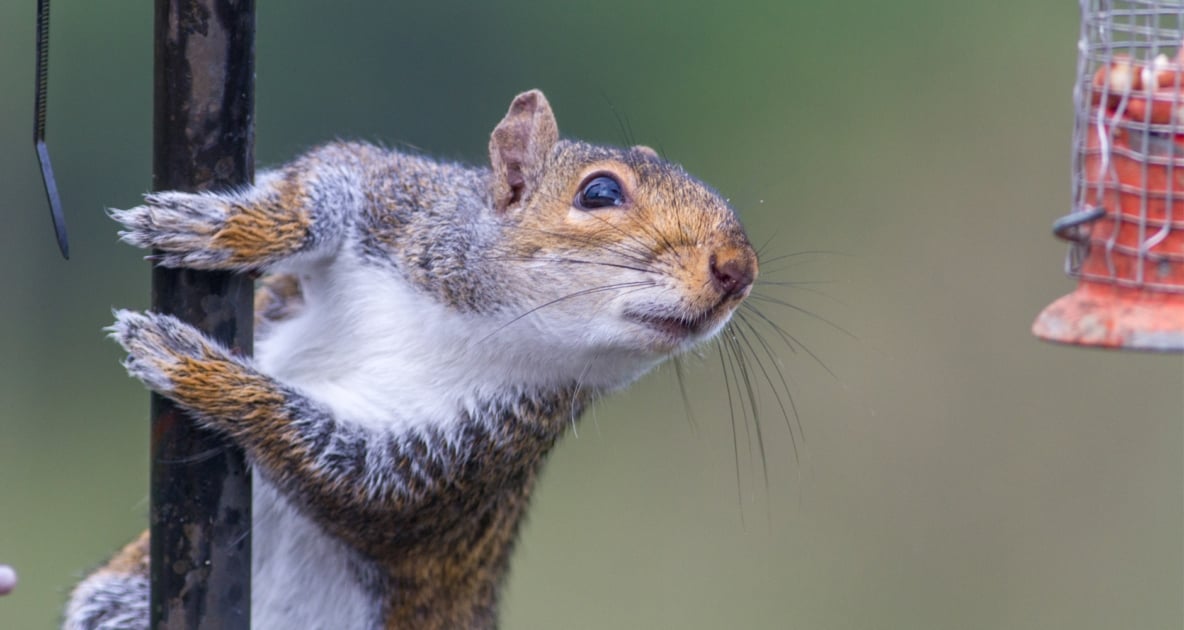
Quick Reference: Gray Squirrels
- Species: the gray squirrel, Sciurus carolinensis, a year-round rodent of yards, forests, and far too many attics.
- Warning signs: scratching, gnawing, and pitter-patter sounds overhead, torn insulation, and chewed electrical lines.
- How they get in: a small hole in a soffit or eave, a rotted louver, or a roof in poor repair, which they mistake for a tree cavity.
- Best fix: live trap at the access point, confirm no young are left behind, then seal the opening with galvanized 1/4 inch wire mesh.
- At the feeder: mount feeders on steel poles at least six feet off the ground with a cone baffle, well away from branches.
Wild animals are part of what makes nature so magical, and watching them can be highly enjoyable. While it’s important to coexist with animals in relative peace, they can cause countless problems when they take up residence in our homes or gardens. In this series, our Wildlife Management Specialist, Shawn Weeks, will educate us about some common household pests, and share some strategies for keeping them under control without dangerous chemicals.
A gray squirrel on the lawn is a fine sight in any season. A gray squirrel in the attic is another matter. These bright, busy rodents are at home in our yards year round, and most of the time they cause no trouble at all. The headaches start when one finds a way into the eaves, raids the bird feeder, or drops down the chimney and cannot climb back out. Here is what our wildlife specialist knows about the gray squirrel, and how to move one along without harsh chemicals.
Habitat and History
Gray squirrels, Sciurus carolinensis, are rodents that can be found as far north as Quebec, Ontario, and New Brunswick, as far south as Florida, and west into eastern Texas and Manitoba. They have also been introduced into Washington, British Columbia, and Vancouver Island. Beyond suburban and urban settings, gray squirrels prefer upland, hardwood forests. North Carolina State Extension keeps a plain-English profile of the eastern gray squirrel if you want to confirm the range and habits for your own region.
Despite their name, gray squirrels exhibit various colors, including black and red, though they are primarily gray, with white sides and underbellies. They generally weigh from one to one and a half pounds and can be anywhere from fifteen to twenty one inches long. They have bushy tails that are usually as long as their head and body.
Gray squirrels are active year round. In the fall they gather and bury their winter food supply. This burying is done randomly. They will dig for their food supply as needed, using their sense of smell to locate and dig for it.
They live in trees, either in cavities or leaf nests they make and suspend in the treetops. They are extreme climbers and jumpers who, when on the ground, are very cautious, wary, nervous, and excitable. When they sense danger, they will immediately head for trees to escape. Gray squirrels have keen senses of smell, hearing, and sight. They are somewhat social, as opposed to their very territorial red squirrel cousins, and will tolerate other squirrels in their habitat.
Gray squirrels are a popular small game species throughout much of their range.
Diet
Gray squirrels eat a variety of mast, including maple seeds, acorns, hickory nuts, butternuts, and beechnuts, along with mushrooms, berries, and some field crops such as corn and pumpkins. That taste for nuts and seeds is exactly why a stocked bird feeder reads like an open invitation, and why a vegetable patch can take a hit in a heavy mast year.
Reproduction
Gray squirrels mate in late winter and early spring. They have a forty four day gestation period, and bear litters of two to seven young. The young are born blind and helpless, but are swiftly weaned and are independent at eight to ten weeks. There is usually a second litter in mid summer. The young are born in the parents’ nest. That second litter is worth remembering, because it is the main reason you must never seal an opening before checking for a hidden nest.

Problems, Solutions, and Health Concerns
The most common problem associated with gray squirrels is their ability to take up residence in people’s homes. They associate holes in eaves, soffits, and roofs with a tree cavity, their natural nest, and move right in. Once inside, they consider it theirs, and they can be very difficult to get rid of.
Gray squirrels will tear up insulation in an attic and use it to make a nest. They will also chew through electrical lines, which is no small matter, since gnawed wiring is a genuine fire risk. If gray squirrels are in your dwelling or building, it is usually because of an existing problem, such as a small hole in a soffit or eave. You could also have a rotted louver that lets them chew through to gain access to your attic. Scratching, gnawing, and pitter-patter sounds are a sure clue that you have a squirrel problem.
An Ounce of Prevention
Prevention is key to keeping gray squirrels, or any other animal, from taking up residence in your home or building. Keep trees and overhanging branches away from your structure. Make sure all parts of the exterior of your building are maintained, and repair any rotted or damaged areas of eaves and soffits. Also, make sure your roof is in good condition.
The best approach to take, if you have an infestation of gray squirrels, is to live trap them at their access point, if possible. Nail a live trap or box trap at the opening and bait it with peanut butter, nuts, apple slices, and the like. If heights are not your thing, you can place the traps in the heavily traveled areas they are using to gain access. Once you have caught a squirrel, check to make sure there are no young or other squirrels inside your home.
It is critically important that you check for more than one squirrel before sealing up any opening. They are very excitable and will cause extensive damage if trapped inside. Also, no one wants to leave behind defenseless young in a nest. The young will most likely die, and the adults will try to gain access to the area by any means, leaving you with more damage than you had before you started.
If you are certain your home is free of squirrels, permanently seal up any openings with galvanized 1/4 inch wire mesh, plywood, new siding, and the like. Once the opening is sealed, it should be safe to release the gray squirrel from the trap, so long as you have eliminated any factors that might be helping them gain access.
If a gray squirrel somehow gains access to the living area of your home, do not attempt to snare or noose it. As mentioned before, they are very excitable creatures. If you run around a room or house trying to catch a squirrel, they will tear up, knock down, and basically demolish your property and furnishings. Instead, try to calmly and swiftly enter the area and open a door or window. Then immediately leave the room and wait outside for the squirrel to calm down and leave on its own.
The same patience pays off out in the yard. If squirrels are digging up your beds and bulbs rather than your attic, our guide to keeping squirrels out of the garden walks through seven natural methods, and our notes on keeping mice out of a car use the same eviction-and-exclusion logic for another stubborn rodent.
Evicting a Gray Squirrel, Step by Step
It helps to work the problem in order rather than reaching straight for the trap. Here is the sequence our specialist recommends, start to finish.
- Find the entry point. Follow the scratching and pitter-patter to a hole in a soffit, eave, roof, or a rotted louver.
- Trap at the opening. Nail a live or box trap at the access point, baited with peanut butter, nuts, or apple slices, or set traps along the routes they travel.
- Check for more. Once you catch one, confirm there are no other squirrels and no young left inside before you go further. A second litter often arrives in mid summer.
- Seal the opening. When the building is clear, close the hole for good with galvanized 1/4 inch wire mesh, plywood, or new siding.
- Release and repair. Release the trapped squirrel only after the opening is sealed and the conditions that let it in are fixed.
Gray Squirrels: Bird Feeder Raiders
Another common problem associated with gray squirrels is their propensity for raiding, and sometimes even damaging, bird feeders. To prevent this problem, make sure when installing bird feeders that they are placed on steel poles at least six feet off the ground and far away from bushes and overhanging branches. Install a metal, cone shaped baffle at the base of the feeder. Do not hang bird feeders from anything. Squirrels have no trouble climbing down ropes, wires, cables, and heavy duty strings to get what they want. If you are still setting up your feeding station, our look at why a fall bird feeder is great for birds and our roundup of the best winter bird foods will help you feed the birds, not the squirrels.
One other problem that is encountered from time to time is that gray squirrels will sometimes get stuck down inside a chimney and find themselves unable to climb out. The best solution for this problem is to drop a rope down the chimney until it hits the bottom. Then place the other end outside on the ground. Weigh this end down, or tie it off. The squirrel will be able to use the rope to climb out. Once the squirrel exits the chimney, pull the rope out of it from the ground. Then install a chimney cap to keep squirrels, or any other animal or bird for that matter, from entering the chimney again.
Squirrels and the Seasons
Because gray squirrels are active year round, the kind of trouble they make tends to follow the calendar. Knowing what to expect helps you stay ahead of it.
The old timers read squirrel behavior as a weather sign, too. What do squirrels have to do with the upcoming winter? Find out!

Gray Squirrels: Frequently Asked Questions
How do I know if a gray squirrel is living in my attic?
Scratching, gnawing, and pitter-patter sounds overhead are the surest clues. You may also find torn insulation pulled into a nest or chewed electrical lines. Squirrels usually get in through a small hole in a soffit or eave, a rotted louver, or a roof in poor repair, which they treat like a natural tree cavity.
What is the best way to get a squirrel out of my house?
Live trap it at the access point. Nail a live or box trap at the opening and bait it with peanut butter, nuts, or apple slices, or set traps along the routes they travel. After a catch, check for other squirrels and young before doing anything else. Only then seal the opening with galvanized 1/4 inch wire mesh, plywood, or new siding.
Why should I check for young before sealing an opening?
Gray squirrels bear litters of two to seven young, often with a second litter in mid summer. If you seal an opening with young left inside, they will most likely die, and the adults will try to gain access by any means, leaving you with more damage than before. Always confirm the building is clear first.
How do I keep squirrels off my bird feeder?
Place feeders on steel poles at least six feet off the ground, far from bushes and overhanging branches, and install a metal, cone shaped baffle at the base of the pole. Do not hang feeders from anything, since squirrels climb down ropes, wires, cables, and heavy duty strings with ease.
A squirrel is stuck in my chimney. What do I do?
Drop a rope down the chimney until it hits the bottom, then weigh down or tie off the other end outside. The squirrel will climb out on the rope. Once it leaves, pull the rope out from the ground and install a chimney cap to keep squirrels and other animals from getting back in.
What does a gray squirrel look like and how big is it?
Gray squirrels, Sciurus carolinensis, are primarily gray with white sides and underbellies, though some are black or red. They weigh from one to one and a half pounds and run fifteen to twenty one inches long, with a bushy tail usually as long as their head and body.
Should I use poison to get rid of squirrels?
No. Our wildlife specialist favors live trapping and exclusion over dangerous chemicals. Poison risks other animals, leaves you with a dead squirrel in a wall or attic, and does nothing to close the opening that let it in. Trap, confirm the space is clear, seal the gap, then release.


Shawn Weeks
Shawn is a lifelong New Englander. He lives in Canton, Conn., with his wife Tami, mother, sister, and her three children. He and his wife have two grown children and two grandchildren. Shawn is an avid hunter, fisherman, and gardener. He is also a writer, a nuisance wildlife professional, small scale farmer, and scout leader. You can email him at [email protected].
- Shawn Weeks

- Shawn Weeks
- Shawn Weeks
- Shawn Weeks




4-12-2022
Frustrated because Squirrels Keep Digging Up and Eating Sunflower Seeds I Plant in the Soil Around My House. I’ve been trying to grow sunflowers from seeds for years now, But I haven’t figured out how to outsmart squirrels. Every day when I arrive home, I notice a pile of broken shells from the sunflower seeds I planted the day before. Dried Chili spice, Cayenne Pepper and other hot dried spices don’t work at all.
Any other suggestions? I’ve already wasted alot of money buying seeds plus my free time planting sunflower seeds over and over again.
i hate you squirrel go die.
Squirrel digging in my annual planter – no bulbs; just spikes, petunias and vinca…
Should I put my 6″ owl statue there? I usually keep it in the house.
In my area we’ve only been able to grow daffodils as bulbs. The squirrels don’t eat them. But forget about tulips – they are like candy to them. Tahiti Daffodils are much prettier and hardier than regular daffodils – they are strong and study and stay in bloom for more than two months. Plus the color on them is amazing and they spread and naturalize wonderfully. It’s all I plant now. Plus I have some Pink Charm Daffodils I planted years ago. They too are pretty and unique looking.
Hi Sally, we’d love to see pictures! You can share them with us on Facebook!
Soot them with an air rifle. Bag them and dump in trash. Or bury them. I have tried relocating them also. Too much work. Some come back even from 15 miles away.
They eat my fruit (peaches, plums, pears). Now they built a nest in an ash tree. Will it help to try to destroy the nest?
I have squirrels that have attached my cars digging up the insulation under the hood. They have even chewed up some wiring costing me money at the shop. We have tried ammonia, cayenne pepper, tar paper, but they are not deterred. We have finally gotten some really nasty smelling spray that you can smell driving down the road. It’s horrible to have to go through such measures. I don’t know why all of a sudden we have this going on.
a five dollar rat trap baited with peanut butter will clean them out one at a time.
Shooting with a 177 air rifle is even better. Use hollow point pellets. Massive stopping power.
A gray squirrel started chewing on coarse hair door mat & would not leave it alone. I poured vinegar on the mat …squirrel left the mat. Next, the squirrel started chewing on the brick border to my garden. The dismantled the brick border and was trying to carry the brick to the tree when I saw him and tried to scare him away…the animal screeched at me… Ok, that was the final straw. My friend gave me an eighteen inch bobble-headed owl and I placed it on the front step, which is near the oak tree. The squirrel moved to the Oak Tree way in the back of my yard. The squirrel stays away from my house now….
Me neighbor has one of those. They still eat her tomatoes and raid her bird feeder.
I use Slinky Toys on my shepherd hook bird feeders. Slip them down the pole, hooked at the top with the feeder hanger. The squirrels cannot climb the pole. They slide or fall off when they encounter the Slinky. I have used these for many years. No greasing needed.
I recently discovered a baby squirrel and he made its way underneath our carport.I love him and woundnt harm him but he will not leave though I did feed it some peanuts and he sleeps out side by our door.I do enjoy a good Crockpot meal though.LOLI don’t think we will be eating him though to cute when they are a baby.I don’t see any problem with squirrels as long as you can feed them with a feeder.That’s all they want is food.Afterall it’s there home too to share
I love them, too. However they don’t need to damage my neighbor’s tomatoes. Mothballs keep out the rabbits ?.
what do you do with a squirrel that is trapped inside an interior wall?
Hi Willie, this happens a lot with flying squirrels, especially. Unfortunately, the only way to get them out is to cut into the drywall. Here’s something we found online: http://www.aaanimalcontrol.com/squirrelwall.htm