

Bee Swarming: What It Is and What to Do (2026 Guide)
A swarm of bees sounds scary, but there’s no need to panic. We explain what they're doing, why they do it, and how you can help.
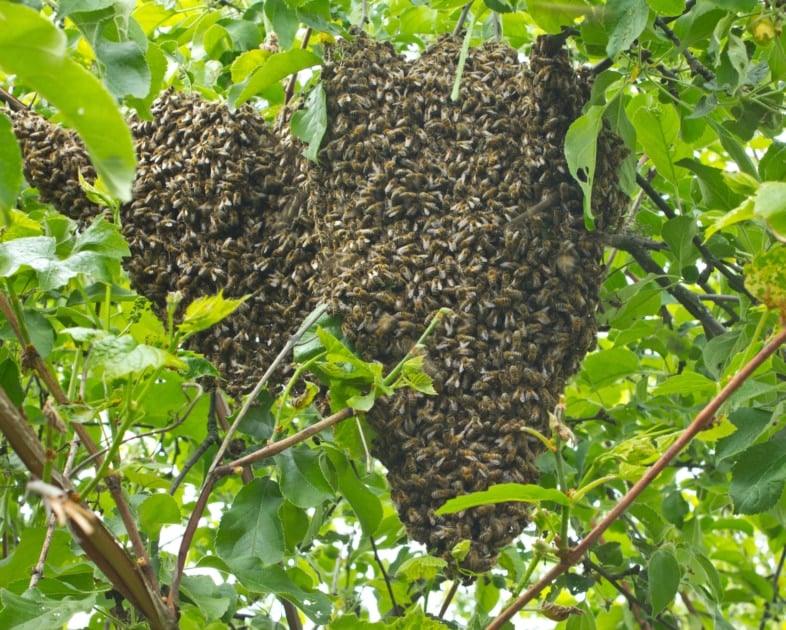
Quick Reference: Bee Swarming
- What it is: a natural spring reproduction event. Roughly half of a honey bee colony leaves with the old queen to start a new home.
- Why it happens: the queen lays up to 2,000 eggs a day, the hive fills, and the colony splits before it runs out of room.
- Are the bees dangerous: generally no. Swarming honey bees are full of honey and have no hive to defend, per USDA APHIS pollinator guidance.
- What you should do: keep your distance, take a photo, then call a local beekeeper or your county Extension office for a free rescue.
- When it happens: most swarms in the US and Canada occur mid-spring through early summer (April to June for most zones).
- Related Almanac tool: the Best Days calendar for outdoor beekeeping tasks.
Amy Grisak and her husband, Grant, live in Montana with their boys and often share stories with us about their adventures as beekeepers.
A swarm of bees sounds scary, and the sight of a buzzing mass in a shrub is enough to send shivers down the spine of many people. There is no need to panic. What you are watching is one of the oldest, most orderly events in nature: a honey bee colony has outgrown its home and is on the move to a new one. Per USDA APHIS and the Xerces Society for Invertebrate Conservation, honey bees in a swarm are unusually calm because they have no brood or honey stores to defend.
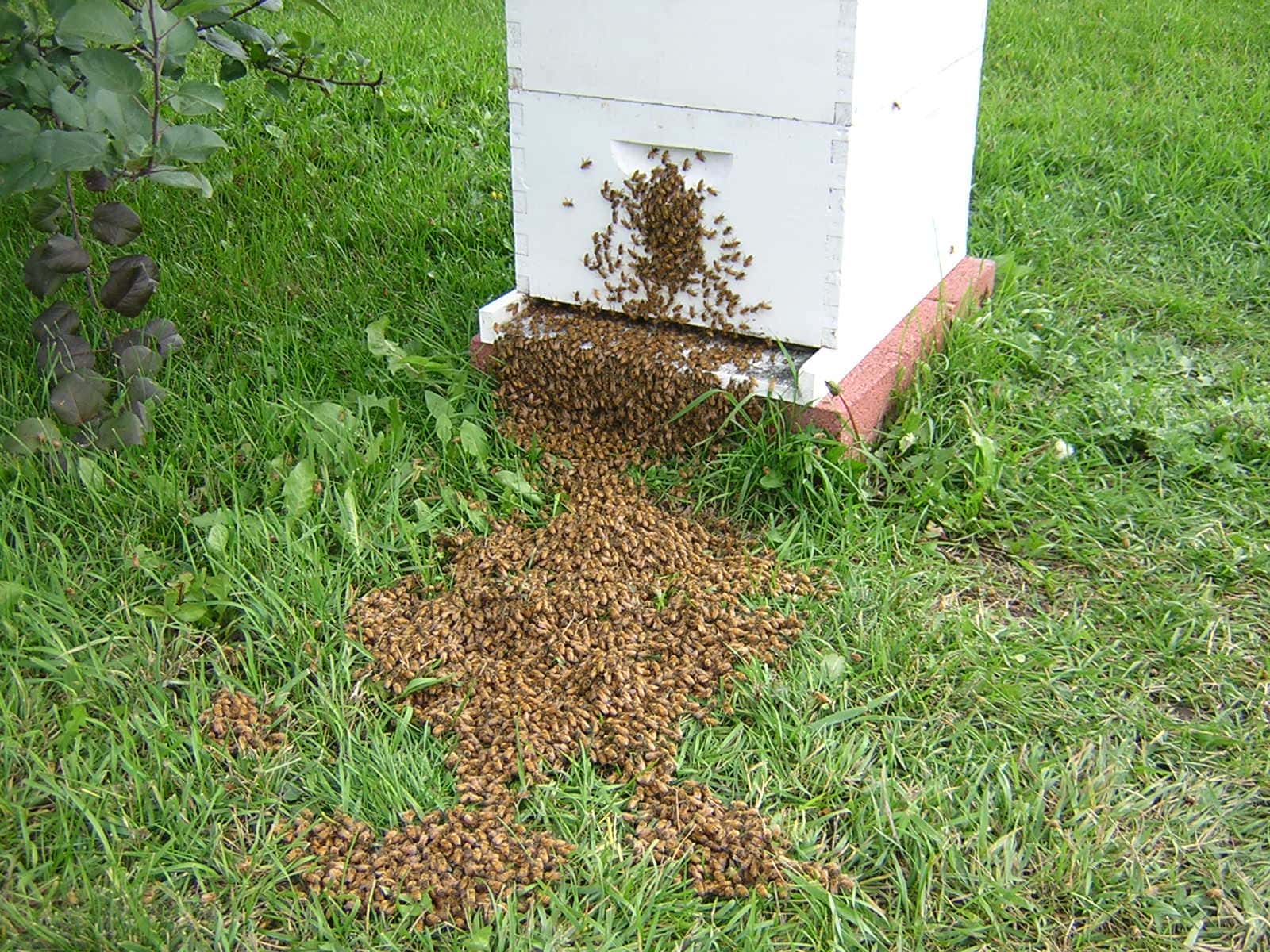
Why Do Bees Swarm?
Swarming is a natural phenomenon that typically occurs in the spring. After surviving winter on stored honey, hive activity climbs sharply as the days grow longer and warmer. During this window the queen lays up to 2,000 eggs a day, and each egg develops into an adult bee in about three weeks. By early to mid-spring the hive is packed with tens of thousands of new bees.
When the workers sense overcrowding, or when conditions inside the hive slip, they build larger cells in the brood chamber and feed the developing larvae royal jelly to produce a new queen. Once she is close to emerging, the original queen leaves with roughly half of the colony to find a new home. This is the swarm.
Reading the signs early is hard even for careful beekeepers. Warning signals include bees clustering at the front of the hive, bearding heavily on hot afternoons, and, most tellingly, capped queen cells hanging from the bottom of the brood frames. Miss the window and you can wake up to find half of your bees gone.
When Swarms Happen Across the US and Canada
Swarming windows shift with latitude and daylight. The pattern below is drawn from state Extension apiary calendars (Cornell, Penn State, Michigan State, UC Davis, and the University of Guelph):
- Southeast US (FL, GA, LA): March to early May, sometimes a smaller late-summer swarm.
- Mid-Atlantic and Ohio Valley: mid-April to mid-June.
- Northeast (NY, MA, ME) and Pacific Northwest: mid-May to late June.
- Upper Midwest and Northern Rockies (MT, ND, MN): late May to early July.
- Canada (ON, QC, BC, AB): late May to early July, tied to first sustained 65 to 70 degree F afternoons.
Beekeepers plan hive inspections for the ten days before their local window opens so they can spot queen cells and split the colony deliberately, rather than losing bees to a swarm.

I experienced my first swarm two decades ago. I thought something was amiss because the bees’ buzzing seemed extraordinarily loud. Imagine my surprise when I saw a group of them clustered on a small lodgepole pine tree. It was an easy retrieval; I snipped the tree below the cluster and shook them into a new hive body, wearing protective gear.
Not everyone is that lucky. A couple of summers ago, a resident living near the alfalfa fields where we keep some of our bees called to say the hive was acting oddly. When Grant investigated, he found that half of the hive had departed, leaving behind bees robbing hundreds of pounds of stored honey. Our strongest hive had taken off, taking most of their honey with them. We searched the cottonwoods and other favored bee locations, but the swarm was never found.
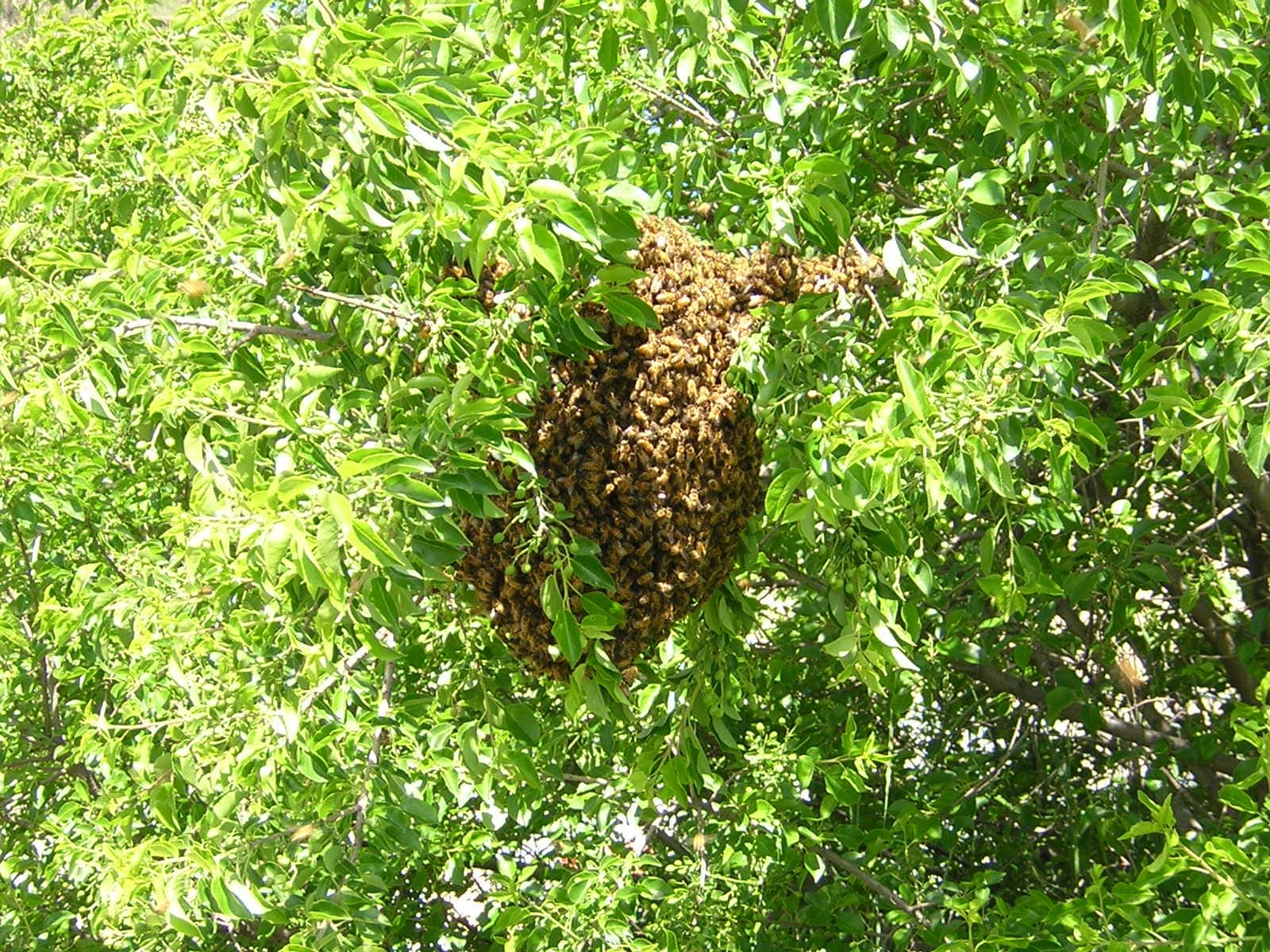
What Should You Do if You See a Swarm?
Honey bees are precious these days, which is why it is important to try to save a colony you find swarming, or one that has settled where it is not welcome. During a swarm, the bees cluster on a tree, fence post, or eave for anything from a few minutes to a couple of days. That pause gives the scout bees time to locate a permanent home. The cluster is generally calm because the workers are loaded with honey and have no brood to defend. That is not an invitation to poke them. Watch from a safe distance and stay calm.
The best way to help is to call a local beekeeper. You can find one through your county Extension office, your state beekeepers’ association, or the Bee Removal Directory maintained by the American Beekeeping Federation. Most beekeepers will not charge for the removal, unless there is a genuine equipment cost (a cherry picker, for example), because a healthy swarm is worth capturing.
How the bees are captured depends on where they land. When we started out we were surrounded by tiny lodgepole pines, which made retrieval easy. When the cluster is higher in the branches, it may take a ladder or a cherry picker to reach them, either to shake the bees into a box or to snip off the branch and lower it down.
Sometimes the bees land in odd places. Like the roof of a hot dog cart in Times Square. One time, Grant captured a swarm that had nestled in the wheel well of a parked car. With a hive tool, he gently scooped the bees onto a frame, careful to gather the queen (who sits protected in the middle of the cluster), then slid the frame into an empty hive body.
In another instance, a feral hive had established itself in the soffit of a barn that had been converted to a guest house. When bees move inside a structure, removal is much harder. You cannot simply seal the hive up or spray it; the smell of tens of thousands of rotting bees and larvae is overwhelming. The owners wanted these bees saved, so Grant went up in a cherry picker, removed enough of the soffit to reach the hive, sliced off the honeycomb by hand, and set it in an empty hive body. It was a textbook removal, and those bees became one of our best colonies.
How Can You Help?
Swarming bees might look intimidating, but they are not. You can help them by keeping an eye on them, especially if they leave their initial cluster area, and by calling a beekeeper who will give them a safe new home. Even if you never keep bees yourself, planting a small pollinator patch (clover, yarrow, borage, echinacea, native goldenrod) and skipping neonicotinoid pesticides gives every swarm in your neighborhood a better chance of surviving the first year in its new home. Per USDA NRCS pollinator guidelines, undisturbed hedgerow and unmowed field edges are the single cheapest habitat improvement.

Bee Swarming FAQ
Are bees swarming dangerous to humans or pets?
Generally, no. Honey bees on the move fill their bellies with honey before they leave the hive, and they have no comb or brood to defend. Per USDA APHIS pollinator guidance, a resting cluster is usually docile. Give the swarm space, keep pets and small children indoors, and call a beekeeper. Africanized honey bees in the southern US are the exception; if you are south of a line from central California to central Texas to Florida, back away calmly and call a professional.
Why is bee swarming most common in the spring?
Spring is when the queen ramps to full egg-laying (up to 2,000 eggs a day) and the workforce catches up. The hive fills quickly, nectar flow is strong, and the colony has enough resources to split. In most of the US that peak lands between mid-April and late June.
How do I find a beekeeper to remove a swarm?
Three quick routes: (1) your county Cooperative Extension office keeps a local beekeepers list, (2) your state beekeepers’ association maintains a swarm removal page, (3) the American Beekeeping Federation and Bee Culture magazine publish national swarm-catcher directories. Most beekeepers rescue for free.
What is the difference between a bee swarm and a wasp nest?
A swarm is a temporary cluster of honey bees hanging in the open, usually the size and shape of a rugby ball, made up of soft golden-brown bees. A wasp or hornet nest is a papery grey structure built in an eave, shrub, or hollow, and the insects are aggressive if disturbed. If it flies fast, is bright yellow and black, and lives in a papery ball, it is a wasp. Call pest control, not a beekeeper.
Should I spray or kill a swarm on my property?
No. Honey bee populations have declined by roughly 40% over the past decade per USDA colony-loss surveys, and swarms are the primary way wild and managed colonies reproduce. A local beekeeper will almost always rescue the cluster for free.
How long does a swarm stay put?
Anywhere from a few minutes to a couple of days. Scout bees are out looking for a permanent cavity: a hollow tree, a wall void, an empty hive box. Once they agree on a site, the cluster lifts and moves as a single dark cloud. If you want the swarm captured, call the beekeeper the moment you spot the cluster.
Can I set up a swarm trap to catch bees for free?
Yes, and it is one of the cheapest ways to start a hive. A 40 liter box mounted 8 to 12 feet up in a shaded tree, baited with a drop of lemongrass oil and an old brood frame, catches swarms during the local swarm window. Cornell and University of Guelph Extension both publish free bait hive plans.


Amy Grisak
Amy Grisak is a freelance writer, blogger, and photographer specializing in gardening, local food, and stories about her home state of Montana. She enjoys sharing her experiences with self-reliant living and outdoor recreation. Her article on the "hugelkultur" gardening technique appears in the 2021 Farmers' Almanac. You can follow her topics on her site, AmyGrisak.com.
- Amy Grisak

- Amy Grisak
- Amy Grisak
- Amy Grisak





Thank you for this article, so informative and everyone needs to know what to do or whom to call for such a task as this. It would also be a good thing to look this information up and have it near by in case you should come across this situation on your on property . Glad to see this on your sight . Thank’s again.
I was touched by Trish’s comment about crying when she was stung by a bee knowing that the bee would die. This degree of compassion is rare in this day and time. My young daughter praised me years ago for braking the car, as we rode along, to avoid striking a butterfly. This memory I will never forget.
I know of a young-ish, (lol) man who would press on the brakes of his vehicle for EVERY critter, be it little or BIG, he saw in the line of view in front of his vehicle! He would also honk the horn to warn it to move. If it didn’t, he would come to a stop right in the road, until it was out of the way!!!
76 years old now enjoying memories of growing up a beekeeper’is daughter. Recall lying on my belly by a hive after putting a spider ‘neath hive top. Waiting till diligent workers pulled dead intruder from entry of hive. I know. Cruel…but with no tv or other fun things…?! Maybe I was 6 or 7. Also remember helping dad bring hives home from mts in NC and hearing rattle of snake seeking warmth beneath hive. Dad warning to put hive back in place and walk away…quickly. Remember the smell of honey house. And the smell of my dad after a day of working in the hives. And an occasional night when he came home for dinner with a stinger in his arm…unnoticed. And remember crying if we got stung…knowing that innocent bee was gonna die because of us. But as to swarms? Dad always had burlap bag in his truck. If he came across a swarm…it came home in that bag, resting on front seat of truck, top tucked beneath his leg.. Let’s pray our bees survive.
Ur
Trish, wish you would write a book! You have a way with descriptions. They paint great pictures in my mind. Be well, Beekeeper’s Daughter.
Around mid March of this year, in Ormond Beach, FL. a swarm of bees was on one of our Japanese plum trees. It appeared out of nowhere. We called our neighbor who has bees, but she said they weren’t hers. She gave us the name of a bee keeper, we called and he said he would be out as quickly as possible, it took him 1 1/2 hrs, and by that time the swarm disappeared! We looked all over our farm to see if they were close, but no luck. He was really disappointed as he had lost one of his hives and was really looking forward to replacing them. Thanks for this information, if it happens again, we’ll know what to expect.
Around Mid March in Ormond Beach, FL, we had a swarm that took up on one of my Japanese Plum trees. We live on a farm and are always surprised at what nature gives us. We called a neighbor who had bees, but she said they weren’t hers. She gave us the name of a beekeeper who we called. It took him about 1 1/2 hrs to get to us, and by the time he arrived, they disappeared! We looked all around our property, but no luck, they were gone! He was real disappointed, as he had lost one of his hives and was anxious to relocate them.
For the last 4 years an old apple tree has been home to honey bees. Poor old rotten tree was sceduled to come down when we discovered them. We witnessed 2 swarms so far, and the Ext. Office gave me a list of bee keepers who were able to re-home them. ♡♥♡