

Water Witching: Fact or Fake?
Locating water underground using a stick? Is it pseudoscience or the real deal? Find out!
Quick Reference: Water Witching (Dowsing)
- Also called: dowsing, divining, doodlebugging, rhabdomancy.
- How old: at least 8,000 years. A Tassili cave painting in North Africa shows a figure holding a forked stick.
- Standard tool: a fresh-cut Y-shaped branch, 12 to 16 inches per arm. Willow, witch hazel, and fruit-tree wood are traditional favorites.
- Scientific consensus: classified as pseudoscience. Controlled trials show dowsers do no better than chance.
- The German GTZ study: 10-year project, 691 wells in Sri Lanka, 96 percent strike rate, depth and yield predicted within 10 to 20 percent. Still debated.
- The likely explanation for hits: ideomotor response in the dowser plus shallow regional groundwater. Belief and geology both play a role.
Some call it “the gift.” Others call it “dowsing,” “doodlebugging,” or “water witching,” the practice of locating water underground using a forked stick. Sounds simple, but does it work? The Britannica entry on dowsing traces the practice across continents and centuries. Below: where it comes from, how to try it yourself, and what the science actually says.
The History of Dowsing
According to the American Society of Dowsers, divining the location of water dates back many millennia. In the Tassili Caves of northern Africa, an 8,000-year-old cave painting depicts a man holding a forked stick, apparently using it to search for water. Historical images that appear to represent dowsing show up all over the world, in the temples of Egyptian pharaohs, in ancient Chinese etchings, and in 15th-century woodcuts from German mining country (where it was used to find ore, not water).
Although most would say that dowsing is nothing more than a myth, there are quite a few people today who believe in this practice. When California was in the middle of its worst drought, ranchers and farmers turned to local dowsers to find hidden sources of water. Despite the skepticism, even a few scientists think there is more here than meets the eye.
What Tool is Used?
Although most dowsers focus on locating water, there are those who apply their skills to uncover a wide range of items, from gold and explosive devices to that elusive TV remote control. The world of dowsing has an array of tools: pendulums, car keys, wire rods, coat hangers, and even pliers.
The most commonly used tool, however, is the dowsing rod. This trusty tool is nothing more than a simple forked branch cut fresh from a tree. You can use branches from nearly any type of tree, but those from willows, witch hazels, and various fruit and nut trees seem to do the trick best.
How to Dowse for Water
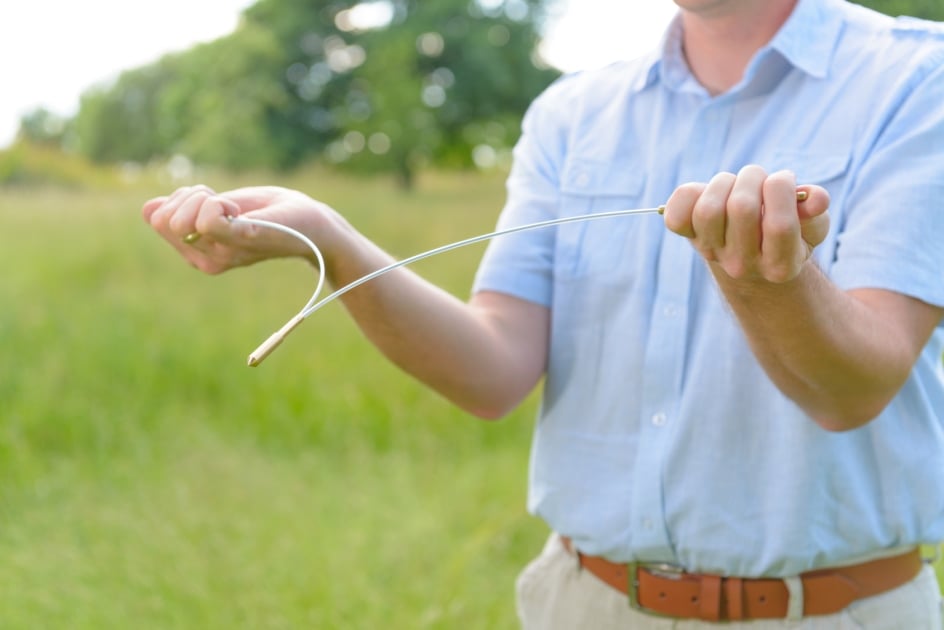
If you would like to try dowsing for yourself, it is quite simple. Cut a Y-shaped stick from a tree, making sure all three sections of the Y are between 12 and 16 inches long. Your dowsing rod should also be relatively flat, with no branches sticking out in odd directions.
Grab both ends of the Y in an underhanded grasp (so that the heels of your hands face the sky) and hold the dowsing rod horizontally so that it points in front of you. Keep your grasp somewhat loose and slowly walk around searching for water. Some say it helps to concentrate on finding water as you walk. As you approach a water source, you should feel your dowsing rod start to bend toward the ground. This is the tricky part; many experienced dowsers say that as you zero in on the source, the rod will bend sharply, which means you will need to tighten your grasp so you do not drop it.
Is Dowsing Real?
Most experts, other than dowsing experts, that is, classify this art as pseudoscience. Over the last century, several studies have shown that the average dowser is no better at predicting the location of water than anyone else.
However, there is one study, conducted by the German government in the 1990s, that perplexed the scientific community. During this 10-year research period, researchers paired up experienced geologists and dowsers, sending them to dry regions like Sri Lanka, Kenya, and Yemen. Scientists were surprised to find that many of the dowsers were spot on. In Sri Lanka alone, drill teams drilled 691 wells under the supervision of dowsers and found water 96 percent of the time.
Now, skeptics would argue that the reason is simple: no matter where you drill, as long as you are willing to drill deep enough, you are bound to find water eventually. However, in this particular study, the dowsers were also asked to tell their drill teams at what depth they would find the water and how much water they would find. The study’s findings showed that the dowsers’ predictions concerning depth and volume were accurate to within 10 to 20 percent.
No one knows why dowsing works, or if, indeed, it does. Some researchers believe humans can detect water by some trace amount of energy it releases. Others believe the talent is in the dowsing rod itself. Still more say the practice is nothing more than a clever hoax tied to a real and well-studied phenomenon: the ideomotor effect, in which a person’s unconscious movements drive a balanced tool. Either way, in much of the rural United States, water witches are still hired before well drillers arrive.
Fortunately, no matter where you stand on the dowsing debate, this is one bit of ancient wisdom you can easily put to the test.
What the Studies Have Found
| Study | What was tested | Result |
|---|---|---|
| Randi, 1979 | Four dowsers placed pegs where they believed water flowed, under agreed conditions | None passed. No applicant ever won the associated prize |
| Munich experiments, Betz and colleagues, 1987 to 1988 | 500 dowsers screened, the best 43 tested over 843 trials. Water was pumped through a pipe on a barn’s ground floor, moved between trials, with the dowser on the floor above | At least 37 of the 43 showed no ability. Betz argued a small number of outliers performed above chance; reviewers in Skeptical Inquirer (1999) called the results a clear failure |
| Betz field reports, 10-year programme | More than 2,000 drillings in Sri Lanka, Zaire, Kenya, Namibia and Yemen | A reported 96 percent success across 691 Sri Lankan drillings. Disputed, since field results were far stronger than anything the controlled tests produced |
| Vogt and Barrett, Harvard | Review of controlled field and laboratory tests | “Controlled field and laboratory tests have failed to establish the validity of dowsing” |
| National Ground Water Association | Position of the drilling industry’s own professional body | Holds that controlled experimental evidence shows the technique is without scientific merit |

Water Witching FAQ
What is water witching?
The practice of locating underground water using a handheld tool, traditionally a forked tree branch. Also called dowsing, divining, or doodlebugging.
Does dowsing actually work?
Controlled scientific trials say no, dowsers do not outperform chance. Open-field studies have produced higher strike rates in shallow-aquifer regions. The scientific consensus is that the rod responds to the dowser’s unconscious movements (ideomotor effect), not to underground water.
What kind of stick is best for a dowsing rod?
A fresh-cut Y-shaped branch, 12 to 16 inches per arm, flat and free of side branches. Willow, witch hazel, peach, apple, and hazelnut are the traditional favorites.
Why is it called “water witching”?
“Witching” is an old English term for divining or seeking by occult means. The word stuck even though most dowsers see the practice as a craft, not a magic ritual.
Can you dowse for things other than water?
Dowsers have claimed to locate gold, lost objects, buried pipes, unmarked graves, oil, and even unexploded ordnance. Most reported successes are in dense, low-blinding contexts and have not held up to controlled study.
Why do dowsers sometimes find water?
In many regions, shallow groundwater is widespread enough that a well will hit water almost anywhere if drilled deep enough. Skilled dowsers also unconsciously read terrain, vegetation, and prior local well data. That makes 70 to 90 percent hit rates believable without any “energy” at work.
Should I hire a dowser before drilling a well?
If you trust your local dowser and the cost is modest, it does no harm. For the most reliable result, consult a licensed hydrogeologist who can read aquifer maps and local well logs. Many U.S. drillers will do both.
For more on folk practices and weather lore, read our companion pieces: witch hazel, nature’s magic potion, animal weather forecasters, and goldenrod facts and folklore.



Amber Kanuckel
Amber Kanuckel is a freelance writer from rural Ohio who loves all things outdoors. She specializes in home, garden, environmental, and green living topics.
- Amber Kanuckel

- Amber Kanuckel

- Amber Kanuckel
- Amber Kanuckel





Would you mind suggesting what rods I would use for this? Are there certain rods for particular things?
Hi Rebecca, As our article suggests here, the traditional “witching stick” is a Y-shaped tree branch. But people have found success with many other types, including metal L-shaped rods, often made of copper. What are you interested in finding? Let us know and we will come back with more specific suggestions for you. Best wishes. 🧡
There are many different types of dowsing, but basic dowsing with dowsing rods can be done by about 90% of people with a few minutes of training. I spent three years looking at the mechanism of basic dowsing with dowsing rods. The dowsing signal is in the microwave region of the electromagnetic spectrum, around 2 to 10 GHz. The source of the microwaves is thermal emission (all objects above absolute zero emit electromagnetic radiation) and as the microwaves pass up through the soil they are affected by the water content (absorbs microwaves), metals (reflect microwaves) and voids (refract microwaves). The dowsing signal therefore is a perturbation in the background thermal microwave emissions. The dowsing signal is sensed near the base of the brain, which causes a slight movement of the shoulder muscles. The rods are typically held at a balance point and the movement of the shoulder muscles causes the rods to move. More details, they can be found in a 300 page book I wrote called “The Science of Basic L-Rod Dowsing: An Investigation,” by Richard Warburton which was published this month (Feb 2025) by McFarland Publishers, and is available on Amazon.
Hi Richard, Thanks for sharing your research with us. Congratulations on your book!
I’m surprised that this article or bloggers did not put forth the scientific explanation. Yes, there is a fact behind the dowsing. When any earth is disturbed such as digging or underground water flow the ground magnetic field also changes. The greater the change the greater the field changes. This is when the wires, etc. will cross or in the case of a tree branch lower downward, water or not. An experienced dowser has an edge on this through experience… it’s in the touch or how the dowser has learned how to make and hold the receptacle-wane when water maybe nearby. The wane material composition is also important. plastic does not work. As far as finding the depth this also can be determined. The waterflow is based on the same principal… electricity-magnetism. This can be done in a lab. Don’t forget water quantity and flow will depend upon the water’s mineral content… this is my opinion or is it! Have fun future witches.
Hi Elehue, Thank you so much for sharing what you know with your community here. Best wishes from all of us at FA.
All I know is Pops paid a geologist/digger 3 times and 3 rd failed attemptI dod dowsing and found an underground spring 8 ft out from our back door. Had wonderful water then on!
Hi Pat, Wow… glad to hear it worked out for you! 🙂
As I walked outside one day, my
father put 2 metal rods, ea. approx. a foot long, in my hands, and told me to walk across the lawn, holding them straight out in front of me about waist high. At 16 and the only girl in the family, my dad and my brothers teased me relentlessly. So my first question was why! He told me to just do it and he wasn’t smiling, so I knew it was serious, and so I walked. About 15 feet out, the rods started to cross each other and bend down towards the ground. It startled me so much that I dropped them and ran back in the house, but not before I heard my dad yell to a man whom I’d never seen before, “See, I told you she could do it!!” I never asked my dad what it was all about, and he always knew I didn’t want to discuss it. I’m 64 now, and really have no interest in scaring myself that bad again. I’m good!!😊
Wow! That must have been a shock! Thank you for sharing!
I have a similar story. Once, shortly after I married and visited my family while on leave from the air fore, my father handed me two L-shaped rods, told me how to hold them, and asked me to walk a couple of paths in front of our house. To my surprise, when I got to a specific point, the rods pointed at something. Then, as I continued walking past the point, the rods turned, continuing to aim toward whatever they were first pointing at.
I’ve never used the rods professionally, but discovered that I could always locate a glass that contained some amount of liquid (e.g., water, juice, beer, or wine).
My actual career consisted of spending four years on active duty in the US Air Force, followed by going back to school and earning a BS, MS and PhD from Bethany College, Marshall University and Michigan State University, respectively,
After earning my PhD I had an extremely rewarding career as an Educational Psychologist/data scientist.
Now that I’m retired, I decided to read up on water dowsing. To my surprise I haven’t been able to find even one study that was able to show, in controlled conditions, that water dowsing works. As a trained and experienced researcher, I would like to conduct a carefully designed study that shows that at least some people can reliably find glasses of water, even when they have no idea where the glasses are hidden. As part of the study, assuming we can find two groups of people (one that can reliably locate hidden glasses of water during a controlled study, and another group that can’t reliably locate the glasses of water), I want to collect the subjects’ saliva samples and see if dna analysis can be used to identify factors that separate the two groups. I am highly trained in both research design, and analytics, and will have a teams that are trained in psychology, research design, engineering, analytics, and dna research. Please let me know if you know of any organizations or people who might be interested in funding the study I want to conduct. I would also be interested in any ideas you might have concerning factors that should be controlled in the study. I can be reached, by email, at [email protected], Thanks, Art
I tried it once, years ago. Had a fresh branch from a cherry tree. Kept palms up, and pointer up. As I walked slowly back & forth, all if a sudden, the pointer started turning downward toward the ground. At the same time, the two branches started twisting, as well. I was doing everything in my power to prevent the stick from going down. How it started twisting as well was beyond me. This was in Maryland. But the stick led me over the hill to an area that was part of a water plant. I did not know this, as I was unfamiliar with the area. But, obviously, it did lead me to water. I fought it, to keep it up, but the pointer still went down and twisted. Don’t ask me how, as I had a good grip on it trying to prevent it.
Hi Constance, How interesting! Thank you so much for sharing your experience with us here.
There is groundwater almost everywhere on earth, so anybody collecting money for this is a sly dog. The real test would be to determine how deep and at what flow rate. Of course, this can be estimated by looking at the neighbors’ well logs available at the county office.
This is absolutely 100% real and true. I was a golf course irrigation foreman for many years and whenever we couldn’t find a system or branch of the main line, I would think pull out 2 metal pieces of wire and locate the missing irrigation line before the other guys even got their high tech (expensive) locators out of the box and powered on. Try it yourself ,grab couple pieces of thin wire or other metal, bend it to fit your hands at approximately 90 degrees and walk across your lawn ,find the water meter in the street and that runs in a straight line to your first hose bib. Walk across slowly a couple times snd you too will be a believer
I had a friend show me how to douse for water. It was life changing for me . I could actually feel the pull inside me. Very profound for someone who is very skeptical
Me too.
It works. Seen my grandfather do it hundreds of times. Could tell how deep to dig and how many gallons you’d get a minute. He was right every time. Used a forked peach tree sprout. People that have never seen it or watched closely think the dowser is turning the stick down intentionally. But the tip of the stick bends first. You can really see it if the pointer part is about a foot long. It’ll start to bend down when you’re getting near the spot, and if you back up, it’ll straighten back up. Reminds me of someone bending their finger. It’s very strange looking.
Don’t know anyone who ever used it for bombs, gold etc, but seen it work for water. Can’t explain it, and I don’t care if anyone believes me, but I know what I’ve experienced.
I am an engineer so did not understand how this works but grew up on farm and often had to dig 6ft down to find filed tiles. Water witching saved me days of work with shovel.
Also taught somebbiy scouts how to do it. 100% of wolf cubs could do it after 30minutes training. How 1) get rod – I used coat hanger cut and bent into l shape.
2) put garden hose or electical extension cord on ground. Turn off water or electricity to start
3) have kids walk with rod in each hand over hose/cord starting about 6 feet back from it. Leave water/electricity off and nothing happens.
4) turn water or electricity on and repeat. Rods will turn in their hands. So definately something to do with natural magnetic or other waves that rods are picking up. If I can teach 9 yr old to do it anyone can do it following this simple technique.
You need lots of experience to no how far below surface but simple training exercise makes believers out of doubters.
Hi. My name is Chad I only read half of your comment. This appears to be a guide on how you electrocute your children. Never place power tools and puddles next to each other!
An old logger showed me how to find water on a parcel of land I purchased from him — on condition that I first locate at least two running streams under ground. He demonstrated with a single branch held loosely in one hand. He was a local legend as a water witcher who succeeded in finding water when drillers failed.
I believed I could do it because I believed in him. I also knew that the Soviet Army travelled with just 2 days fresh water supply, but several battalions of dowsers.
I was stunned by my first success when the stick pointed straight down and pulled my hand with it. I found two more spots and rushed to tell him. He said he knew of those locations and there were others on my land. Then he showed me how to determine depth to drill.
Later I told a highly skeptic friend who insisted I show him. We drove to my land that weekend and I set him on the same path I had taken, then stood back and watched. As he approached the spot, he registered a look of total shock and surprise as the stick led his hand straight down.
Subsequently I’ve located running water multiple times. Thank you, Clarence Inman of Bonny Doon 🙂
It worked for me using a peach tree fork. As the point went downward I tried to pull it up and the bark scratched the palms of my hands. The force was strong. I located an underground river and I walked the direction it flowed.