

Friday the 13th: Origins, Myths, and Next Dates
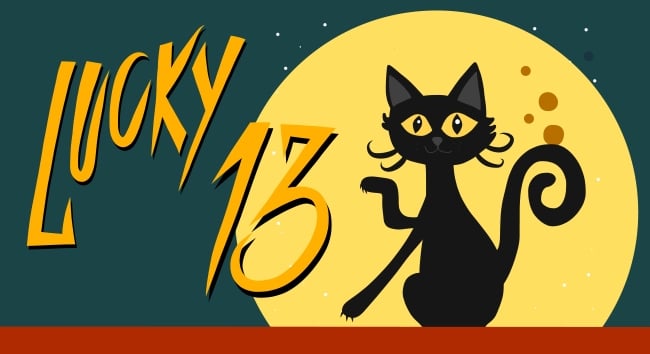
Quick Reference: The Number 13 and Friday the 13th
- Next Friday the 13th: February, March, and November in 2026.
- How often: Friday the 13th lands at least once and at most three times every year.
- The fear has a name: triskaidekaphobia, the fear of the number 13.
- The old roots: a Norse dinner in Valhalla, and Judas as the 13th guest at the Last Supper.
- The bright side: 13 is lucky in India, China, Italy, Tibet, and Jewish tradition, and it sits on the first American flag.
Friday the 13th is considered to bring bad luck in some Western cultures, the same way folks once worried about walking under a ladder, seeing a black cat cross the path, or breaking a mirror. But where did the dread of the number 13 begin, why this number and not some other, and when is the next Friday the 13th? Here is what the folklore, the history, and the calendar have to say.
Friday The 13th Superstition Origins
Folklore historian Donald Dossey traces the unlucky reputation of the number “13” back to a Norse myth about 12 gods sitting down to a dinner party in Valhalla. Loki, the trickster god, turned up as the 13th guest even though no one had invited him, and he arranged for Hodr to shoot Balder with a mistletoe-tipped arrow. As Dossey tells it: “Balder died, and the whole Earth got dark. The whole Earth mourned. It was a bad, unlucky day.” From that story, the number 13 came to be seen as unlucky.
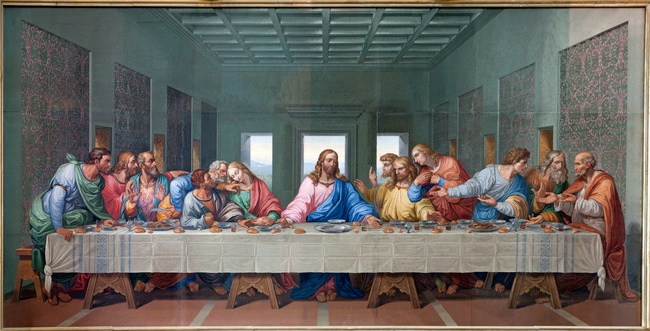
That unlucky 13th dinner guest shows up again in the story of Jesus’ Last Supper, where Judas was the 13th person to arrive. His betrayal led to the crucifixion on Good Friday. Even so, there is no record of “Friday” and “13” being paired together as especially unlucky before the 19th century.
One of the first written references to the misfortune of Friday the 13th comes from a French play, Les Finesses des Gribouille (1834). A character laments, “I was born on a Friday, December 13th, 1813, from which come all of my misfortunes.”
An early documented reference in English turns up in H. S. Edwards’ biography of the Italian composer Gioachino Rossini, who died on a Friday the 13th. “Rossini was surrounded to the last by admiring friends; and if it be true that, like so many Italians, he regarded Fridays as an unlucky day and thirteen as an unlucky number, it is remarkable that on Friday the 13th of November he passed away.”
Many people credit the popularity of the modern Friday the 13th superstition to T. W. Lawson’s novel Friday, the Thirteenth (1907), in which an unscrupulous broker takes advantage of the myth to set off a Wall Street panic. For a fuller history of how the date gathered its reputation, Wikipedia’s overview of Friday the 13th collects the literary and cultural references in one place.
Learn how to increase your luck on Friday the 13th.
Phobia Of Friday The 13th
The dread of Friday the 13th has a tongue-twisting name of its own: triskaidekaphobia (truh-skai-deh-kuh-fow-bee-uh), meaning a fear or avoidance of the number 13. Another word for the fear of Friday the 13th in particular is friggatriskaidekaphobia (frigg-ah-tris-kah-deck-ah-f-oh-bee-ah). Try saying that one thirteen times fast.
Because of the unlucky reputation that clings to 13, hotel guests sometimes balk at a room on the 13th floor, or even a room numbered 13.
In the United States and China, some hotels set aside the 13th floor for storage and maintenance only. The elevator has a button for every floor except that one, so the panel jumps straight from 12 to 14. You will also be hard pressed to find a restaurant with a table number 13, or a hospital with a room or bed marked 13.
When Is The Next Friday the 13th?
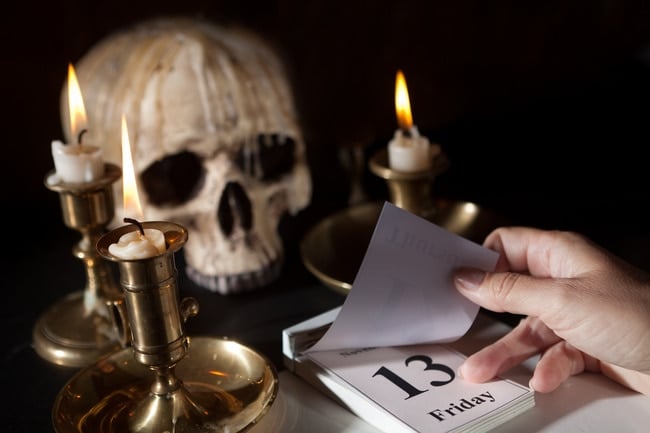
Friday the 13th comes around whenever the 13th day of the month falls on a Friday, which happens at least once and at most three times every year. The next one is in February 2026, with two more to follow that same year.
| Year | Friday the 13ths | How many |
|---|---|---|
| 2026 | February, March and November | 3, the maximum possible |
| 2027 | August | 1, the minimum possible |
| 2028 | October | 1 |
| 2029 | April and July | 2 |
| 2030 | September and December | 2 |
13, A Strange Number?
Some people regard 13 as “cursed” simply because it follows 12, a number that signals completeness. Twelve divides evenly into 2, 3, 4, and 6, which makes it feel like a “friendly” number. We see it everywhere: 12 months in a year, the 12-hour clock, 12 inches in a foot, a dozen eggs, kindergarten through grade 12 (K-12), 12 pairs of ribs in the human body, the Twelve Days of Christmas, and on it goes. The number 13, by contrast, is an odd prime that gives an impression of incompleteness. It does not slot in neatly, so it can come across as “unfriendly.”
American author Mark Twain poked fun at the odd number when he wrote, “The thirteenth stroke of the clock is not only false of itself, but casts grave doubt on the credibility of the preceding twelve.”

The Bright Side Of The Number 13
For all its bad press in the West, 13 carries good fortune in plenty of places. Here is the brighter side of the number, gathered from cultures and history around the world.
- The Thirteen Club was formed in the latter part of the 19th century to debunk superstitions about the number 13 being unlucky and to make the case for it. The club started in Brooklyn in 1882 with just 13 members, but its fame and reach spread quickly, and by 1886 it boasted 550 members from all over New York City.
- The number 13 is not unlucky in every culture. In India, the 13th day of the lunar fortnight is considered highly auspicious and is called Triyodashi. It belongs to Lord Shiva and is believed to bestow long life, peace, and good fortune. The number 13 is also considered very lucky in Chinese culture, where it represents “assured growth” or “definitely vibrant.”
- In Italy, 13 is considered lucky and is associated with the Great Goddess, fertility, and the lunar cycles, a number thought to bring prosperity and life. In ancient Greece, Zeus was the thirteenth and the most powerful god of Greek mythology.
- The number 13 is sacred and lucky in Tibet, because the 13th layer of the heaven is said to be the desireless pure land described by Master Tsongkhapa.
- For Jews, 13 has long been a symbol of strength and sometimes even good luck. The first provisional government of Israel had 13 members, because its founders believed they needed all the luck they could get.
- In Judaism, 13 marks the age at which a boy matures and becomes a “Bar Mitzvah,” a full member of the Jewish faith qualified to be counted in a minyan. (A minyan is the quorum of ten Jewish adults required for certain religious obligations.)
- The Moon’s phases take roughly 29.53 days to complete, which means 12 lunar cycles take just 354 days. So about every 2.5 years a 13th full Moon shows up within a single calendar year, known as a Blue Moon.
- A full Moon on Friday the 13th is an extremely rare event. According to the Farmers’ Almanac, the next one falls on August 13, 2049.
- The number 13 also holds a special place in United States history, because the first American flag was made with 13 stripes and 13 stars, one for each of the 13 original colonies.
Lucky or Unlucky? The Number 13 Around the World
The number 13 wears two faces depending on where you stand. Here is a quick look at how different traditions read it.
Folklore for the Superstitious Day
Whether you read 13 as lucky or unlucky, a little folklore never hurt anyone. If Friday the 13th has you feeling cautious, plenty of old remedies promise to tilt the odds back your way, from carrying a small token in your pocket to keeping clear of black cats and ladders. The Almanac has always treated superstitions as worth preserving and testing, not mocking. Try a few, keep the ones that bring you comfort, and let the rest go.
If you would rather plan around the calendar than around old fears, our 13 ways to improve your luck and our roundup of common superstitions are good places to start. You may also enjoy reading about the home buying superstitions that folks still follow today.
Related Articles
How To Improve Your Luck On Friday The 13th

The Number 13 and Friday the 13th: Frequently Asked Questions
When is the next Friday the 13th?
The next Friday the 13th is in February 2026, followed by March and November of the same year. Friday the 13th lands at least once and at most three times every year, whenever the 13th day of a month falls on a Friday.
Why is the number 13 considered unlucky?
Folklore historian Donald Dossey traces it to a Norse myth in which Loki crashed a dinner of 12 gods in Valhalla as the 13th guest, setting off the death of Balder. The number also recalls Judas as the 13th guest at the Last Supper. There is no record, though, of “Friday” and “13” being paired as especially unlucky before the 19th century.
What is the fear of Friday the 13th called?
The fear of the number 13 is called triskaidekaphobia. The fear of Friday the 13th in particular has its own longer name, friggatriskaidekaphobia. The dread is common enough that some hotels skip the 13th floor and many buildings have no room or table numbered 13.
Is the number 13 lucky anywhere?
Yes. In India, the 13th day of the lunar fortnight (Triyodashi) is auspicious and belongs to Lord Shiva. The number is lucky in China, where it means “assured growth,” and in Italy, where it is linked to the Great Goddess and fertility. In Jewish tradition, 13 marks the age of the Bar Mitzvah, and the first American flag carried 13 stars and 13 stripes.
How often does Friday the 13th happen?
At least once and at most three times a year. In 2026 it happens three times, in February, March, and November. A full Moon falling on a Friday the 13th is far rarer; according to the Farmers’ Almanac, the next one is August 13, 2049.
Why is 12 a “friendly” number and 13 an “unfriendly” one?
Twelve divides evenly into 2, 3, 4, and 6, and it turns up everywhere, from 12 months in a year to a dozen eggs to the Twelve Days of Christmas, which gives it a sense of completeness. The number 13 is an odd prime that does not divide neatly, so it can feel incomplete. Mark Twain joked that “the thirteenth stroke of the clock” casts doubt on the twelve before it.
Join The Discussion
Do you believe that the number 13 is bad luck?
What is one superstition that you hold to be true?
Let us know in the comments below.


Dr. Aziz Inan
Dr. Aziz Inan is an electrical engineering professor at the University of Portland, Oregon. He has been studying palindrome calendar dates for more than a decade. Dr. Inan’s work with numbers has been featured in The New York Times, USA Today, Los Angeles Times, and many other news sources: NPR, CNN, CBS News, NBC News, and ABC News. Dr. Inan has also contributed to Smithsonian Magazine, Scientific American, Stanford Magazine, and Caltech Magazine.
- Dr. Aziz Inan

- Dr. Aziz Inan
- Dr. Aziz Inan
- Dr. Aziz Inan





So I went into the USAF on a Friday the 13th October 1967 – it was not a bad omen, it began the rest of my life out from the influence of my family. I actually see this day as my second birthday when my life really began!
It was a Friday the 13th in October when the French King had all the Knights Templar arrested, later to be killed. That was unlucky.