Notice More Spiderwebs Lately? Here’s Why Late Summer Is Spider Season

Seeing spiderwebs everywhere in August and September? There’s a reason. Late summer is prime spider season, when many orb-weaving spiders reach adulthood and their large, intricate webs suddenly become impossible to miss.
Walk outside on a late-August morning and you may notice something that wasn’t there—or at least wasn’t visible—the day before.
Spiderwebs.
They stretch between porch railings, shrubs, tree branches, garden plants, fences, and sometimes directly across the path you were planning to walk down.
If it seems like spiderwebs suddenly appear everywhere in late summer, you’re not imagining it.
August and early fall are among the best times of year to spot large web-building spiders, particularly orb-weaver spiders, which create the familiar circular webs most people associate with spiders.
And those webs can be one more sign that fall is getting closer.
Why Are There So Many Spiderwebs in August and September?
The answer has a lot to do with the spider life cycle.
Many spiders hatch during spring and spend the summer feeding, growing, and molting. Early in the season, they may be tiny enough to go almost completely unnoticed.
By late summer, however, many species have grown substantially larger.
That means larger spiders.
And larger spiders build much larger webs.
According to the University of Minnesota Extension, orb-weaving spiders are commonly found outdoors in gardens, fields, and landscapes. Large black-and-yellow garden spiders are especially noticeable in late summer.
Colorado State University Extension similarly notes that some of the year’s most spectacular web-building spiders become particularly conspicuous outdoors during late summer.
In other words, the spiders probably didn’t suddenly invade your yard.
They’ve been growing there all summer.
You’re simply noticing them now.
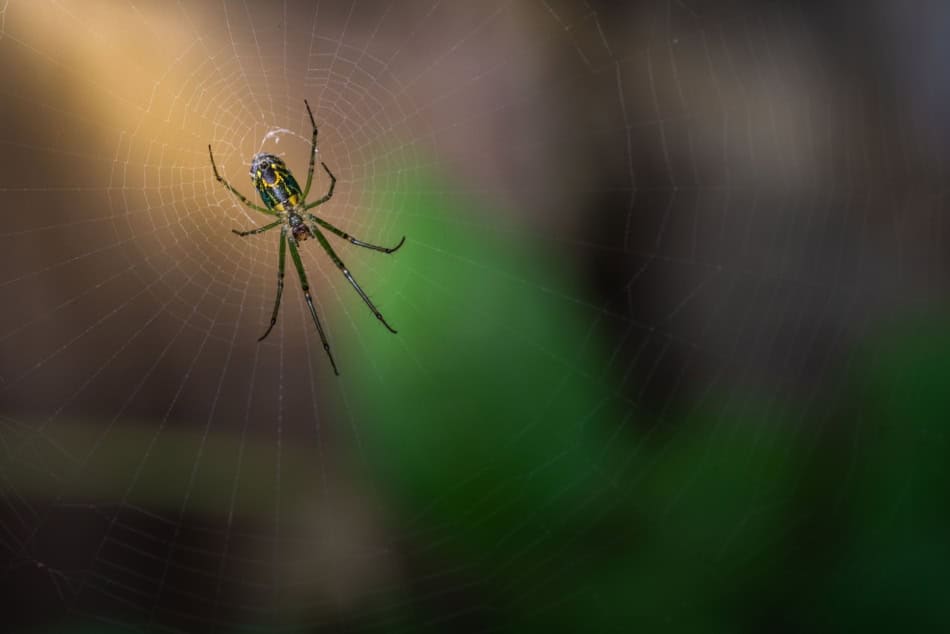
What Are Orb-Weaver Spiders?
If you’re seeing a large, almost perfectly circular spiderweb suspended between plants or trees, there’s a good chance you’re looking at the work of an orb weaver.
Orb weavers include hundreds of species and are known for constructing the classic wheel-shaped web made of radiating lines connected by spirals of silk.
Common orb weavers you may encounter in late summer include:
- Yellow garden spiders
- Banded garden spiders
- Barn spiders
- Marbled orb weavers
- Cross orb weavers
- Cat-faced spiders
- Spined micrathenas
Utah State University Extension says orb-weaving spiders are often seen around homes and buildings in late summer and early fall, particularly near porches, entryways, landscaping, and exterior lights.
Some species are true late-season specialists.
Penn State Extension reports that adult cross orb-weaver spiders are found from late summer through autumn, while marbled orb weavers can remain active from midsummer until the first hard freeze.
Why Do Spiderwebs Seem to Appear Overnight?
Sometimes they really do.
Many orb-weaver spiders do much of their web construction during the evening and nighttime hours.
Depending on the species, an orb weaver may repair damaged portions of its web or tear down and reconstruct significant portions of it.
So a walkway that was perfectly clear yesterday afternoon can have a large spiderweb stretched across it the following morning.
Building these structures requires spider silk produced by specialized organs called spinnerets.
Different kinds of silk serve different purposes. Some strands form the structural framework of the web, while others help trap insects.
When a moth, fly, mosquito, beetle, or other insect hits the web, vibrations travel through the silk and alert the spider.
It is essentially an extremely sensitive insect-catching net.
Morning Dew Makes Spiderwebs Much Easier to See
There is another major reason you suddenly notice so many spiderwebs in August:
morning dew.
A dry spiderweb can be surprisingly difficult to see.
Cover that same web with hundreds of microscopic water droplets and suddenly every strand becomes visible.
This is particularly dramatic on cool, humid mornings as summer begins transitioning toward autumn.
Penn State Extension notes that dew can clearly outline the webs of grass spiders, making webs that were nearly invisible the previous day suddenly stand out across lawns.
Look across a lawn early in the morning and you may see dozens of shimmering, funnel-shaped or sheet-like webs sitting just above the grass.
In the right sunlight, they can make a yard look as though it has been covered in silver lace.
Those cooler mornings are also one of several natural signs that fall is approaching.
Why Do Spiders Build Webs Across Doorways and Walkways?
Unfortunately, spiders don’t know where you’re planning to walk.
They are looking for two things:
good anchor points and lots of insects.
Door frames, railings, porch columns, tree branches, shrubs, fences, and tall garden plants provide excellent supports for web building.
Porches can be especially attractive.
Why?
Outdoor lights attract insects.
And where insects gather, spiders often follow.
Utah State University Extension notes that orb-weaving spiders are commonly found near exterior lighting.
That’s why the porch light beside your front door may also explain the enormous spiderweb hanging across it every morning.
Are Garden Spiders Dangerous?
The appearance of a big spider sitting in the middle of a large web can be startling, but most common orb-weaving spiders are not considered dangerous to people.
University of Minnesota Extension notes that orb weavers are extremely unlikely to bite humans, despite their sometimes intimidating size and bright coloration.
Penn State Extension similarly describes yellow garden spiders as large and showy spiders commonly found in gardens, tall weeds, and sunny areas across much of the United States.
As with any wild animal, it’s best not to handle them unnecessarily.
But finding an orb-weaver web in your garden is generally not a reason for concern.
Are Spiders Good for the Garden?
Absolutely.
Spiders are among nature’s most effective insect predators.
They feed on a wide variety of insects and arthropods, including:
- Mosquitoes
- Flies
- Moths
- Beetles
- Leafhoppers
- Gnats
- Other garden insects
Colorado State University Extension describes spiders as beneficial arthropods that can play an important role in controlling insect populations in gardens, fields, forests, and around homes.
Grass spiders can be particularly beneficial in lawns because they prey on insects that might otherwise feed on grass and garden plants.
So unless a spiderweb is blocking your doorway or walkway, consider leaving it alone.
That spider may be providing free natural pest control.
For more ways to deal with spiders without immediately reaching for pesticides, see our guide to natural ways to keep spiders out of your house.
Why Are There More Spiders in the House During Fall?
Late summer and early fall can also bring more spider sightings indoors.
Some spiders wander inside as outdoor conditions change.
Colorado State University Extension notes that certain spiders may move into homes in early fall as temperatures cool.
If you would rather keep them outdoors, late summer is a good time to:
- Seal cracks around windows and doors.
- Replace damaged window screens.
- Install tight-fitting door sweeps.
- Reduce clutter around foundations.
- Move firewood and leaf piles away from the house.
- Reduce unnecessary exterior lighting near doors.
You can find more suggestions in our Farmers’ Almanac guide to keeping spiders out naturally.
How Long Does Spider Season Last?
Those impressive late-summer spiderwebs won’t be around forever.
Many web-building spiders have annual life cycles.
Adults mate during late summer or fall, females produce egg sacs, and freezing temperatures eventually kill many adult spiders.
The next generation survives inside protected egg sacs before emerging the following spring.
For example, Penn State Extension reports that cross orb-weaver females leave their webs in September to deposit hundreds of eggs inside protective silk cocoons.
Marbled orb weavers can remain visible until the first hard freeze of fall.
Want to know when freezing temperatures typically arrive where you live? Check our 2026 First Frost Dates guide.
Are Lots of Spiderwebs a Sign of a Harsh Winter?
This is where weather folklore enters the story.
For generations, abundant or unusually large spiderwebs have sometimes been interpreted as a sign that cold weather or a harsh winter is coming.
It’s a charming bit of old-fashioned weather lore—but there isn’t scientific evidence showing that spiders can predict the severity of the coming winter months in advance.
Their late-summer activity is much more easily explained by their natural life cycles, abundant insect prey, temperature, and seasonal conditions.
Still, observing spiders is part of a long tradition of watching nature for clues about changing seasons.
If you enjoy those old signs and sayings, take a look at our collection of 10 signs from nature said to predict a harsh and cold fall.
Spiderwebs Are One of Late Summer’s Quiet Signs of Fall
There comes a point every August when nature begins to feel different.
The shadows grow longer.
Sunset comes a little earlier.
A few leaves begin changing.
Morning dew becomes heavier.
And suddenly, spiderwebs seem to be everywhere.
Many of those spiders have been living quietly around us for months. Late summer is simply when they’ve become large enough—and their webs spectacular enough—to command our attention.
So the next time you step outside on a cool August morning and discover a perfectly formed spiderweb sparkling with dew, take a moment before brushing it aside.
You’re looking at one of nature’s most intricate creations—and one more small sign that summer is beginning to wind down.
Related Farmers’ Almanac Reading
- 10 Signs in Nature That Fall Is Closer Than You Think
- Natural Ways To Keep Spiders Out Of Your House
- First Frost Dates 2026: When Will the First Frost Hit Your Area?
- It’s Not Too Late! Vegetables & Flowers You Can Still Plant in Late August
- Farmers’ Almanac Gardening Calendar


- Farmers' Almanac Staff

- Farmers' Almanac Staff
- Farmers' Almanac Staff
- Farmers' Almanac Staff