Draconid Meteor Shower 2026: Watch Right After Dark
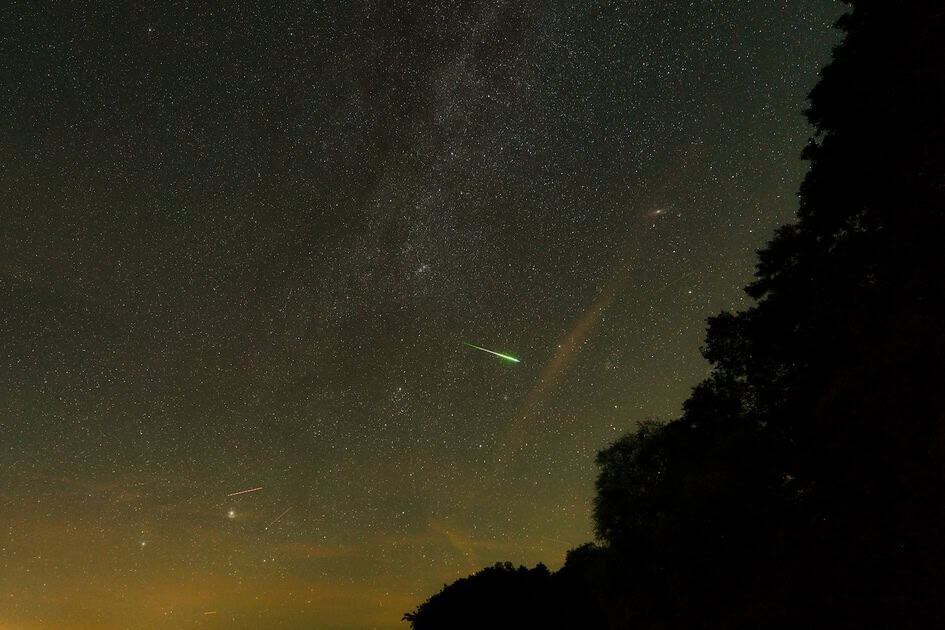
Quick Reference: Draconid Meteor Shower 2026
- Peak night: Thursday 8 October into Friday 9 October
- Best time: the hours right after dark, not before dawn
- Moon: a 3 percent crescent that sets at 5:19 p.m. EDT, before the Sun
- Full darkness in New York: 7:57 p.m. EDT
- Rate: usually 5 to 10 an hour, with rare outbursts in the hundreds
- Where to look: north, towards the head of Draco, high up at nightfall
Almost every meteor shower asks you to get up at three in the morning. The Draconids do not. They are the one shower of the year that performs best in the early evening, and in 2026 the Moon gets out of the way completely.
Why This Year Lines Up
The radiant, the point the meteors appear to come from, sits in the head of Draco. For most of the northern United States and Canada, Draco is highest just as the sky goes dark and then sinks through the night. That is the opposite of the usual pattern, and it is why the Draconids reward an evening on the lawn rather than an alarm clock.
The Moon usually spoils this. Not in 2026. On the peak night the Moon is a three percent waning crescent, and it sets at 5:19 p.m. Eastern, which is before sunset. By the time astronomical darkness arrives at 7:57 p.m. in New York, the Moon has been gone for over two hours. The radiant is at its highest exactly when the sky is at its darkest. That combination is rare.
| What | When, Eastern time | Why it matters |
|---|---|---|
| Moon sets | 5:19 p.m., Thursday 8 October | The Moon is gone before the sky darkens |
| Civil twilight ends | 7:25 p.m. | First bright meteors become visible |
| Astronomical darkness | 7:57 p.m. | Full darkness, radiant still high |
| Best watching | 8:00 p.m. to midnight | Radiant highest, sky darkest |
| New Moon | 11:50 a.m., Saturday 10 October | The following nights are dark too |
It holds across the country. Wherever you are, the Moon is down well before the sky is properly dark.
| City | Moon sets | Full darkness | Dark and moonless from |
|---|---|---|---|
| Boston, MA | 5:07 p.m. | 7:46 p.m. | 7:46 p.m. |
| New York, NY | 5:19 p.m. | 7:57 p.m. | 7:57 p.m. |
| Chicago, IL | 5:15 p.m. | 7:52 p.m. | 7:52 p.m. |
| Denver, CO | 5:25 p.m. | 8:00 p.m. | 8:00 p.m. |
| Seattle, WA | 5:35 p.m. | 8:16 p.m. | 8:16 p.m. |
| Los Angeles, CA | 5:19 p.m. | 7:50 p.m. | 7:50 p.m. |
What You Will Actually See
Be realistic. In a normal year the Draconids produce five to ten meteors an hour, which is a quiet shower. What makes them interesting is that they do not behave. The parent comet, 21P Giacobini-Zinner, has produced spectacular outbursts, most famously in 1933 and 1946 when rates reached thousands an hour, and again more modestly in 2011 and 2018. Nobody can tell you in advance which kind of year you are getting.
| Year | Estimated peak rate per hour | What happened |
|---|---|---|
| 1933 | Several thousand | The classic storm, seen best from Europe |
| 1946 | Several thousand | The second great storm, seen across North America |
| 1985 | Several hundred | A strong return, best observed from Japan |
| 1998 | Several hundred | A sharp, short outburst |
| 2011 | Up to a few hundred | Predicted in advance and duly delivered |
| 2018 | Around 150 | Briefly the equal of the Geminids |
The pattern behind those years is the parent comet. 21P Giacobini-Zinner goes round the Sun roughly every six and a half years, and the big displays have tended to fall when Earth crosses the stream shortly after the comet has passed through and left fresh debris behind. Nobody is forecasting a storm for 2026. The point is that the Draconids are the one shower where the downside is a quiet evening and the upside is something you remember.
Draconid meteors are also slow. They hit the atmosphere at around 20 kilometres a second, roughly a third of the speed of an Orionid, so they drift rather than flash. People often say they are the most pleasant meteors to watch.
- Face north and look up, not at the horizon. Meteors appear all over the sky.
- Give your eyes twenty minutes to adapt and keep your phone in your pocket.
- Lie back rather than standing. The radiant is high, and your neck will thank you.
- Bring more layers than you think. Early October nights are colder than they look.
- No telescope, no binoculars. Both narrow your view and make things worse.

If You Miss It
The Orionids follow later in the month, peaking on the night of 21 to 22 October, and they are the opposite in every way: fast, bright, and best before dawn. See our Orionid guide for that one, and the full meteor shower calendar for the rest of the year.
Frequently Asked Questions
When is the Draconid meteor shower in 2026?
The peak is the night of Thursday 8 October into Friday 9 October 2026. Unlike most showers, the best watching is in the hours right after dark rather than before dawn.
What time should I watch the Draconids?
From about 8 p.m. local time until midnight. Astronomical darkness begins at 7:57 p.m. in New York on the peak night, and the radiant is highest at nightfall then sinks through the night.
Will the Moon interfere with the 2026 Draconids?
No. The Moon is a three percent crescent on the peak night and it sets at 5:19 p.m. Eastern, before sunset, so the sky is fully dark and moonless for the whole watching window.
How many Draconid meteors will I see?
Usually five to ten an hour. The shower is unpredictable, and has produced rare outbursts of hundreds or thousands an hour, most notably in 1933 and 1946.
Which direction do I look for the Draconids?
North, towards the head of the constellation Draco, which is high in the sky at nightfall. Meteors will appear across the whole sky, so do not stare at one spot.
Read Next
- Orionid Meteor Shower: How to See It
- Meteor Shower Calendar
- Hunter’s Moon 2026: October Full Moon Date and Folklore

Josh Morley grew up in Liverpool, where checking the sky before you leave the house is less a habit than a survival skill. He has spent his working life with data, and he came to the Farmers' Almanac by way of the thing the two have in common: the weather is the largest dataset any of us live inside, and most of us read it every day without noticing.
- Josh Morley

- Josh Morley

- Josh Morley

- Josh Morley