

Hunter’s Moon 2026: October Full Moon Date, Folklore, and Viewing Guide
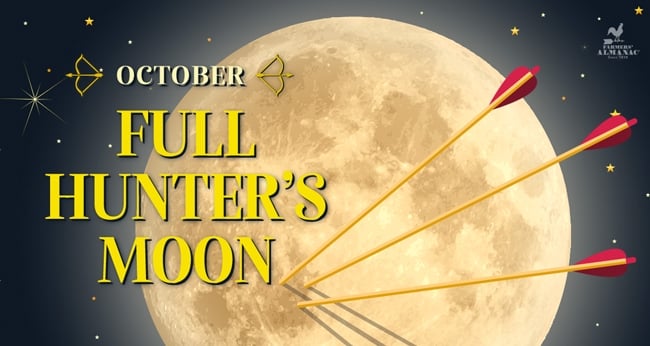
Quick Reference
- Hunter’s Moon 2026: Monday, October 26, 2026
- Peak illumination: 12:12 a.m. Eastern Daylight Time (04:12 UTC)
- Best viewing: Sunday evening, October 25, and Monday evening, October 26
- Why “Hunter’s”: Game animals were fattened for autumn and easier to spot in bare stubble fields under a bright Moon; also tied to the opening of the Anglo-Saxon hunting season
- Other names: Travel Moon, Dying Grass Moon, Sanguine Moon, Falling Leaves Moon
- Halloween: Falls five nights before Halloween on October 31, lighting up the run-up to the holiday
The Hunter’s Moon, the full Moon that follows the Harvest Moon and ushers in the heart of autumn, peaks just after midnight on Monday, October 26, 2026, at 12:12 a.m. Eastern Daylight Time. Bare hardwoods, stubble fields after the corn comes off, woodsmoke from leaf piles, and the last warm afternoons of the year: October is a sensory month, and a bright full Moon sits at the center of it five nights before Halloween.
When Is the Hunter’s Moon 2026?
Full Moon October 2026: Monday, October 26
Peak Illumination: 12:12 a.m. Eastern Daylight Time (04:12 UTC)
The Moon reaches full phase at the same instant for the entire planet, so only the clock changes by time zone: 12:12 a.m. EDT on Monday, October 26, is 11:12 p.m. CDT and 10:12 p.m. MDT on Sunday, October 25, 9:12 p.m. PDT Sunday, and 04:12 UTC Monday. North America is still on daylight time the night of peak, with the switch to standard time arriving the following Sunday, November 1, 2026.
The Moon looks essentially full to the naked eye for about a day on either side of peak, which gives readers two strong viewing nights. Sunday evening, October 25, the Moon will rise in the east near sunset and climb into the sky carrying nearly all of its illumination. Monday evening, October 26, it rises again roughly an hour after sunset, slightly past peak but still visibly round and bright.
For local moonrise and moonset times, see our Full Moon Calendar.
Why It’s Called the Hunter’s Moon
The name lines up with the season. By late October the harvest is in, the corn and grain are off the fields, and game animals have spent weeks fattening on the leftovers. Deer, fox, wild turkey, and other game are easier to spot in the bare stubble than they were a month earlier, and a bright full Moon over open ground extends the day for anyone with a need to stock the larder before winter.
Old English and Anglo-Saxon tradition pinned the same Moon to the opening of the hunting season. With shorter days and colder nights, autumn was the practical window to put meat away. The Hunter’s Moon name carried across the Atlantic with English settlers, and it has stayed in regular use longer than most colonial-era almanac labels.
The Hunter’s Moon also keeps a sky habit that the Harvest Moon is better known for. Around this time of year, the Moon’s path across the sky makes a shallow angle with the eastern horizon, so successive moonrises come only about 30 minutes apart on consecutive nights instead of the more typical 50 minutes. The effect was useful to anyone working outdoors after sunset: bright moonlight arrived early and stayed in the sky for hours, night after night.
The Hunter’s Moon and the Harvest Moon
The Hunter’s Moon is defined by its place in the calendar relative to the Harvest Moon, not by a fixed month. The Harvest Moon is the full Moon that falls closest to the autumn equinox, which lands on September 22 or 23 most years. The Hunter’s Moon is the next full Moon after that, which usually puts it in October but occasionally in early November. In 2026, the Harvest Moon falls on September 26, so the Hunter’s Moon arrives one lunation later, on October 26.
The two Moons share the same shallow-ecliptic phenomenon. The Moon’s orbital path crosses the eastern horizon at a low angle through the autumn weeks, which compresses the night-to-night gap between moonrises. Farmers in the days before electric light leaned on that quirk to bring crops in, and hunters used the same long-twilight glow to track game across stubble fields and open meadows.
For more on the September full Moon and its calendar quirks, see our September Harvest Moon guide.
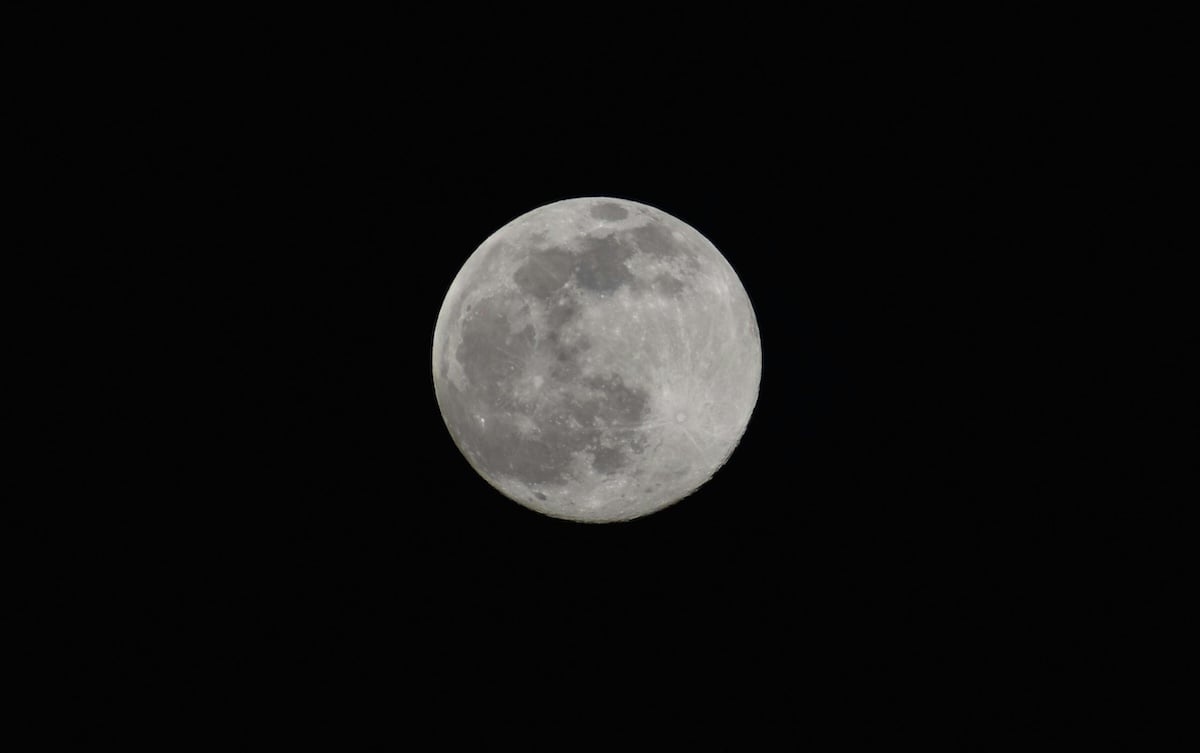
Other October Full Moon Names
Hunter’s Moon is the headline, but October’s full Moon collects several other names worth knowing.
- Travel Moon: bright autumn nights made October a favored window for migration and long overland trips before the winter weather closed the roads.
- Dying Grass Moon: a plain description of the pastures by late October, when grass has turned brown and the growing season is finished.
- Sanguine Moon or Blood Moon: not the eclipse usage of “Blood Moon,” which we cover below. The October sense ties to atmospheric haze from autumn harvest burns and woodsmoke, which can give the rising Moon a deep red or coppery cast.
- Falling Leaves Moon: a self-explanatory name from several traditions, describing the deciduous canopy thinning out across the northern half of the continent.
Each name carries the same idea from a different angle: autumn is in full swing, the harvest year is closing, and winter is on the horizon.
More Hunting Related Names
While “Hunter’s Moon” is the most common name for the October full Moon, the Stockbridge-Munsee tribe of Wisconsin and the Tunica tribe of Louisiana have a slight variation, and call this the “Hunting Moon,” associating with the action rather than the person. Still, the connection to hunting season is clear for this month’s full Moon.
In Pagan, Wiccan, and English Medieval traditions, the October full Moon was called the “Blood Moon” or “Sanguine Moon” to also show the association with hunting as a bloody season, but part of the natural progression of the seasons all the same.
The Ponca tribe of the southern Great Plains calls this Moon the “When They Store Food in Caches” Moon. This name is also connected to hunting, as food reserves become useful when temperatures start to drop. It can also refer to the agricultural harvest, and the October full Moon also goes by other names related to food and harvest.
Moon Names for Seasonal Changes
The falling leaves, dropping temperatures, and beginning frosts common in October have all given rise to related full Moon names. The Ojibwe, Abenaki, and Arapaho tribes all call October’s full Moon the “Falling Leaves Moon,” while the Lakota of the northern plains call this the “Moon When The Wind Shakes Off Leaves” to describe regional weather patterns. The Shawnee of the Midwest, particularly Ohio and Pennsylvania, use the term “Wilted Moon” to indicate changes in all plant life.
In colder regions, the season’s first frost and ice can come around October’s full Moon. For the Algonquin of the northeast, this is the “White Frost on Grass Moon,” and the Potawatomi of the Great Lakes call this full Moon the “Moon of the First Frost.” Similarly, the Cheyenne of the Great Plains refer to October’s Moon as the Moon when “Freeze Begins on Stream’s Edge.”
Changes in animal patterns also influence Moon names for different native tribes. The Cree of the northern plains and Canada call October’s Moon the “Moon the Birds Fly South” and the Haida of Alaska refer to it as the “Bears Hibernate” Moon.
Even human patterns are noted by this full Moon, such as the Wishram tribe of the Pacific Northwest calling this the “Travel in Canoes Moon” and the Iroquois, Algonquin, and other mountain tribes referring to it as the “Travel Moon” due to their ancestors leaving higher altitudes before winter and traveling to lower elevations to spend the cold season. The Dakota tribe calls this month’s Moon “The Moon When Quilling and Beading Is Done” to note those seasonal activities after harvesting is finished and there is time to do such tasks.
October Hunter’s Moon Names by Region, A Quick Map
| Region | Nation | Name for October’s full Moon |
|---|---|---|
| Northeast | Algonquin | White Frost on Grass Moon, and the Travel Moon |
| Northeast | Iroquois | Travel Moon, for the move down from higher ground before winter |
| Northeast | Abenaki | Falling Leaves Moon |
| Great Lakes and Wisconsin | Stockbridge-Munsee | Hunting Moon |
| Great Lakes and Wisconsin | Oneida | Someone Stores Food Moon |
| Great Lakes | Potawatomi | Moon of the First Frost |
| Great Lakes | Ojibwe | Falling Leaves Moon |
| Southeast | Creek, in Alabama and Georgia | Big Chestnut Moon, for the nut harvest |
| Southeast | Tunica, in Louisiana | Hunting Moon |
| Great Plains | Lakota | Moon When The Wind Shakes Off Leaves |
| Great Plains | Dakota | The Moon When Quilling and Beading Is Done |
| Great Plains | Arapaho | Falling Leaves Moon |
| Northern Plains and Canada | Cree | Moon the Birds Fly South |
| Pacific Northwest | Wishram | Travel in Canoes Moon |
| Alaska | Haida | Bears Hibernate Moon |
Southern Hemisphere Names
As the seasons are reversed in the Southern Hemisphere, it is reasonable that the October full Moon would have more spring-related names instead of autumn themes. Depending on the location and cultures, southern names for the October full Moon include “Egg Moon,” “Fish Moon,” “Pink Moon,” “Seed Moon,” and “Waking Moon.”
However you enjoy the tenth month, there is an October full Moon name to celebrate.

The Hunter’s Moon and Halloween
The 2026 Hunter’s Moon peaks five nights before Halloween. By Saturday, October 31, the Moon will be a waning gibbous, still bright but past full, rising several hours after sunset and adding a useful glow to trick-or-treat hours in many neighborhoods.
A genuine full Moon on Halloween night is rare. The last one fell on October 31, 2020, and the next will not arrive until 2039. Most years the holiday lands somewhere on the waxing or waning side of full, with the Hunter’s Moon serving as the closest “big Moon” event on the calendar. In 2026, the Hunter’s Moon five nights earlier is the Moon most people will remember from late October.
For more on the holiday itself, see our explainer on when Halloween falls and why.
October Sky Highlights
The Hunter’s Moon is the headline, but October hosts the year’s most reliable autumn meteor shower as well. The Orionids peak overnight from Wednesday, October 21, into Thursday, October 22, 2026, with up to 20 meteors per hour visible under a dark sky. The radiant rises near the constellation Orion in the eastern sky after midnight, and a waxing crescent Moon early in the week leaves most of the night sky dark for viewing.
The Orionids are debris from Halley’s Comet, swept up by Earth’s orbit each October. The meteors are fast and often leave glowing trails that linger for a second or two, which makes the shower a favorite of veteran observers. By the time the Hunter’s Moon arrives a few nights later, the sky will be bright enough to wash out most meteors, so the Orionid window is the better dark-sky target for the month.
For background on the equinox that opens the season, see the autumn equinox and the first day of fall.
Hunter’s Moon Folklore
Folklore around the October full Moon tends to circle three themes: the harvest year closing, the hunting and trapping season opening, and the long night-after-night glow of the autumn Moon. Anglo-Saxon writers used the Hunter’s Moon as a practical calendar marker, the start of the season for putting meat away. Across the Atlantic, the same Moon kept its name in colonial American almanacs and stayed there.
A Note on “Blood Moon” and the Sanguine Moon
The October full Moon is sometimes called the Sanguine Moon or Blood Moon, and this is worth a careful note. The folkloric “Sanguine Moon” name has nothing to do with a lunar eclipse. It describes the deep red or coppery color a rising October Moon can take on when its low-angle light passes through thick atmospheric haze, typically from autumn harvest fires, woodsmoke, or dusty late-season air. The Moon turns the same color at sunrise and sunset on any other month for the same physical reason.
The modern “Blood Moon” usage that shows up in headlines is a different phenomenon: a total lunar eclipse, when Earth’s shadow falls across the full Moon and the disc takes on a red cast from refracted sunlight bending around the planet’s atmosphere. There is no total lunar eclipse anywhere on the calendar for October 26, 2026, so the 2026 Hunter’s Moon will look the way it always does: bright, near-white when high in the sky, sometimes amber or red near the horizon depending on the air, but not an eclipsed Moon. The two “Blood Moons” are unrelated, and the names get tangled in popular coverage often enough to call out.
Gardening and Best Days for October
For gardeners following the Moon, late October is the closing window of the active growing year across most of the United States and Canada. The waning days after the Hunter’s Moon, from October 27 through early November, are a traditional period for clearing finished beds, mulching perennials, and planting garlic, shallots, and spring-blooming bulbs that need a winter chill to perform.
The full Moon itself is generally treated as a rest day in lunar gardening tradition, with the days running up to full reserved for above-ground crops and the days after full for root crops and below-ground work. Our All-Access members get the full Gardening by the Moon Calendar and the Best Days chart, both of which line up the planting, harvesting, and household timing with the lunar cycle through October and the rest of the year.
How to See the Hunter’s Moon
The Hunter’s Moon is easy to find. It rises in the east near sunset, climbs through the southern sky, and sets in the west near sunrise. No telescope, no binoculars, no app required. A clear horizon helps, and a light jacket usually does too.
Best Viewing by Region
| Region | What to expect |
|---|---|
| Northeast and Great Lakes | Cool, often clear after a passing cold front. The Moon rises over bare hardwoods and gives a sharp disc against a dark sky. |
| Southeast and Gulf | Warm late afternoons and a mix of clear and overcast nights. Check the forecast a day ahead and aim for a clearing window. |
| Midwest and Plains | Open horizons make for dramatic moonrise. The Moon often looks especially large coming up over a section line or unbroken farm field. |
| Mountain West and Rockies | Dry, dark skies in many spots. High altitude and low humidity make October one of the best Moon-watching months of the year. |
| Pacific Northwest | Marine layer and early-season rain are the main risks. Inland valleys often clear earlier than the coast. |
| Southwest | Long, clear nights and warm afternoons. The Moon over red-rock country or open desert is hard to beat. |
| Ontario, Quebec, and the Maritimes | Cool, often crisp nights after a Canadian high settles in. Excellent contrast against fall color along the St. Lawrence and through the Bay of Fundy. |
| Canadian Prairies | Open horizons and dry October air. The Moon stays in the sky for hours and gives strong shadows on stubble fields. |
| British Columbia | Coastal cloud is the main risk. Interior cities such as Kamloops and Kelowna typically have clearer October skies than the coast. |
Practical Tips
- Step outside about 20 minutes before sunset on Sunday, October 25, or Monday, October 26, to catch moonrise low in the east.
- Let your eyes adjust for five to ten minutes. The bright Moon paired with bare branches and dry leaves makes for striking contrast.
- For photography, a phone in night mode handles the wide scene; a DSLR at 1/125 second, f/8, ISO 200 will hold detail on the disc.
- The Moon looks largest near the horizon, an optical illusion that has fooled humans for centuries. Catch it at moonrise for the most dramatic photo.
- If the sky is hazy from a nearby wildfire or a regional inversion, the rising Moon may take on a deep red or amber color. That is the “Sanguine Moon” effect at work and worth a photo on its own.
- Check local moonrise and moonset for your ZIP code using our Moon Phases Calendar before heading out.
For deeper background on Moon-month tracking and the Indigenous and European names attached to each one, see the NASA monthly skywatching guide.

Hunter’s Moon FAQ
When is the Hunter’s Moon in 2026?
The Hunter’s Moon peaks on Monday, October 26, 2026, at 12:12 a.m. Eastern Daylight Time (04:12 UTC). Because peak falls just after midnight Eastern, the prime viewing windows are Sunday evening, October 25, when the Moon rises near sunset already nearly full, and Monday evening, October 26, when it rises again about an hour after sunset just past peak.
Why is the October full Moon called the Hunter’s Moon?
By late October the harvest is in, game animals have fattened on field leftovers, and a bright full Moon over open stubble made it easier to spot and track them. Anglo-Saxon tradition pinned the same Moon to the opening of the hunting season, the practical window for putting meat away before winter. The name carried into colonial American almanacs and stayed there.
Is the Hunter’s Moon always in October?
Almost always, but not by definition. The Hunter’s Moon is the full Moon that follows the Harvest Moon, and the Harvest Moon is the full Moon closest to the autumn equinox. In most years the Hunter’s Moon lands in October. In years when the Harvest Moon falls in early October, the Hunter’s Moon can slip into early November. In 2026 the Harvest Moon is September 26 and the Hunter’s Moon is October 26.
Is the Hunter’s Moon a “Blood Moon”?
The folkloric “Sanguine Moon” or “Blood Moon” name for October’s full Moon describes a deep red or coppery cast the rising Moon can take on when its light passes through harvest-fire haze or thick autumn air. It is not the modern eclipse “Blood Moon,” which refers to a total lunar eclipse. There is no total lunar eclipse on October 26, 2026.
What other names does the October full Moon have?
Travel Moon, Dying Grass Moon, Sanguine Moon, and Falling Leaves Moon are the most common alternatives. Each one describes the same season from a different angle: brown pastures, thinning canopy, autumn travel windows, and the smoky color of the rising Moon over harvest country.
Does the Hunter’s Moon land on Halloween in 2026?
No. The 2026 Hunter’s Moon peaks October 26, five nights before Halloween. By October 31, the Moon will be a waning gibbous, still bright but past full. A genuine full Moon on Halloween night is rare. The last one was October 31, 2020, and the next is not until 2039.
Do I need a telescope to see the Hunter’s Moon?
No. The full Moon is easily visible to the naked eye. Step outside near moonrise, about 20 minutes before local sunset, on Sunday, October 25, or Monday, October 26, and look east. A clear sky and a low horizon are all you need.
What is the next full Moon after the Hunter’s Moon?
The Beaver Moon, the November 2026 full Moon, follows the Hunter’s Moon. It peaks on Tuesday, November 24, 2026, at 9:53 a.m. Eastern Time and opens a run of three consecutive supermoons that close out 2026 and open 2027.
What is a Super Hunter’s Moon?
A full Moon that falls within about 90 percent of perigee, the Moon’s closest point to Earth in its slightly elliptical orbit. A Super Hunter’s Moon appears roughly 7 percent larger and 15 percent brighter than an average full Moon: noticeable side by side, but not dramatic on its own.
Do Southern Hemisphere cultures use the same names?
No. Because the seasons are reversed, southern traditions give the October full Moon spring names such as Egg Moon, Fish Moon, Pink Moon, Seed Moon and Waking Moon, reflecting the awakening of life rather than hunting and harvest.
Join The Discussion
What is your favorite name for October’s full Moon?
Will you be out on Sunday night, October 25, or Monday night, October 26, to catch the Hunter’s Moon over your own horizon?
Related Articles
- September’s Full Harvest Moon
- Full Moon Names And Times
- October Birthstone
- October Birth Month Symbols And Fun Facts
- When Is Halloween?
- Fall Equinox: First Day Of Fall
- Moon Phases Calendar
- Subscribe To The Farmhouse, Our Members-only Community!


Melissa Mayntz
Melissa Mayntz is a writer who specializes in birds and birding, though her work spans a wide range—from folklore to healthy living. Her first book, Migration: Exploring the Remarkable Journeys of Birds was published in 2020. Mayntz also writes for National Wildlife Magazine and The Spruce. Find her at MelissaMayntz.com.
- Melissa Mayntz

- Melissa Mayntz
- Melissa Mayntz
- Melissa Mayntz




Hi Meliissa — thank you for taking to time to give a nod to what we are looking forward to in the fall. It’s a very special time for my in that 10/12 is my birthday which is so amazing in and of itself, but in the celebration of things, my women are going to come-together on that weekend, the 19th in the Shenandoah valley.
We have all visited many time, but this, the 25, the school is now co-ed, for the first time in over 100 years. A lot of coming together on thiis hunters moon. cheers.
I’m so happy for this booklet if information. I’ve been reading it for a long time and weather forecast aren’t ever wrong. Thank you
My father gave me a Farmers Almanac when I was 13 years old, it amazed me with its formation and I’ve been reading the Farmers Almanac utilizing its information throughout my life I am a senior citizen now and I am so happy that you have this on the internet so every morning when it’s posted I can read something new ?
Thank you ????
The American Indian nations were one of the planets greatest civilizations.They have given us so many different medicines and knowledge and have received so little in return.Thank God for the people. AL
My grandmother was Cherokee. I was born in Robbinsville, NC, and my great greats hid in the forest, didn’t walk the Trail of Tears. In college history courses that is hardly mentioned and only that the inhuman Andrew Jackson was ‘controversial’. This is all so very wrong but the mistreatment of native peoples, no matter how hot it stirs my blood, does not shake my Christian faith. And God gave us all the light, including the incredible moon. I’m old enough to remember when the stars truly filled the sky too.
I honor our Red Brothers every day! It was a fabulous life style, i,e, following the Buffalo for food and clothing. I am currently reading “Geronimo” and his life story. What a Read!
*** See the Movie; “Geronimo” if you can. It sheds light on the shortcomings of the white men (U.S. Army) and their unfair treatment of this proud race.
Attn: Michael Van…
Please consider that the earth just might be 4.5 billion years old, even for a christian.
Sorry can’t do that. Enjoy the blessing!!
Michael, Zaria said they came here from. Not were evolved here. please read for meaning going forward.Interesting article thanks
Thank you for sharing this, we need to pass this information to the next generation
Sioux Indians
The Sioux Indians actually came to North America from the continent of Asia about 30,000 years ago. The name Sioux actually means “little snake”, which was given to the tribe by the Chippewa Indians. The features of Sioux Indians that particularly stand out is their long, straight jet-black hair, representative of people descending from Asia.
Generally, the Sioux Indians were nomadic, meaning that they never really stayed in one place for a very long amount of time. Typically they followed the pattern of the buffalo, assuring them that there would be food and clothing wherever they traveled. The Spanish introduced horses to the Sioux in the 1500’s. Once they began to use horses as a means of carrying articles and transportation, life became much easier, particularly since they were living a nomadic lifestyle. The tribe had chiefs designated for various aspects of life, including war, civil rules, and of course, medicine men. The men of the tribe could become chiefs eventually if they demonstrated strong warrior skills.
So on behalf of my ancestors,I thank you for informing people what the blood moon means.