

How Fresh Are Supermarket Eggs? Decode the Julian Date, Sell-By, and Float Test
You may have often wondered how old the eggs are that you buy from the supermarket. Believe it or not, they could be up to two months old. How do you know? Are they still safe to eat? Find out!
Quick Reference: Egg Freshness
- Average supermarket egg age: 4 to 6 weeks old at purchase. USDA allows up to 30 days from packing to sale + 30 day sell-by extension.
- The Julian date: the 3-digit number on the side of the carton (001 to 365). It is the day the eggs were packed, not the sell-by date.
- Float test: fresh eggs sink and lie flat. 2 to 3 weeks: stand on end. Floating: discard.
- Refrigerator safe storage: 4 to 5 weeks past pack date if continuously refrigerated.
- Best Days tool: the Almanac’s Best Days calendar for egg-related farm tasks.
On this page
Related Almanac guides
Sources cited in this guide
Per USDA Food Safety and Inspection Service rules, a supermarket egg can be up to 60 days old by the time the sell-by date arrives, and even older if the store’s stock turns slowly. The carton contains all the information you need to decode this if you know where to look: the 3-digit Julian date stamped on the side. This guide is how to read every date code on a US egg carton, the at-home float test that tells you exactly how fresh your eggs are, and the USDA-backed safe storage rules.
How Old a Supermarket Egg Actually Is
Per USDA FSIS shell-egg regulations, a supermarket egg passes through several aging steps before you buy it.
- Lay date. The hen lays the egg.
- Pack date. Eggs are washed, graded, dated, packed. USDA allows up to 30 days between laying and packing.
- Shipping date. Cartons ship from packer to wholesaler to retail (usually 1 to 7 days).
- Shelf date. Carton hits the supermarket cooler. Sell-by stamp goes up to 30 days from the pack date.
- Your purchase. Could be 30 to 60 days from lay date, possibly older if turnover is slow.
- Your storage. USDA confirms eggs remain safe 3 to 5 weeks past sell-by if continuously refrigerated.
How to Decode the Carton (3 Numbers to Find)
Every USDA-graded egg carton has three required codes. Once you know them, you can read the carton faster than the cashier can scan it.
- The Julian date (3 digits): day of year the eggs were packed. 001 = January 1, 365 = December 31. This is the most useful number on the carton.
- The plant code (P-####): the USDA-assigned 4-digit plant code, prefixed with P. Identifies the actual packer in case of a recall.
- The sell-by or use-by date: stamped by the packer. Can be up to 30 days past the Julian date. USDA does not require it but most states do.
The Float Test (Works at Home)
Per Penn State Extension egg-quality research, the float test is the most reliable at-home freshness check.
- Fill a bowl with cool tap water. Gently place the egg in the water.
- Sinks and lies flat on the bottom: very fresh. Less than 1 week old.
- Sinks but tilts: 1 to 2 weeks old.
- Sinks but stands upright: 3 to 4 weeks old. Best for hard boiling (easier to peel).
- Floats: air cell has expanded too much. Cracked or spoiled. Discard.
Original Detail: What Fresh Eggs Daily Says, Tips, Date Codes
Below are the original sections on what Fresh Eggs Daily tells us, how to ensure store-bought freshness, and date code definitions.
Here’s What Fresh Eggs Daily Tells Us:
By law, an egg can be sold for up to 30 days after the date it was put in the carton. And farmers have up to 30 days to go from when the egg is laid to the carton. That means those supermarket eggs can be two months old by the time you buy them. Despite their age, however, the eggs will be fine to eat, just not as fresh, of course (and we can all agree, nothing is better than a farm-fresh egg!). You may find that the yolks won’t be quite as firm and the whites will be more runny, but from a safety standpoint, there are no dangers as long as each egg passes the smell test: if it doesn’t smell good, toss it! The reason for the runnier consistency is that more air has had the chance to seep through the pores in the shell , commercial egg processors remove the microscopic protective exterior membrane called the “bloom” which keeps bacteria out. The one plus side to an older egg? It’s easier to peel when hardboiled.
So how can you ensure your store-bought eggs are as fresh as possible?
You have to “crack” the “code.”
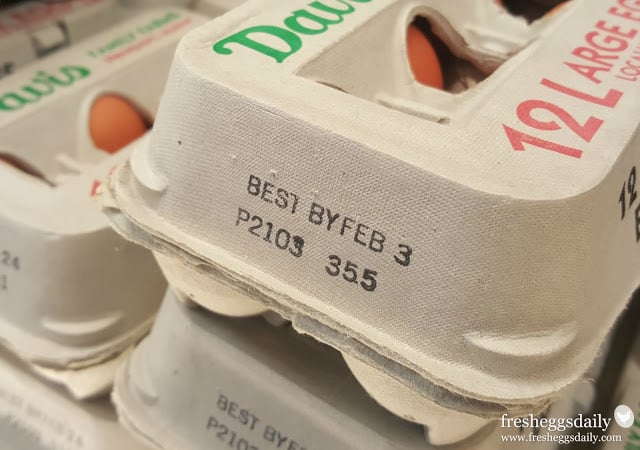
On each egg carton, there’s a number printed, from 1 to 365. That number represents the day of the year the carton was filled: 1 being January 1st and 365 being December 31st. Using the code, you can at least tell when the eggs were put in the carton.
For example, a carton with the code 355 means the eggs were put in the carton on the 355th day of the year, or December 11th. If the carton was purchased at the grocery store on January 8th, that means those eggs are at least 28 days old.
Best By, Sell By, Use By Dates
Most cartons will also include a “Best By” date and a “Sell By” date. The “Best By” or “Use By” date can’t be more than 45 days past the packaging date. The “Sell By” or “Expiration” date can’t be more than 30 days past the packaging date.
An interesting test to try to figure out the age of eggs, either store-bought or from your backyard, is to conduct the “Float Test.” Gently submerge the uncooked egg in a glass of water. A very fresh egg will lie on the bottom of a glass of water, while an older egg will start to rise up on one end, and eventually float.
The best way to get the freshest eggs possible is to get them from your own chickens or a local farm. However, if that’s not possible, remember to get in the practice of checking carton dates and codes and at least choose those eggs that are the freshest.
For great tips on raising backyard chickens, be sure to visit the Fresh Eggs Daily web site.

Supermarket Egg Freshness FAQ
How can I tell how fresh my supermarket eggs are?
Three checks. (1) Find the 3-digit Julian date on the carton side, gives the exact pack day. (2) Do the float test (fresh sinks and lies flat; older stands; bad floats). (3) Crack one onto a flat plate; fresh whites stand tall around a domed yolk; older spread thin.
What does the date on the egg carton mean?
Three different dates appear. The Julian date (3 digits like 045 or 312) is the day of the year the eggs were packed. The sell-by/use-by date is the date the store should sell them by, typically 30 days after packing. The pack date is sometimes written separately as a regular calendar date.
How long can you keep eggs after the sell-by date?
Per USDA, 3 to 5 weeks past the sell-by date if continuously refrigerated. Always do the float test if in doubt. Eggs are far safer past their sell-by date than most foods because the shell + cold storage protects them.
Are farm-fresh eggs different from supermarket eggs?
Yes by age. Farm-fresh eggs from a hen-keeping neighbor are typically 1 to 7 days old. Supermarket eggs are typically 30 to 60 days old. Both are safe and nutritious if handled properly, but the farm-fresh have firmer whites, taller yolks, and better baking performance.
Should you wash supermarket eggs before using them?
No. US supermarket eggs are already washed and lightly oiled at the packer (USDA-required process). Re-washing removes the protective bloom and pushes water through the shell, raising contamination risk. Just crack and use.
What is the best way to store eggs?
In the original carton on a middle refrigerator shelf, not in the door (the door swings too far in temperature). Refrigerator should be 40 F or below per USDA. Keep eggs pointed-end down to keep the yolk centered.


This article was published by the Staff at FarmersAlmanac.com. Any questions? Contact us at [email protected].
- Farmers' Almanac Staff

- Farmers' Almanac Staff

- Farmers' Almanac Staff

- Farmers' Almanac Staff





i raise chickens if eggs are less than 2 months old it will take extra 20 minutes to hard boil or they wont peel easy i have kept them in basement for 6 months i never had a problem
I have eggs that still have a beautiful golden yolk can i eat them or give them to my dog cause they are floating
What does this date mean?
158. P1442. a
DAY 158 on the JULIAN calendar is June 7th 2026. today is Day 190 or July 9th 2026. the P# is the packer not entirely sure what the a is. lol them eggs if bought today about 62 days OLD.
Nice detective work, Romy, your Julian math is spot on. Two quick clarifications on the other codes you spotted:
Sixty-two days is on the older end but usually still safe if refrigerated properly. The float test is your best final check.
Interesting information. You may wish to correct your example, tho, as the 355th day is December 21st, not December 11th.
When in question, put your egg in water. If it floats, throw it away. If it sinks, eat it. Worked for years on the farm.
I saw a program that showed that when eggs are out of date in the stores. They get sent back to the supplier. Supplier take those eggs, and reincorporate the old eggs back into fresh. So you never know how fresh they are, sad world we live in folks ! Just like that really red meat in the stores. A safe amount of carbon monoxide is added and some other gas. 🙁
Yep they sure do if it prepacked beef you get bet your last dollar it’s been gassed.If you want good fresh meat go to a store that still has a market that cuts there meat them self. My brother had 5 gro. Stores he had the best meats chicken fresh from the processing plant. It doesn’t get any fresher that that unless your cleaning your on chickens.