November Birth Flower: Chrysanthemum Meaning and Care
Quick Reference: The November Birth Flower
- Official flower: the chrysanthemum, or “mum” for short.
- Alternate flower: the peony.
- Family: Asteraceae, a cousin of daisies, asters, sunflowers, and marigolds.
- What it means: luck, joy, loyalty, and long life in the West; remembrance and mourning across much of East Asia.
- Where it grows: a perennial in US Hardiness Zones 5-9, a fall accent everywhere else.
- Gift note: the official flower of the 13th wedding anniversary.
November brings the last full flush of color before winter closes in, and the chrysanthemum wears it best. The rich fall hues of the mum make it the ideal choice as the November birth flower, but there is deep symbolism and centuries of lore behind this bloom. Learning more about the beloved “mum” can help you appreciate these iconic flowers even more, whether you are celebrating your birthday, Thanksgiving, a wedding or anniversary, or any other special occasion in November.
November Birth Flower at a Glance
Most months carry one birth flower, but November comes with two. The chrysanthemum is the official bloom, and the peony stands in as the recognized alternate. Here is how the pair compares before we look at each one in turn.
| Chrysanthemum | Peony | |
|---|---|---|
| Standing | The official November birth flower | The recognised alternate |
| Family | Asteraceae, a cousin of daisies, asters, sunflowers and marigolds | Paeoniaceae, a family of its own |
| What it means | Luck, joy, loyalty and long life in the West. Remembrance and mourning across much of East Asia | Prosperity, good fortune and a happy marriage |
| Where it grows | Perennial in US Hardiness Zones 5 to 9, a fall accent everywhere else | Long-lived perennial in colder zones; it needs winter chill |
| Gift note | The official flower of the 13th wedding anniversary | Traditionally the 12th |
About Chrysanthemums
The chrysanthemum, of which there are many individual species, belongs to the floral family Asteraceae. This is one of the largest floral family classifications, which makes these beautiful blooms related to dahlias, sunflowers, zinnias, and several other popular birth month flowers, including the daisy (April), the aster (September), and the marigold (October). See all birth month flowers.
These lovely blooms started out as stunning wildflowers in China and East Asia, and the first records of cultivation are found in China approximately 3,500 years ago (in 1500 B.C.E.). Today, there are about 35-40 species of chrysanthemums recognized altogether, with 20,000 or more varieties worldwide. In the wild, the greatest diversity is still found in Asia, but several types turn up wherever mums have spread.
These popular flowers are perennial flowering herbs that grow naturally across a wide range of habitats, including grasslands, mountain slopes, roadsides, and even the beach edges where grasses climb the sandy dunes. That reach means no matter where one lives, chrysanthemums are likely to be available.
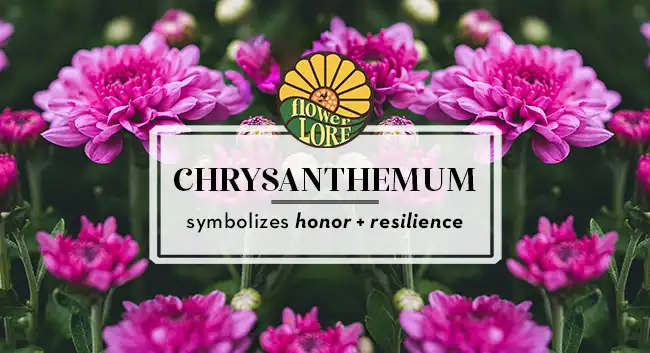
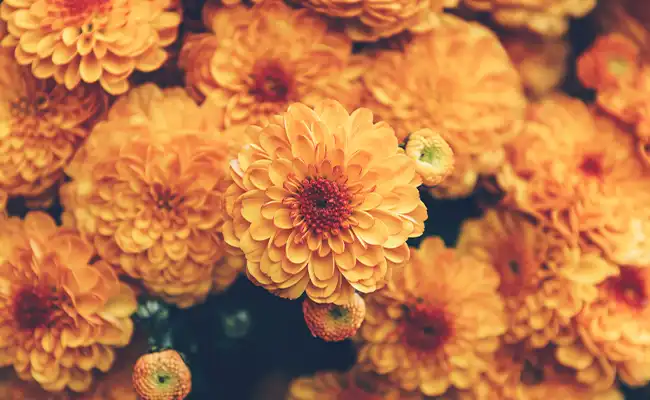
Their name comes straight from their traditional color: chrysos is Greek for “golden” and anthemon means “flower.” While yellow and golden shades are the natural, native colors of mums, these November flowers also come in white, red, purple, pink, orange, peach, and even green, depending on the cultivar.
The shape of the bloom varies just as widely. Thirteen varieties of chrysanthemums are recognized, with creative names that describe their petals and overall shape: button, pompon, spoon, anemone, incurved, spider, quill, cushion, football, and more.
Speaking of football mum … or soccer mom … have you seen our new FA brand Hoodie Blanket? Get yours now!

Symbolism of Chrysanthemums
These flowers are widespread, highly symbolic, and prevalent in many cultures. In general, chrysanthemums are associated with luck, optimism, love, happiness, devotion, joy, trust, loyalty, fidelity, and wealth. In many East Asian cultures, however, these flowers are more often tied to death, grief, mourning, sympathy, and remembrance, particularly in China. Some memorial associations are common in European countries as well.
In Japan, chrysanthemums carry special meaning and extraordinary symbolism as the official national flower and as the Imperial Seal, or the Chrysanthemum Seal of the emperor. The flower’s neat symmetry and golden color, reminiscent of the Sun, make it the perfect symbol for the “Land of the Rising Sun,” and it even appears on Japanese passports. Different members of the Japanese imperial family use slight variations on the seal as their personal emblems, with differences in petal count, orientation, or color.

Chinese and Korean cultures hold their own special meanings for the chrysanthemum. The bloom is one of the “Four Gentlemen,” or “Four Noble Ones,” and it stands for autumn alongside three other seasonal blooms: the orchid (spring), the lotus (summer), and the plum blossom (winter). All four turn up often in art and design, showing the changing of the seasons and the beauty of nature through the year.
In the language of flowers, the color of a chrysanthemum changes what the flower means:
- Red, romance, love, passion, courage
- Pink, gentleness, affection, optimism
- White, mourning, sympathy, remembrance, respect
- Orange, excitement, enthusiasm
- Purple, good health, get well, luxury, longevity
- Green, renewal, rebirth, youth
- Yellow, happiness, joy, celebration
Interestingly, unlike many other flowers with roots in old folklore, there are no Greek legends directly tied to the chrysanthemum. That is likely because these flowers did not originate in the Mediterranean region and were never widely naturalized in ancient Greece. For the season’s other timekeepers, folks in November also watch the sky for the Beaver Moon and the year’s other named full Moons.
Chrysanthemums in the Kitchen
As an herb, the chrysanthemum has a real place in the kitchen, particularly across Asia. In China, chrysanthemum tea is a sweet drink long believed to help restore youth. During the Han Dynasty (202 B.C.E. to 220 C.E.), chrysanthemum wine was especially popular. The wine was prized most on the ninth day of the ninth month of the lunar calendar, roughly mid to late October, for the Double Ninth Festival.
Also known across China, Japan, and Korea as the Chrysanthemum Festival, the Double Ninth Festival celebrates good health and honors the elderly. In Japan, the drink of choice would be sake flavored with chrysanthemum.
Any questions? Contact [email protected]
Beyond drinks, chrysanthemum shows up in salads, soups, and more. Both the blossoms and the leaves can be edible, but be sure to check labels to confirm yours is the culinary variety, and ask a professional if you are unsure. Flowers might be folded into pancakes, crystallized as cake decorations, or the leaves steamed or boiled as a fresh green.
Depending on how it is prepared, chrysanthemum carries a light floral flavor that many describe as similar to chamomile. It can be refreshing and add a mild touch of sweetness to plenty of recipes without any extra sugar.
It is worth noting that if you are allergic to ragweed, you may also be allergic to chrysanthemums and should use them cautiously in case of a reaction.
Medicinal and Other Chrysanthemum Uses
While the chrysanthemum has a long history in the kitchen, its history in the medicine cabinet runs longer still. Important note: The Farmers’ Almanac does not offer medical advice. Information included here is for education purposes only. For millennia, these flowers have been used to relieve a variety of symptoms and conditions, including dizziness, vision problems, coughs, headaches, sore throats, and more.
These flowers also carry anti-fungal and antibacterial properties, and folks have long added them to a wash or compress for wound care and healing.
Even today, chrysanthemums hold a place in modern medicine for their anti-inflammatory and anti-obesity properties and for helping control blood pressure and blood sugar, though studies are ongoing.
As with cooking, these flowers should be used sparingly and only under a doctor’s direction if you may have a ragweed allergy.
Outside the medicine cabinet, chrysanthemums contain pyrethrins, which can be potent insecticides. Growing the flowers may help ease problems with moths, flies, and mosquitoes, which is why they are a popular addition around doorways or on patios and other outdoor seating areas.
Take care, though, because mums can be dangerous and toxic to both dogs and cats, and should be kept out of reach of pets. If ingested, pets may experience vomiting, diarrhea, excessive saliva, loss of balance, skin problems, and other trouble, and the reaction could even be fatal depending on the exposure or the amount consumed.
Chrysanthemums can be toxic to horses as well, so they should not be present in pasture areas or used as barn or corral decorations where curious equines could reach them.
The Art and Literature of Mums
With so much history behind them, these flowers feature in a great deal of Asian art, especially seasonal depictions of the “Four Gentlemen” (tap to view) and across many media, from silkscreens and brush painting to woodblock prints and porcelain.
Chrysanthemums have been popular in other eras and other artwork too, most notably in French impressionist Claude Monet‘s oil on canvas from 1882, titled “Chrysanthemums.”
In a more contemporary work, the chrysanthemum was clearly featured in Kehinde Wiley’s 2018 presidential portrait of Barack Obama for the Smithsonian’s National Portrait Gallery.
No less lovely on a smaller scale, chrysanthemums have appeared on postage stamps, not only the 2020 US Global Forever Stamp but also releases across many past years from Korea, China, Japan, Vietnam, the Marshall Islands, Poland, Hungary, and Czechoslovakia.
Another modern take on the mum is its use in floral tattoos, often as memorial or remembrance designs or as part of sleeves and bouquets. The bloom’s great symmetry and full display of petals is ideal for covering scars, reworking old tattoos, or other ink work.
In literature, John Steinbeck’s short story “The Chrysanthemums,” published in 1937, uses the flowers as a potent metaphor for the protagonist’s emotions and treatment during the Great Depression in California. The blooms are also popular in Asian poetry and literature.
One day, a famous author may even carry a name rooted in the chrysanthemum. Crisanta and Chrissantha are both feminine names derived from the flower, while Kiku is another option or nickname that means chrysanthemum in Japanese.
Growing Chrysanthemums
These popular blooms are easy to grow and reliable even for novices. They are considered a perennial in US Hardiness Zones 5-9, which covers a great deal of the lower 48 states. Outside those zones, and for many casual gardeners even within the mum’s perennial range, these flowers are often used as seasonal autumn accents in porch pots or as landscaping color. They are great for fall weddings, cheerful as wreaths, and can even go into pumpkin displays, right down to pumpkin vases.
Depending on the exact cultivar, chrysanthemums range from 12-36 inches tall, and their typical mounding shape may reach 48 inches wide, so give them adequate space if you plant them as a perennial. Bloom size can be less than half an inch for smaller button mums, or up to a whopping 10 inches wide for more specialized blooms.
Chrysanthemums prefer well-draining, slightly moist soil, so if you are planting in a pot, be sure it has plenty of drainage holes. Aim for a pH of 6-7. Full sun brings the most colorful, fullest flowers, but partial sun can also work. The soil should have a good organic component to feed mums, so add manure, compost, or bone meal if needed. Fertilizing in spring and midsummer will keep these plants well fed.
To help chrysanthemums hold their signature mounding shape, deadhead them regularly, which encourages more flowers to fill in any gaps. Cutting the plants back to 6 inches tall after they finish blooming preserves them for the next year, and they should be mulched over winter to protect their delicate roots. For a plain-English rundown on soil, spacing, and pinching, Clemson Cooperative Extension keeps a helpful chrysanthemum fact sheet.
Because mums resist deer and squirrels, they are favorites for protecting garden areas, but you can plant them anywhere for a burst of autumn beauty.
As the official November birth month flower, chrysanthemums make an ideal gift for November birthdays and anniversaries, especially the thirteenth wedding anniversary, since they are also the official flower for that milestone. If you like to time gifts and plantings by the Moon, the Best Days Calendar lists the favorable days each month.
They are also popular in Thanksgiving decorations and as centerpieces, depending on the size. Inside the home, they help clean the air, too. A study conducted by NASA in 1989 found mums to be especially good at pulling toxins such as ammonia, benzene, toluene, and formaldehyde from the air.
An Alternative November Birth Flower, The Peony
If the chrysanthemum is not quite your thing, the peony stands as the recognized alternative November flower. Part of the family Paeoniaceae, there are about 30 varieties of peonies, and they come in red, pink, white, and yellow.
Peonies bloom from late spring to early summer, typically April through June, which makes it fair to wonder why they turn up as a November birth flower at all. The connection to chrysanthemums is real, though: both blooms are herbaceous perennials that first originated in Asia. Peonies, however, are also native across Europe and in parts of North America.
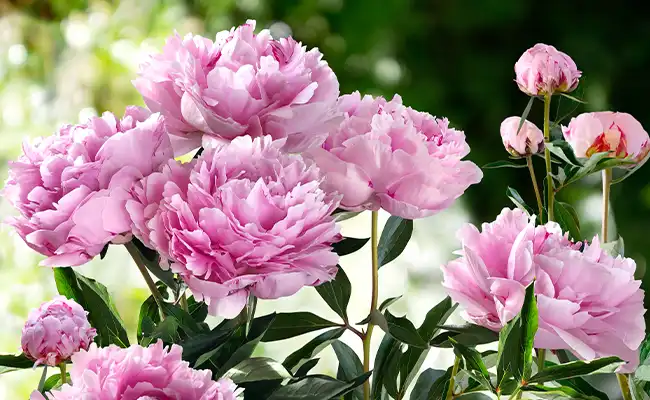
In China, peonies represent riches and prosperity, and they can also symbolize romance, passion, honor, and even bashfulness. These blooms are the state flower of Indiana, the national bloom of Romania, and the unofficial but favored flower to symbolize China. They are also the official flower of the twelfth wedding anniversary, right ahead of the chrysanthemum on the thirteenth.
Peonies are named for Paean, the physician to the Greek gods, and these flowers have in fact been used in traditional ancient Chinese medicine and for flavoring in salads and cool drinks. Another Greek origin legend claims the blooms first appeared when Aphrodite discovered the beautiful nymph Paeonia flirting with Apollo and turned the nymph into a peony as punishment.
The peony grows 2-3 feet tall and 3-5 feet wide, and it can be planted alongside chrysanthemums in full sun with moist, well-draining soil at a pH of 6.5-7. These plants are hardy in zones 3-9, which makes them marginally more widespread as a perennial than mums. Ideally, plant peonies in a sheltered location, since taller varieties may flop or droop in heavy wind or rain. Staking can help protect the blooms and keep them upright.
Whether you choose the official chrysanthemum or the alternative peony as your November birth flower, either bloom can be beautiful in the landscape and a delight to give as a gift for any special moment in the eleventh month of the year.
Join The Discussion
Which November birth month flower do you prefer: chrysanthemums, peonies, or something else?
Did anything surprise you about the chrysanthemum flower meaning?
Share your thoughts, tips, and tricks in the comments below.

November Birth Flower: Frequently Asked Questions
What is the birth flower for November?
The official November birth flower is the chrysanthemum, often called the “mum.” The peony is recognized as an alternate November flower. Chrysanthemums carry the rich golds, reds, and purples of fall, which makes them a natural fit for the eleventh month.
What does the chrysanthemum symbolize?
In much of the West, chrysanthemums stand for luck, optimism, joy, loyalty, fidelity, and wealth. Across many East Asian cultures, particularly China, they are more often tied to death, grief, mourning, and remembrance. Color matters too, from red for love to white for sympathy.
What do the different chrysanthemum colors mean?
Red means romance and passion, pink means gentleness and affection, white means mourning and remembrance, orange means excitement, purple means good health and longevity, green means renewal and youth, and yellow means happiness and celebration.
Are chrysanthemums toxic to pets?
Yes. Chrysanthemums are toxic to dogs, cats, and horses and should be kept out of reach. If ingested, pets may experience vomiting, diarrhea, excessive saliva, loss of balance, and skin problems, and the reaction can be serious depending on the amount consumed. Contact your veterinarian if you suspect exposure.
What growing zone do chrysanthemums need?
Chrysanthemums are perennial in US Hardiness Zones 5-9, which covers much of the lower 48 states. Outside that range they are usually grown as seasonal fall accents. They prefer full sun, well-draining soil with a pH of 6-7, and regular deadheading to hold their mounding shape.
What is the alternate November birth flower?
The peony is the recognized alternate. Although peonies bloom in late spring and early summer, April through June, they share Asian origins with chrysanthemums and carry rich meanings of prosperity, romance, and honor. Peonies are hardy in zones 3-9 and are the flower of the twelfth wedding anniversary.
Which wedding anniversary is the chrysanthemum for?
The chrysanthemum is the official flower of the thirteenth wedding anniversary. The peony, its November alternate, is the flower of the twelfth anniversary, so the two blooms sit side by side on the anniversary calendar.


Melissa Mayntz
Melissa Mayntz is a writer who specializes in birds and birding, though her work spans a wide range—from folklore to healthy living. Her first book, Migration: Exploring the Remarkable Journeys of Birds was published in 2020. Mayntz also writes for National Wildlife Magazine and The Spruce. Find her at MelissaMayntz.com.
- Melissa Mayntz

- Melissa Mayntz
- Melissa Mayntz
- Melissa Mayntz