

White Christmas Odds 2026: What Are Your Chances Of Snow?
Quick Reference: Your Odds Of A White Christmas 2026
- Definition: NOAA calls it a white Christmas when at least 1 inch of snow is on the ground at 7 a.m. on December 25.
- Highest odds (over 90%): Northern Minnesota, upper Michigan, northern Maine, the Sierras, the higher Rockies, Alaska.
- Moderate odds (50 to 90%): Interior New England, northern New York, the northern Plains, most of the interior Northwest.
- Low odds (under 10%): Southern California, southern Arizona, the Gulf Coast, most of Florida.
- Snowfall on the day is rarer than snow on the ground: only isolated western mountain sites, the lee of Lakes Superior and Ontario, and northern New England exceed 50%.
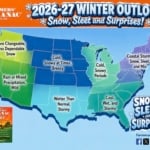
- Farmers’ Almanac 2026 outlook: stormy over the Rockies and Plains with heavy snow possible, wet in the Pacific Northwest and Southwest highlands, dry but unseasonably cold from the Southeast down to the Gulf Coast.
Christmas cards, carols, stories, and movies keep painting December 25 in white. Frosted rooftops, sleigh bells, a fresh two-inch dusting on the front walk. It is a pretty picture, and for a lot of America it is a long shot. NOAA’s climate record shows that outside the northern tier and the western mountains, a snow-on-the-ground Christmas is more the exception than the rule.
Below are the science, the odds by region, the Farmers’ Almanac long-range outlook for December 25, 2026, and the full White Christmas lyrics, in case you plan to sing along whether or not the flakes cooperate.
The notion of a “white Christmas” was popularized by the writings of Charles Dickens. The snow-covered Christmas season depicted in his 1843 classic, A Christmas Carol, and in a number of his other short stories, was apparently influenced by memories of his own childhood, which happened to coincide with the coldest decade in Great Britain in more than a century.
The song “White Christmas,” written by Irving Berlin and sung by Bing Crosby, was featured in the 1942 film Holiday Inn, and is known as the best-selling single of all time. It nostalgically speaks of a white Christmas and has since become embedded in our holiday tradition. See the lyrics below.
What Are The Odds?
The 1991 to 2020 Climate Normals are the latest three-decade averages of the country’s climatological measurements. This collection contains daily and monthly normals of temperature, precipitation, snowfall, heating and cooling degree days, frost and freeze dates, and growing-degree days calculated from observations at roughly 9,800 stations operated by NOAA’s National Weather Service. The result is the most complete map we have of what “normal” looks like at any given ZIP code.
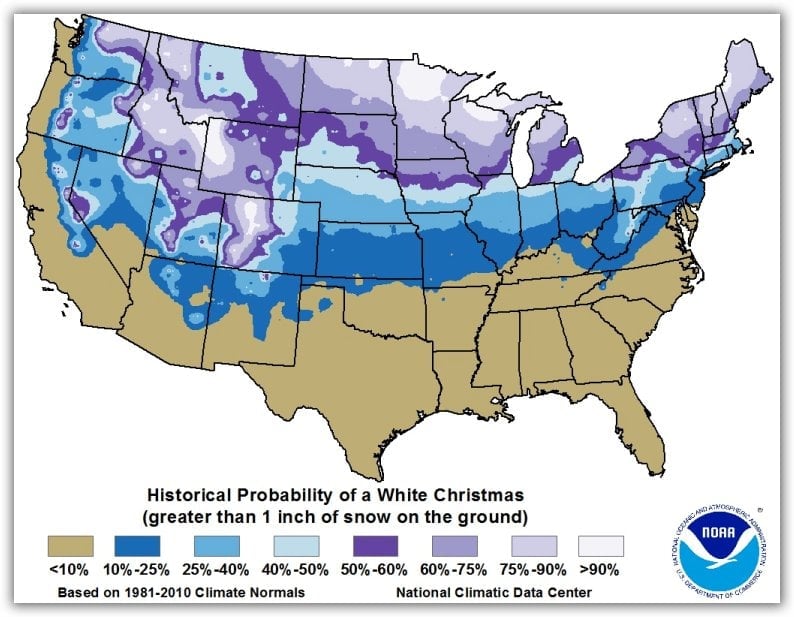
The map shows the historical probability that a snow depth of at least one inch will be observed on December 25. Actual conditions in any given year can vary widely, because the weather pattern in the two weeks before the holiday, and on the day itself, decides how much stays on the ground. Read the map as a guide, not a promise.
Where are the best places for experiencing snow on the ground, or fresh snowfall, on Christmas Day? To answer that we referred to the December 22, 2015 issue of the Bulletin of the American Meteorological Society (BAMS), which referenced long-term climate statistics published by NOAA.
In the Sierras, the Cascades, the leeward side of the Great Lakes, and northern New England, Christmas snow cover is close to a lock. In these regions most precipitation in late autumn and early winter falls as snow, and the probability of fresh snowfall on the day itself can exceed 25 percent. At higher elevations of the Rocky Mountains, and at many stations between the northern Rockies and New England, fresh snowfall on Christmas Day is considerably less frequent, yet the probability of snow already on the ground exceeds 50 percent.
For those who would like to escape the snow, the best places to be in late December are Southern California, the lower elevations of the Southwest, and Florida. In those spots a “green Christmas” is far more likely than a white one.
White Christmas Odds By US Region
NOAA’s National Centers for Environmental Information calculates the odds city by city from the 1991 to 2020 climate normals. A representative sample:
| Region | Representative Cities | Odds of a White Christmas |
|---|---|---|
| Far North Midwest and Great Lakes Superior | Duluth MN, Marquette MI, International Falls MN | 80-95 percent |
| Northern Plains | Bismarck ND, Fargo ND, Rapid City SD | 75-85 percent |
| Northern New England | Burlington VT, Portland ME, Concord NH | 65-75 percent |
| Great Lakes (east) | Buffalo NY, Cleveland OH, Erie PA | 55-70 percent |
| Upper Midwest | Minneapolis MN, Madison WI, Des Moines IA | 50-65 percent |
| Southern New England and Northeast | Boston MA, Hartford CT, Albany NY | 35-55 percent |
| Great Lakes (south and west) | Chicago IL, Detroit MI, Indianapolis IN | 25-45 percent |
| Mountain West (at elevation) | Salt Lake City UT, Denver CO, Cheyenne WY | 25-40 percent |
| Mid-Atlantic and Appalachians | Pittsburgh PA, Philadelphia PA, New York NY | 8-20 percent |
| Pacific Northwest | Seattle WA, Portland OR | 5-10 percent |
| Mid-South | Washington DC, Louisville KY, Kansas City MO | 5-15 percent |
| Southeast and Gulf | Atlanta GA, Charlotte NC, Nashville TN | 1-5 percent |
| Deep South and Southwest | Dallas TX, Houston TX, Phoenix AZ | Less than 2 percent |
| Pacific Coast and Florida | Los Angeles CA, San Francisco CA, Miami FL | Less than 1 percent |
Source: NOAA National Centers for Environmental Information, 1991-2020 climate normals. “White Christmas” = at least 1 inch of snow on the ground on December 25. Ranges are intentionally banded to avoid false precision in a dataset that varies year to year.
Canadians see the biggest odds anywhere. Environment and Climate Change Canada reports that Winnipeg, Quebec City, Ottawa, Sudbury, Timmins, and the Prairie towns north of them all sit at or above 90 percent. Vancouver, sitting in the maritime rain shadow, drops to about 7 percent, close to Seattle across the border.

Chances Of “Flakes Flying” On Christmas Day
The most common definition of a white Christmas is significant snow already on the ground, but it is worth noting the climatological probability of snowfall on the day itself, since many cultural references to Christmas invoke an image of snowflakes falling, and travel is more likely to be disrupted by fresh snow than by snow that stopped falling three days ago. The only places where the probability of measurable snowfall on December 25 exceeds 50 percent are isolated mountain locations in the West, some stations on the lee side of Lake Superior and Lake Ontario, and a handful of weather stations in northern New England.
Why A White Christmas Is A Warming-Trend Question
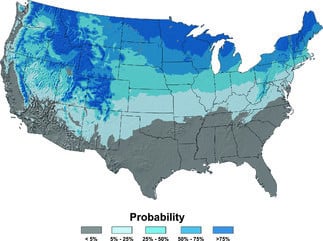
Between the 1961 to 1990 climate normals and the current 1991 to 2020 normals, NOAA has recorded a shrinking snow-on-the-ground zone. Cities that used to sit at 50 percent odds now sit closer to 35 percent. The northern edge of “reliable” snow has crept north by roughly a hundred miles over the last three decades. That is not a doomsday reading, it is a math-based one: warmer late-Decembers mean more precipitation falls as rain and more of what falls as snow melts before Christmas morning.
The practical outcome for a household: if you live in the mid-Atlantic, the interior South, or the Pacific Northwest lowlands, a white Christmas has always been a coin toss at best, and today it is closer to a bad bet. Book the cross-country ski trip, do not count on the front-yard snowman.
What Does The Farmers’ Almanac Say About Christmas 2026?
Our Christmas forecast for 2026 is drawn from the long-range outlook we published last summer, built on our proprietary sunspot, tidal, and planetary-position formula. In broad strokes:
- Rockies and Plains: possible stormy weather, with heavy snow in the mountains.
- Pacific Northwest and the Southwest US: expected to turn unsettled, with possible snow across the high-terrain areas.
- Southeast US: dry, but unseasonably cold Yuletide, with possible frosts down to the Gulf Coast.
- Interior Northeast: a wintry mix looks likelier than a picture-postcard snowfall.
Once we get inside a week of Christmas, always pair a long-range outlook with your local National Weather Service forecast. For NOAA’s own climatological breakdown, visit the NCEI page here. Whatever the weather, we wish you all warm greetings for a Merry Christmas and a joyous holiday season.
Be sure to visit our Extended Forecast page to read what we’re predicting for this winter.
White Christmas Lyrics
I’m dreaming of a white Christmas
Just like the ones I used to know
Where the tree tops glisten
And children listen
To hear sleigh bells in the snow, oh, the snow
I said, I’m dreaming of a white Christmas
With every Christmas card I write
May your days be merry and bright
And may all your Christmas’ be white
(Let’s go, sticks, let’s go)
I said, I’m dreaming of a white, oh, Christmas
Just like the ones I used to know
Where the tree tops glisten
And the children listen
To hear sleigh bells in the snow
I’m dreaming of a white Christmas
With every Christmas card I write
May your days, may your days, may your days
Be merry and bright
And may all your Christmas’ be white
(Come on now, woo)
(J-man, up, up, up)
I’m dreaming of a white Christmas
With every Christmas card I write
May your days be merry and bright
And may all your Christmas’ be white
White Christmas lyrics are copyright Downtown Music Publishing, Tratore.

Frequently Asked Questions About A White Christmas
How does NOAA define a white Christmas?
NOAA calls it a white Christmas when at least 1 inch of snow is on the ground at 7 a.m. on December 25 at the nearest official weather station. The measurement uses the same standard snow ruler and the same reporting time used all year, so results are comparable across decades and cities.
Where are the highest odds of a white Christmas in the United States?
Northern Minnesota, upper Michigan, northern Maine, most of interior Alaska, the Sierras, and the higher Rockies all sit above 90 percent based on the 1991 to 2020 climate normals. International Falls, Marquette, Caribou, and Fairbanks are the reliable four in the lower 48 plus Alaska.
What are the odds of a white Christmas in New York City?
About 10 percent, based on NOAA’s 30-year averages. Snow already on the ground beats fresh snowfall on the day for most East Coast cities. Boston clocks in around 23 percent, Philadelphia around 8 percent, and Washington DC around 4 percent.
Where are the odds of a white Christmas essentially zero?
Los Angeles, San Diego, Phoenix, Miami, most of Florida, most of the Texas Gulf Coast, and the low deserts of the Southwest. A “green Christmas” is the norm in these places, and a snowy one is a once-in-a-generation story.
Are white Christmases becoming rarer?
Yes, on average. Comparing the 1961 to 1990 normals with the current 1991 to 2020 normals, NOAA has recorded declining snow-on-the-ground probabilities across much of the mid-latitude United States. Warmer late-Decembers mean more of what falls arrives as rain and more of what falls as snow melts before December 25.
What does the Farmers’ Almanac say about Christmas 2026 weather?
Our long-range outlook calls for stormy weather over the Rockies and Plains with possible heavy snow, unsettled conditions in the Pacific Northwest and Southwest highlands with mountain snow, and a dry but unseasonably cold Yuletide across the Southeast with possible frosts down to the Gulf Coast.
Does snow on the ground count if it fell on December 23?
Yes. NOAA’s white-Christmas standard measures snow depth at 7 a.m. on December 25, regardless of when the snow fell. That is why many parts of interior New England log a white Christmas even when the day itself is calm and clear.
Join The Discussion
Are you looking forward to a white Christmas this year?
Do you know all the White Christmas lyrics?


Caleb Weatherbee
Caleb Weatherbee is the official forecaster for the Farmers' Almanac. His name is actually a pseudonym that has been passed down through generations of Almanac prognosticators and has been used to conceal the true identity of the men and women behind our predictions.
- Caleb Weatherbee

- Caleb Weatherbee
- Caleb Weatherbee
- Caleb Weatherbee


Love it!