

Ray Geiger: A Look Back at Our Longest-Serving Editor
Ray Geiger was the Farmers’ Almanac’s 6th editor and the reason we have a Farmers’ Almanac today. Here's a look back, in photos, at his wonderful career.
Quick Reference: Ray Geiger
- Full name: Ray Geiger, Editor, Philom.
- Life dates: September 18, 1910 to April 1, 1994.
- Editor number: 6th editor of the Farmers’ Almanac.
- Tenure: 60 consecutive editions, the longest editorship in the Almanac’s history.
- Circulation growth: From 85,000 copies to more than 6.5 million during his run.
- Signature nickname: “Most Interviewed Man in America,” given by broadcaster Art Linkletter.
- Successor: His son, Peter Geiger, the Almanac’s 7th editor.
Ray Geiger sat in the editor’s chair at the Farmers’ Almanac for 60 consecutive editions. He is the reason the Almanac is still on newsstands, and the reason a small New England annual grew into a household name across North America. This look back keeps every photograph, every anecdote, and every line from our earlier tribute, and adds the editorial legacy and historical context that new readers ask about.
Ray Geiger, Editor, Philom.
September 18, 1910 to April 1, 1994.
Edited 60 consecutive editions of the Farmers’ Almanac.
Ray Geiger was the Farmers’ Almanac’s 6th editor and the reason we have a Farmers’ Almanac today. What follows are the highlights of a long, wonderful, and colorful career.
The abbreviation after his name, “Philom.,” is short for Philomath, a lover of learning. Almanac editors have carried that title for centuries. Ray wore it plainly. He was self-taught in weather, agriculture, and Americana, and he treated the Almanac’s readers as neighbors who deserved a straight answer.
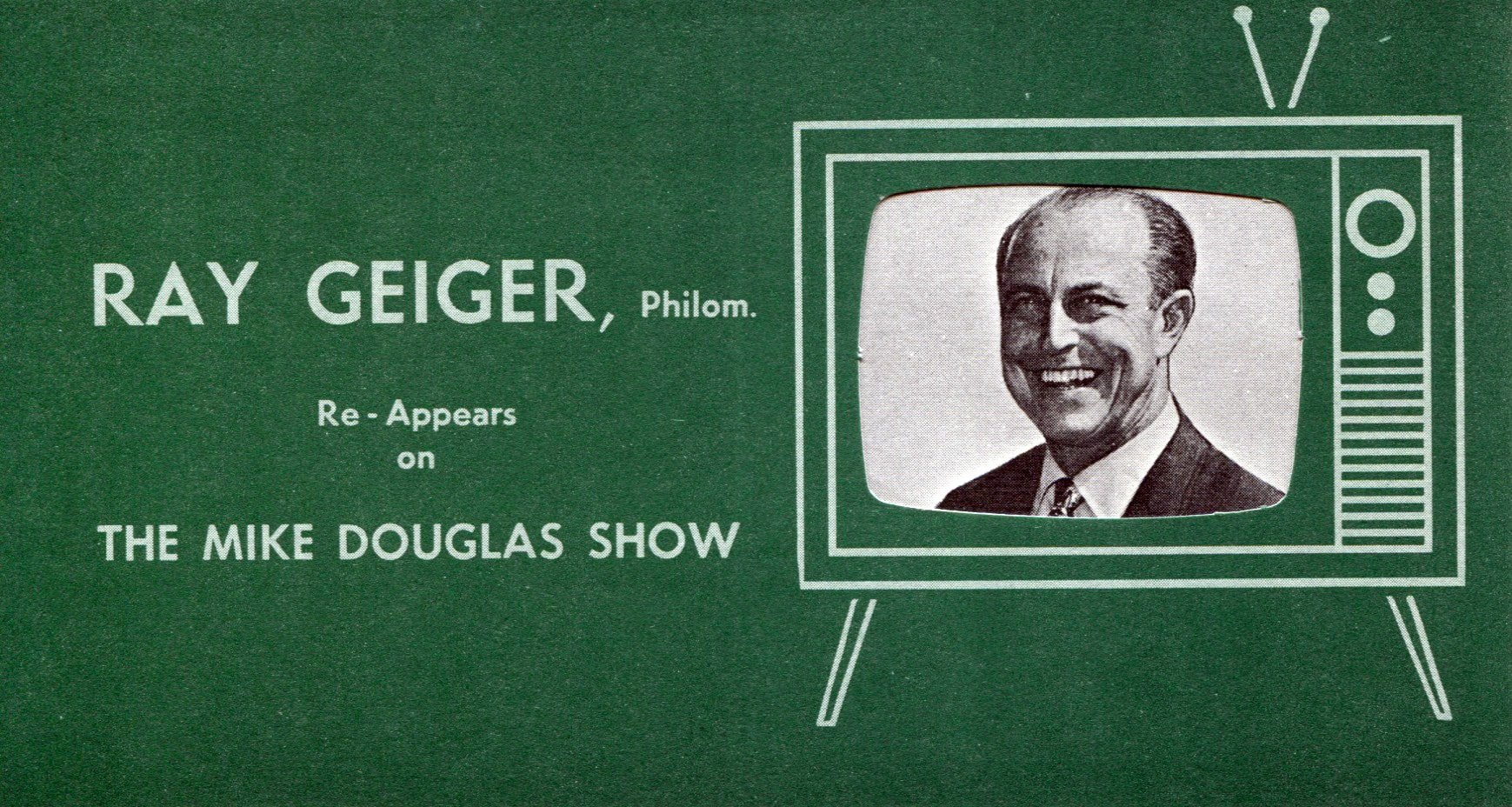
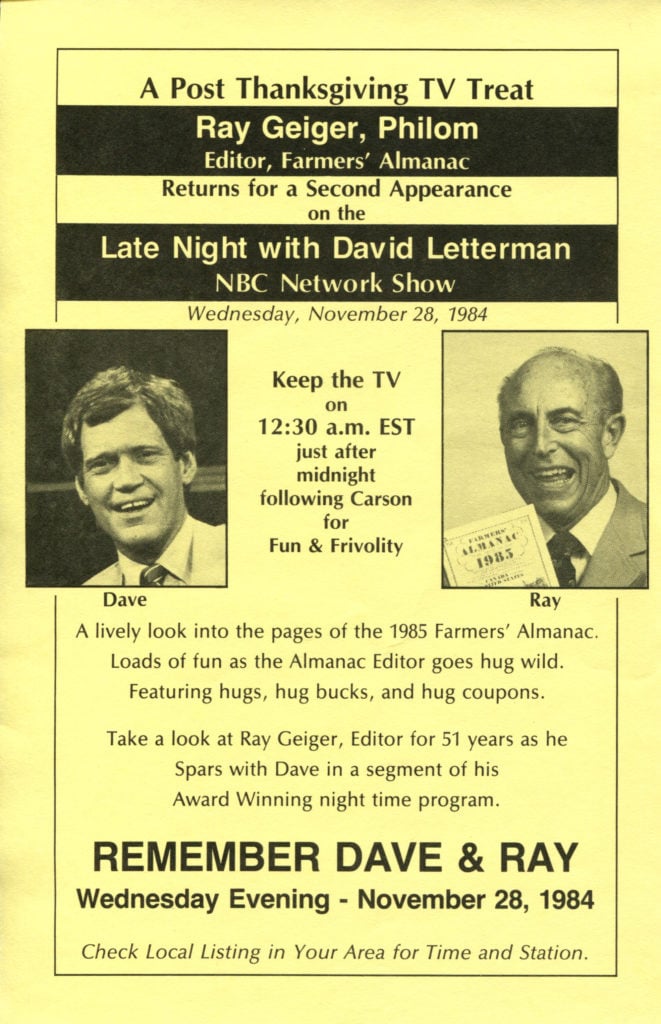
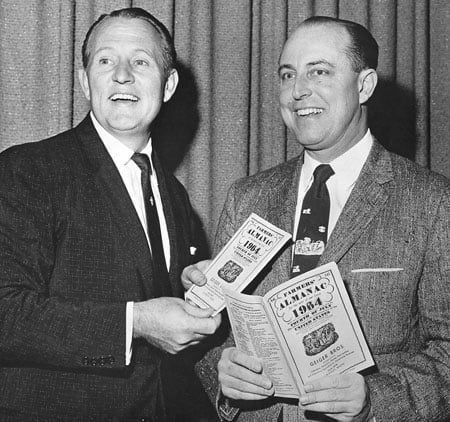
Dubbed the “Most Interviewed Man in America” by Art Linkletter
Ray participated in more than 30,000 interviews, touting the virtues and uniqueness of the Farmers’ Almanac to audiences everywhere. Radio hosts in every US and Canadian time zone learned to call Lewiston, Maine, in late August. That is when the new edition dropped, and Ray was ready with a printed rundown of the winter forecast, planting dates, and folklore stories they could read on-air.
He appeared on The Mike Douglas Show, Late Night with David Letterman, and countless morning programs. He rehearsed nothing and improvised nothing; he simply knew the book cover to cover. Broadcaster Art Linkletter, a name every reader over 40 will recognize, is the one who first called him “the most interviewed man in America.” The tag stuck for the rest of his career.
Marketing Genius
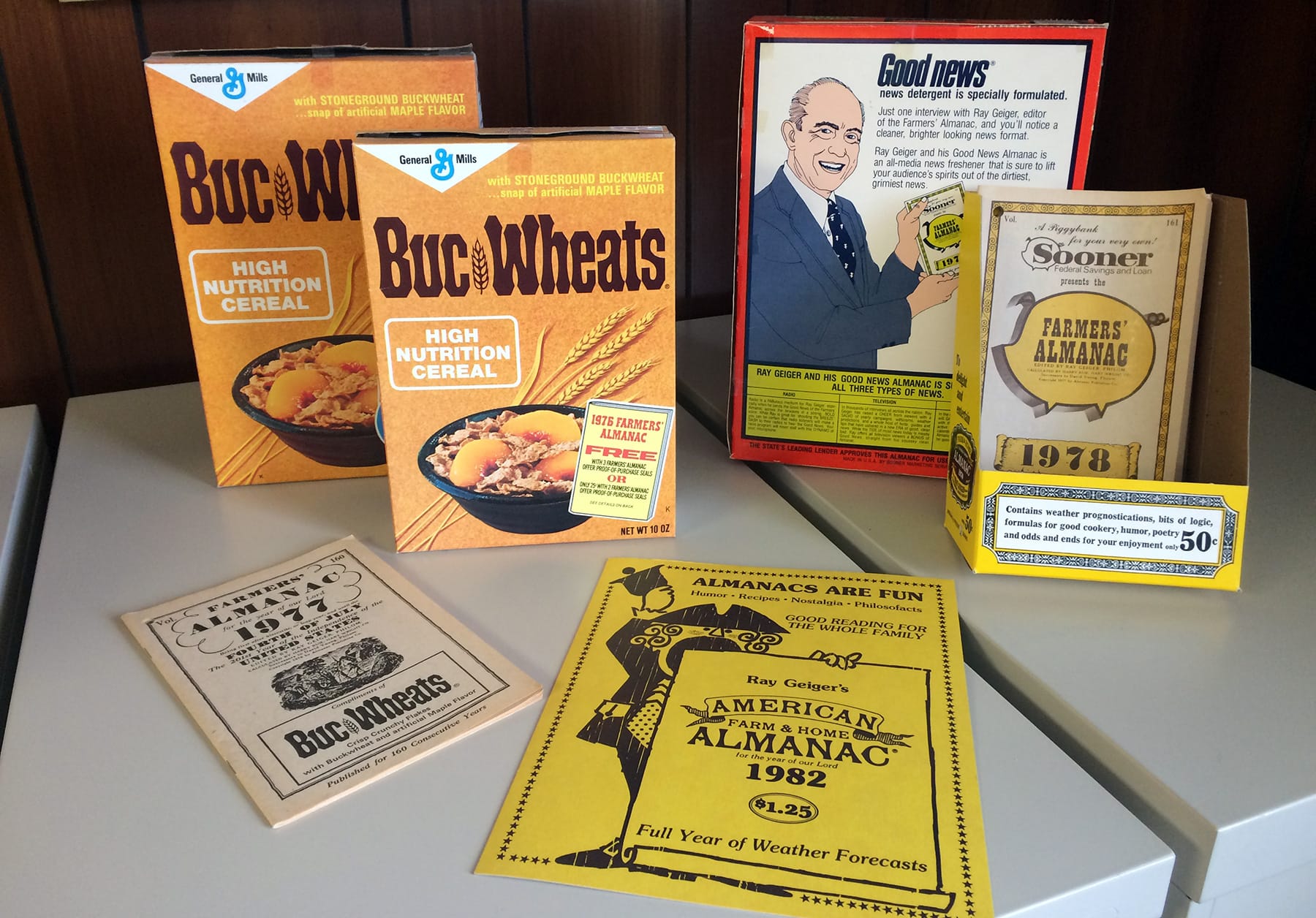
Ray was credited with growing the circulation of the Farmers’ Almanac from 85,000 copies to over 6.5 million. Many of those copies were sold as promotional and marketing products to a wide variety of clients: banks, feed stores, hardware chains, insurance agents, and small-town newspapers.
This was the branded-almanac trade. Each partner got its business name printed on the cover, and every customer who walked through the door got a copy. The idea kept the Almanac in more American kitchens than any other reference of its era. It also gave Ray a business reason to keep the forecast honest, the planting calendar reliable, and the folklore respectful. If any of those slipped, the client list would shrink the next year.
Historians of American print culture note that mass-market almanacs, once ubiquitous, faded fast during the second half of the twentieth century. The Encyclopaedia Britannica overview of the almanac traces how few titles survived the shift to radio, then television, then the web. The Farmers’ Almanac is one of the few that did. Ray’s promotional model is a big part of why.

Keen Sense of Humor
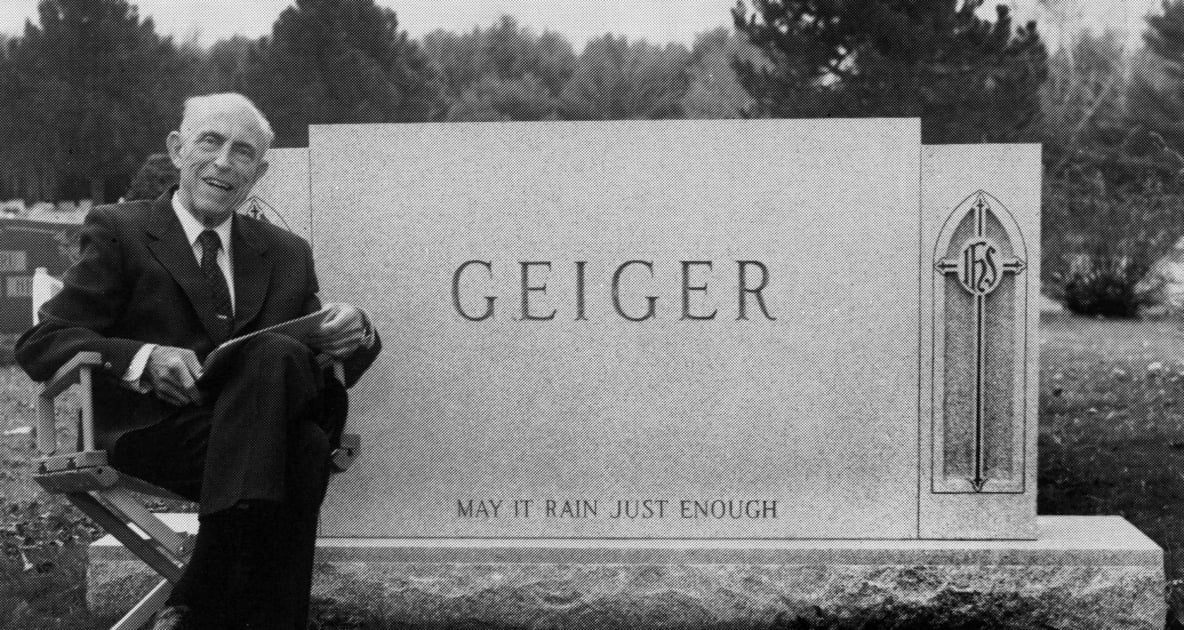
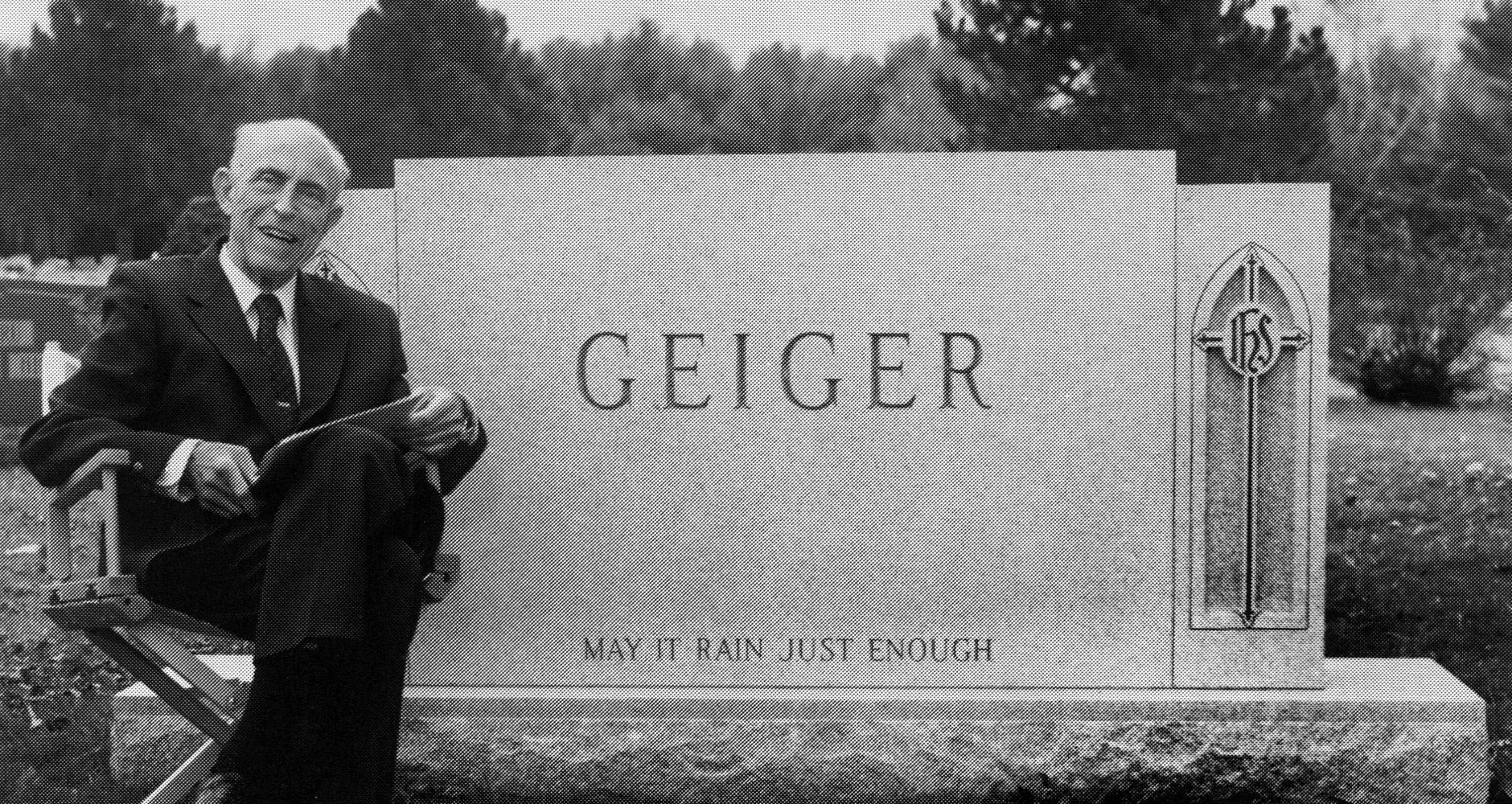
Ray held a “Predeceased Adventure” at his tombstone in 1990, complete with the following poem:
Friends I am delighted and really quite excited;
That you came to this unusual grave event;
For I’d rather have you gather as I write it;
Than to have you come to see me when I am dead.
The event was pure Ray. He rented a tent, invited friends and family, and greeted every guest beside his own headstone. That stone is engraved with the closing line “May It Rain Just Enough.” It is the same line he used to sign off letters to readers who wrote asking about drought, flood, and the wisdom of the seasons.
Ever the Showman
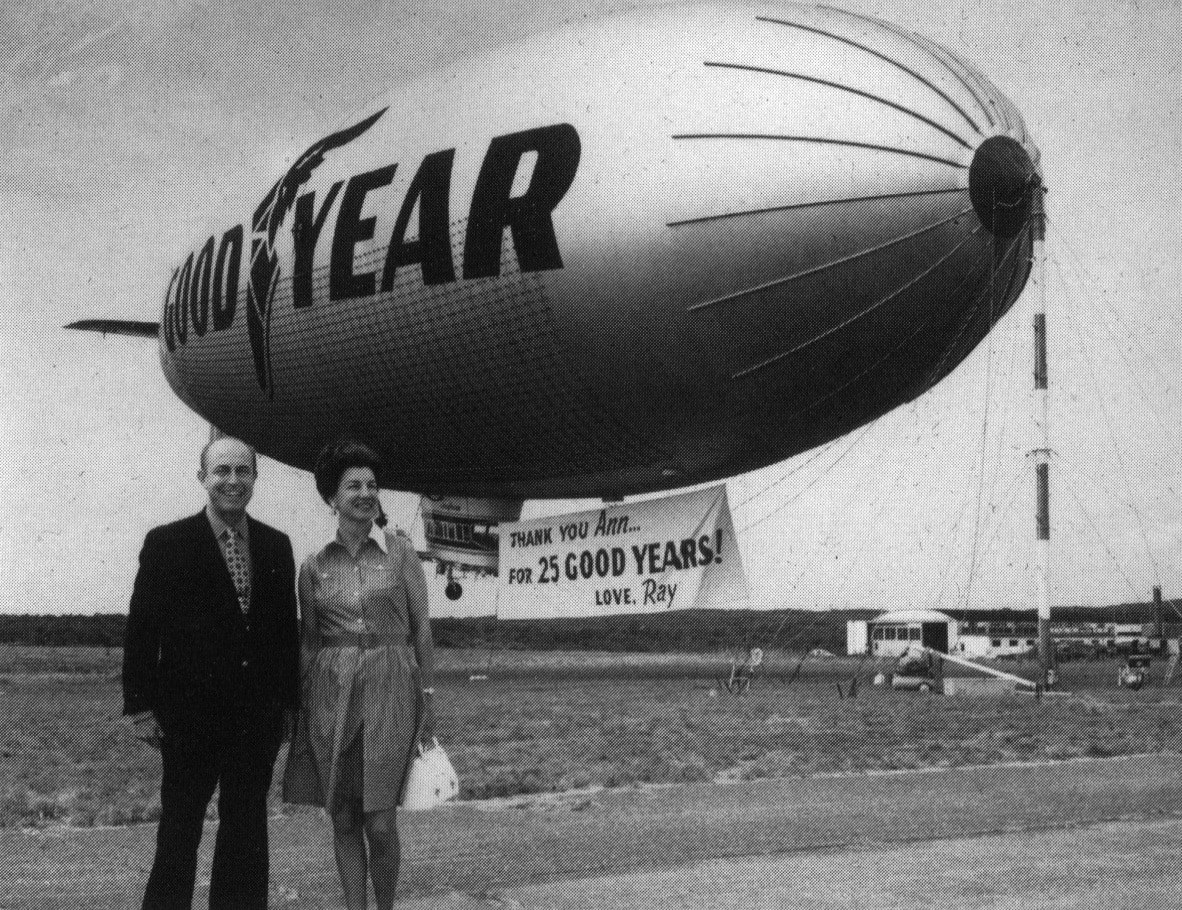
Ray celebrated his 25th wedding anniversary by surprising wife Ann with the Goodyear Blimp. The photo was picked up in papers worldwide. Ann had walked out the front door expecting a quiet dinner. Ray had arranged for the blimp to fly over the yard trailing an anniversary message. It landed in a nearby field so the family could climb aboard.
He treated marketing the same way he treated forecasting: pick a signal readers will remember, pair it with a real story, and do not overexplain. A blimp over a New England yard did more for the brand than any paid ad of the era.
Ray’s Editorial Legacy at the Farmers’ Almanac
Ray joined the Almanac in 1934 and took the editor’s chair for the 1935 edition. He held it until 1994, a run of 60 consecutive editions that no editor before or since has matched. His fingerprints are on almost every feature readers still open the book for today.
- The long-range weather forecast. Ray defended the Almanac’s math-based, sun-and-moon-cycle formula against every wave of new meteorology. He insisted the forecast be printed to the day, for every US and Canadian region, and he took the phone call when a reader disagreed.
- Best Days by the Moon. Ray kept the Best Days feature front-and-center, printed month by month, so a reader could plan a haircut, a wedding, a first sowing, or a fencing job by the same rules his grandfather had used.
- Regional planting calendars. Under Ray, planting dates were broken out for US frost zones and Canadian growing regions. That regional detail is still the reason gardeners buy the book.
- Folklore paired with plain science. Ray printed the weather signs, the persimmon-seed rule, the woolly bear, but always with a plain caveat about what the science does and does not support.
- Homely humor. The corny jokes, the “if the groundhog sees his shadow” bits, the puns in the calendar margins, all classic Ray. He believed a reference book could earn a reader’s loyalty by making them smile.
He also worked closely with editorial contributors like Caleb Weatherbee, the pen name still used for the Almanac’s forecaster. The name shields the working meteorologist behind the forecast from unwanted phone calls, a Ray-era tradition that continues.
Historical Context: The Farmers’ Almanac When Ray Took Over
Ray inherited a book that was more than a century old. The Farmers’ Almanac was founded in 1818 by editor David Young and publisher Jacob Mann in Morristown, New Jersey. By the time Ray sat down at the desk in 1934, five editors had come before him, and the American almanac market was crowded, thin-margin, and slowly collapsing.
The book he took charge of was small, black-and-yellow, and printed on newsprint that yellowed within a year. Radio was replacing the almanac as the country’s first source for weather and daily wisdom. Ray’s response was not to modernize the book out of its own tradition. He kept the yellow cover, the hole in the corner for hanging on a nail in the kitchen or barn, and the promise that every date, tide, and moon phase would still be printed to the minute.
He also moved the offices to Lewiston, Maine, where the Almanac is still based today. Lewiston sits in the middle of the northern New England climate the Almanac’s early forecasts were built around. Ray felt strongly that the book needed to be edited by people who lived under the same skies its readers did.
For readers who want to trace the whole timeline, our Timeline of Farmers’ Almanac history lays every editor, every publisher change, and every milestone side by side. You can also read about the long-range weather forecast Ray defended for 60 years, and the Best Days Calendar he kept in every edition.
Why Ray’s Approach Still Shapes the Almanac Today
Everything the Almanac publishes today, from the extended forecast to the moon-sign planting calendar to the Best Days for canning, traces back to editorial rules Ray codified. He held the line on three things, and those three still hold.
- Every fact gets a date anchor. No claim about weather or planting appears in the Almanac without a specific date, region, and source. Ray called this the “when and where” test.
- Every forecast owns its accuracy. The Almanac has always printed an honest accuracy figure. Ray refused to inflate it. That number sits around 80 percent today, and the book still owns the misses in print.
- Every reader gets a plain-English answer. No jargon, no fluff, no talking down. Ray edited every page against a plain-English standard he called “kitchen-table clear.”
Peter Geiger, Ray’s son, took over as 7th editor in 1994 and has led the book ever since. He inherited the desk, the rules, and the yellow cover. Anyone who has read a recent edition can trace Peter’s editorial hand right back to his father’s.
Passing the Torch
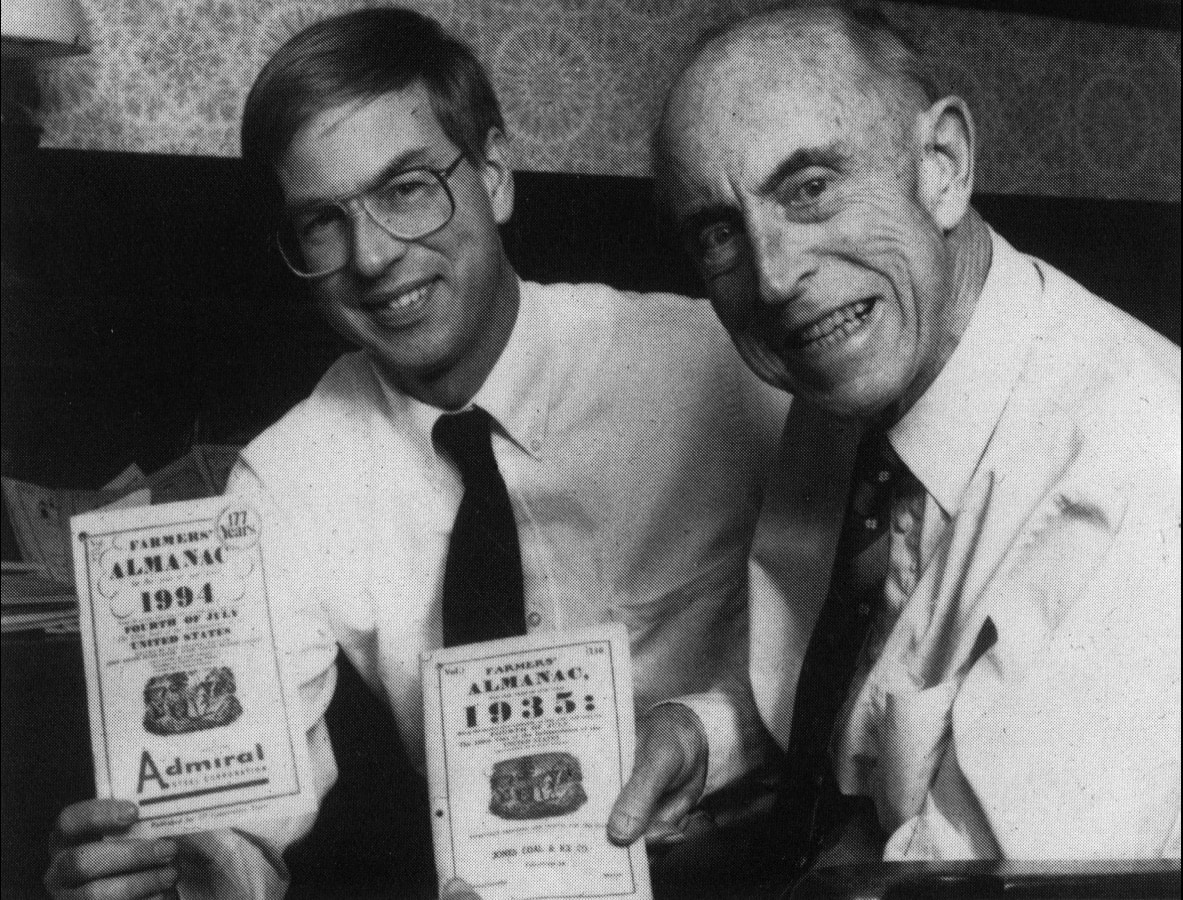
Ray and his son Peter, the Almanac’s 7th editor, holding Ray’s first and last editions. The photo was taken not long before Ray’s final edition went to press. Peter has now edited more editions than any Almanac editor except his father.
Want to see more Farmers’ Almanac history? Visit a Timeline of our growth.
Frequently Asked Questions About Ray Geiger
Who was Ray Geiger?
Ray Geiger was the 6th editor of the Farmers’ Almanac. He was born September 18, 1910 and died April 1, 1994. He edited 60 consecutive editions of the Almanac, from the 1935 edition through 1994, the longest tenure of any editor in the book’s history.
How long did Ray Geiger edit the Farmers’ Almanac?
Sixty consecutive editions. He joined the staff in 1934, took the editor’s chair for the 1935 edition, and continued in that role until his death in 1994. No editor before or since has matched that run.
Why was he called the Most Interviewed Man in America?
Broadcaster Art Linkletter gave him the title. Ray participated in more than 30,000 interviews across radio and television during his career, promoting the Farmers’ Almanac to audiences from small AM stations to national programs like The Mike Douglas Show and Late Night with David Letterman.
How much did circulation grow under Ray Geiger?
The Farmers’ Almanac grew from 85,000 copies to more than 6.5 million during Ray’s tenure. Much of that growth came from branded-almanac partnerships, in which a bank, feed store, or hardware chain would sponsor a custom cover and hand copies out to customers.
What does “Philom.” after his name mean?
Philom. is short for Philomath, a lover of learning. It is a traditional honorific used by almanac editors going back centuries. It signaled to readers that the editor was self-taught and widely read across weather, agriculture, astronomy, and folklore.
Who succeeded Ray Geiger as editor?
His son, Peter Geiger, took over as the 7th editor in 1994 and still holds the role today. Peter carries forward the same editorial rules his father set: date-anchored facts, an honest accuracy figure on the long-range forecast, and plain-English writing.
What is engraved on Ray Geiger’s headstone?
The line “May It Rain Just Enough” is engraved on his headstone. Ray used the same phrase to sign off letters to readers who wrote in about drought, flood, and the wisdom of the seasons.
What was Ray Geiger’s Predeceased Adventure?
In 1990, Ray hosted a living wake at his own tombstone. He rented a tent, invited friends and family, and greeted every guest beside the headstone. He read an original poem that opened with the line “Friends I am delighted and really quite excited.” It was pure Ray: a bit of theater, a bit of humor, and a reminder to gather while there is still time.

This article was published by the Staff at FarmersAlmanac.com. Any questions? Contact us at [email protected].
- Farmers' Almanac Staff

- Farmers' Almanac Staff

- Farmers' Almanac Staff

- Farmers' Almanac Staff




Awesome I love stuff like this. I would love to see if y’all got the first Almanac ever written?