

Chariot of the Sun: Greek Sun-God Folklore and the Science
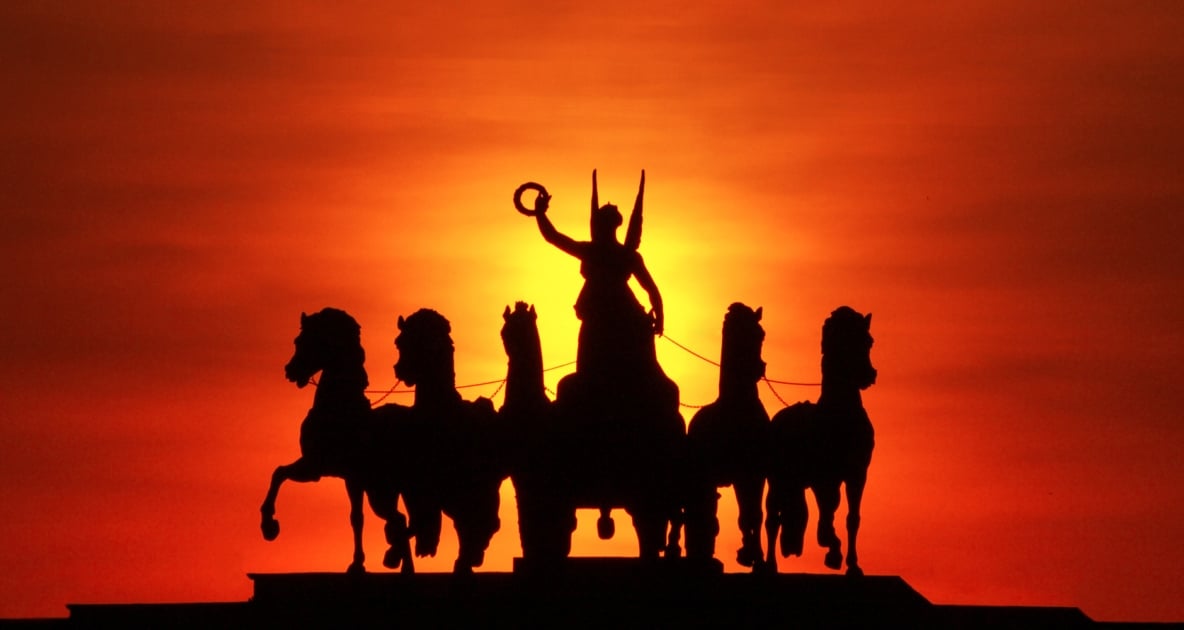
The ancient Greeks believed the Sun traveled across the sky in a flaming chariot pulled by four fiery, winged horses. Learn more!
Quick Reference
- The myth: the Greek sun-god Helios drove a fiery chariot pulled by four winged horses across the sky each day, from east to west.
- The horses: Pyrois, Aeos, Aethon, and Phlegon. All four named in Hesiod and later Greek poetry.
- The science: the sun appears to move because Earth rotates on its axis once every 24 hours. The illusion of solar motion is a product of our spinning planet, not the sun’s actual position.
- How fast we are moving: Earth orbits the sun at about 67,000 mph. Earth’s surface at the equator spins at about 1,037 mph from the rotation alone.
- Why the myth lasted: for any culture that assumed Earth was stationary, the chariot was the most economical explanation for what the sky obviously did.
The image of the sun riding a horse-drawn chariot across the sky is one of the most enduring metaphors humanity has ever produced. The Greeks gave it a god named Helios, four named horses, and a daily route from east to west that ran the length of the world. The Egyptians had a different version with the god Ra in a solar boat. Hindu, Norse, and Slavic mythology each have their own variations on the same idea: the sun is a thing carried across the heavens by some powerful, divine driver. Beautiful as the imagery is, the science of why the sun appears to move is something else entirely. Here is the chariot, the four-horse roster, and the modern understanding of what is actually moving when the sun rises and sets.
The Greek Legend of Helios
Helios was the personification of the sun in early Greek mythology. He was described as a handsome and charming young god with a shining crown of golden rays around his head. Each morning he rose from the eastern horizon driving a chariot of fire pulled by four winged horses. The four horses were named Pyrois (the Fiery), Aeos (the Dawn), Aethon (the Burning), and Phlegon (the Blazing). Together they pulled the sun across the dome of the sky from sunrise to sunset, shining their light on the people of Earth below.
At sunset, Helios descended into the bowl of a great golden cup beneath the western ocean. The cup ferried him through the underworld to the eastern horizon overnight, where he was rested and ready to begin the journey again at dawn. The Hesperides (the nymphs who tended the western edge of the world) were keepers of the place where the chariot landed. The whole cosmology had a closed-loop logic that worked beautifully as long as you accepted the basic premise: the Earth was stationary, and everything else in the sky moved around it.
The Greek Solar Stories
Helios appears in many Greek stories, often as a witness to events the other gods would prefer hidden. In Homer’s Odyssey, Odysseus’s crew slaughter cattle that belong to Helios on the island of Thrinacia, despite explicit warning not to. Helios complains to Zeus, and the gods drown the crew at sea (everyone except Odysseus, who had not eaten the cattle). The story is one of the older Western narratives about consequences for breaking a sacred prohibition.
The most tragic Helios story is the one about his son, Phaeton. Phaeton was a half-mortal child of Helios. As a teenager, Phaeton begged his father for permission to drive the chariot for one day to prove his divine parentage. Helios reluctantly agreed. Phaeton lost control of the four horses almost immediately. The chariot careened too high (freezing the Earth) and then too low (scorching it, creating the deserts of North Africa according to one telling). Zeus, watching the disaster, struck Phaeton dead with a thunderbolt to save the world. The boy’s body fell into the river Eridanus. The story is sometimes read as the Greek explanation for the Sahara Desert.
Why So Many Cultures Made the Sun a Chariot
The chariot-of-the-sun image is not unique to Greek culture. Variations of the same metaphor appear across the ancient world:
- Egyptian: Ra rode a solar barge through the sky each day, then through the underworld each night.
- Hindu: Surya drives a chariot pulled by seven horses (or by one horse with seven heads, depending on the text).
- Norse: the goddess Sol rides a chariot pulled by horses named Arvak and Alsvid, fleeing the wolf Skoll who chases her across the sky each day.
- Slavic: the sun-god Khors drives a horse-drawn chariot in some traditions; in others, the sun is a daughter of the chief god, riding her own chariot.
- Roman: Sol Invictus, the imported sun-god of late antiquity, was widely depicted in chariot iconography that the Greeks would have recognized immediately.
The convergence is striking. Cultures that were not in regular contact with each other produced almost identical metaphors for the same phenomenon. The most likely explanation is that the metaphor is intuitive given the assumptions early peoples shared: the Earth is stationary, the sun obviously moves across the sky, and a chariot or boat is the most economical way to imagine an object that visibly traverses an arc each day.
The Science: What Is Actually Moving
The sun is not moving across our sky. We are. Earth rotates on its axis once every 24 hours, completing a full turn from west to east. As the planet turns, the side facing the sun changes. From any fixed point on the surface, the sun appears to rise in the east, climb to a noon peak, and set in the west. The actual motion is Earth’s: we are turning toward the sun in the morning and away from it in the evening, at a rotational speed of about 1,037 mph at the equator.
Underneath the rotation, two larger motions are also happening:
- Earth orbits the sun at about 67,000 mph (107,000 km/h). One full orbit takes 365.25 days, which is the Earth-year.
- The sun and the entire solar system orbit the center of the Milky Way galaxy at about 514,000 mph. One galactic orbit takes about 230 million years.
- The Milky Way itself is moving through space relative to nearby galaxies at about 1.3 million mph.
Add it all up and Earth is moving at well over a million miles per hour through space at any given moment. We do not feel any of it because we are moving with the planet, the planet is moving with the solar system, and the solar system is moving with the galaxy. Everything is moving together, so the relative motion within our reference frame is zero.
From Geocentric to Heliocentric: The Long Argument
For most of human history, the assumption that Earth was the still center of the universe felt obviously correct. Drop a stone, it falls straight down. Walk across a field, the ground does not shift under your feet. The sun, moon, and stars clearly trace arcs across the sky each day. Why would anyone assume otherwise? The Greek philosopher Aristarchus of Samos proposed a heliocentric (sun-centered) model in the 3rd century BC, but his idea was rejected by most contemporaries because it violated common sense.
The geocentric model held for nearly 1,800 more years. In the 16th century, Polish astronomer Nicolaus Copernicus revived the heliocentric idea with mathematical detail that finally made the case persuasive. Galileo’s telescope observations in the early 1600s (especially Jupiter’s moons orbiting Jupiter) provided the visual proof. By 1700 the scientific consensus had shifted decisively to heliocentric. By 1900 the new question was where in the galaxy the sun is, and by 2000 it was where in the universe the galaxy is. The chariot of Helios looks quaint by comparison, but the basic problem the Greeks were trying to solve (why does the sun move across the sky?) was the right question. They just had the geometry inverted.
The Sun Today: What We Actually Know
The sun is a 4.6-billion-year-old G-type main-sequence star, about 92.96 million miles from Earth on average. Its diameter is roughly 109 times Earth’s. Its mass is 333,000 times Earth’s. Its surface temperature is about 5,500 degrees Celsius (10,000 degrees Fahrenheit). Its core temperature is around 15 million degrees Celsius. It produces energy through nuclear fusion, converting hydrogen to helium at a rate of 4.3 million tons of mass per second.
The energy reaching Earth (about 174 petawatts of incoming radiation) drives every weather pattern, every plant, and every food web on the planet. The Greeks were right that the sun is the source of life on Earth. They just attributed the daily motion to the wrong thing.

What the Chariot Got Right and Wrong
For folklore that pairs with this solar lore from the European weather-lore tradition, see our April weather lore and animal weather folklore archives. The chariot myth got the sun’s importance exactly right. The Greeks understood that the sun was the source of light, warmth, and life on Earth. They got the daily route right (east to west). They got the pattern of the sun rising in the morning and setting in the evening right. They even got the seasonal variation right (the chariot’s path is higher in summer and lower in winter, which is exactly what the sun’s apparent path does because of Earth’s axial tilt).
What they got wrong was the mechanism. There is no chariot. There are no four winged horses. The sun does not move at all relative to its position; it is the Earth that turns, and our perspective from the surface produces the apparent motion. The myth was an excellent description of the appearance, with a fanciful explanation of the cause. Modern science kept the appearance and replaced the cause.
The Greeks also gave us a vocabulary that has outlived the myth. “Helios” became the root of “helium” (the gas first discovered by its absorption lines in solar spectra), “heliocentric” (sun-centered), “heliotrope” (a plant that turns to follow the sun), and many other modern scientific terms. The chariot is gone. The horses are gone. The god has retired. But Helios is still in the dictionary, and the sun still rises in the east.
For more solar-related folklore that has held up alongside the science, see our sun halo piece on the 22-degree halos that appear around the sun in cirrostratus clouds. For the optical-physics cousin (rainbows in their many forms), see our types of rainbows piece. For the deep-history reference on Helios, the Theoi Project maintains a comprehensive Helios reference page drawn from primary Greek sources.

Frequently Asked Questions
Who was Helios in Greek mythology?
Helios was the personification of the sun in early Greek mythology, depicted as a young god who drove a four-horse chariot of fire across the sky each day from east to west. He was sometimes conflated with Apollo, though originally they were distinct deities.
What were the names of Helios’s four horses?
Pyrois (the Fiery), Aeos (the Dawn), Aethon (the Burning), and Phlegon (the Blazing). All four are named in Hesiod and later Greek poetry.
Why does the sun appear to move across the sky?
Earth rotates on its axis once every 24 hours. From the surface, the apparent motion of the sun is caused by Earth turning, not by the sun moving. The sun’s actual position relative to Earth changes only slowly, on a yearly cycle as Earth orbits.
How fast is Earth actually moving?
Earth’s surface at the equator spins at about 1,037 mph from rotation alone. Earth orbits the sun at about 67,000 mph. The solar system orbits the Milky Way center at about 514,000 mph. Add it all up and Earth is moving over a million mph through space at any moment.
When did people figure out that Earth orbits the sun?
Aristarchus of Samos proposed it in the 3rd century BC but was rejected. Nicolaus Copernicus revived the heliocentric model in the 1540s. Galileo’s telescope observations in the early 1600s provided the visual proof. The scientific consensus settled by about 1700.
Did other cultures have a sun chariot myth?
Yes. Egyptian (Ra in a solar barge), Hindu (Surya with seven horses), Norse (Sol pursued by the wolf Skoll), Slavic (Khors), and Roman (Sol Invictus) all have variations on the same metaphor. The convergence reflects the shared assumption of a stationary Earth.
What does the Phaeton story explain?
In some Greek tellings, Phaeton’s loss of control of the sun chariot scorched parts of the Earth as he flew too close, creating the deserts of North Africa. The story functioned as a folk explanation for the Sahara and as a moral lesson about the dangers of overreaching.


Jaime McLeod
Jaime McLeod is a longtime journalist who has written for a wide variety of newspapers, magazines, and websites, including MTV.com. She enjoys the outdoors, growing and eating organic food, and is interested in all aspects of natural wellness.
- Jaime McLeod

- Jaime McLeod
- Jaime McLeod
- Jaime McLeod





“Don’t knock the weather. If it didn’t change once in a while, nine out of ten people couldn’t start a conversation.”
Kin Hubbard (1868 – 1930)
Which is why I enjoy this site. It gives a different perspective to the conversation.
Thank you, Jaime McLeod. (is it pronounced “mc cloud”?)
Jack
Hi Jack,
Yep, it’s pronounced “MacCloud.” You’ll often see it spelled that way, actually. It’s just an Americanization of the same ancestral name.