

St. Swithin’s Day (July 15): Will It Rain for 40 Days?
According to folklore, the weather on St. Swithin's Day determines the weather for the next 40 days. Learn why.
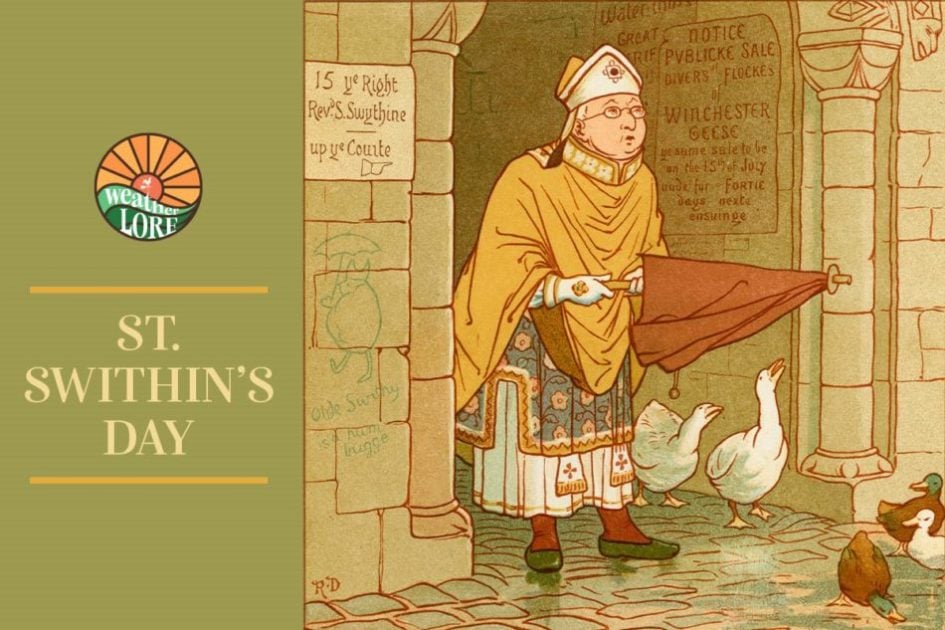
Quick Reference: St. Swithin’s Day
- When: July 15 every year (also spelled St. Swithun’s Day).
- The rule: rain on July 15 is said to bring 40 more days of rain; a fair, dry July 15 promises 40 dry days.
- Who he was: a 9th-century Anglo-Saxon Bishop of Winchester, England, who died in 862.
- The legend: a storm is said to have broken out when his body was moved inside the cathedral on July 15, 971, and rained for 40 days.
- Any truth to it? No 40-day stretch of rain or sun has ever been found in the record. It is more legend than forecast.
What’s the weather doing outside your window today? July 15th is St. Swithin’s Day, a church holiday honoring St. Swithin (also spelled Swithun), and according to folklore, the weather on this day will determine the weather for the next 40 days. It is one of the oldest weather sayings still quoted in the English-speaking world, and it comes with a rhyme that has been passed hand to hand for centuries.
St. Swithin’s day if thou dost rain,
Traditional, recorded in English since at least the 16th century. “Nae mair” is Scots for “no more”
For forty days it will remain;
St. Swithin’s day if thou be fair,
For forty days ’twill rain nae mair.
Who Was St. Swithin?
St. Swithin was a medieval Ango-Saxon bishop who lived in the 9th century and died as the Bishop of Winchester in 862. He was buried, according to his wishes, outside the walls of the Cathedral, “where the rain could fall and comfort him” and “steps of passersby might fall on his grave.”
But over a century later, on July 15, 971, due to an expansion of the Cathedral, his body was removed and placed inside the cathedral, contrary to his wishes. According to legend, after his body was moved inside, a terrible storm ensued. Heavy rain stopped the priests from doing their work. They could not resume until the next day, but yet the rain continued for 40 days. Thus the saying seems to be more legend than weather prediction.
In addition to his role in this old lore, St. Swithin is also one of the saints traditionally prayed to during periods of drought. In parts of England the day was once marked at the market too, since old wisdom held that apples were not ready to pick until St. Swithin had “christened” them with a July rain.

Rain Saints Around the World
St. Swithin is not the only saint with a hand on the rain barrel. Across Europe, farming communities pinned their summer worries to a single day on the calendar, and the number 40 shows up again and again. The saints and dates change with the border, but the shape of the belief stays the same: watch the sky on one key day, and you will know the weeks to come.
The French version even rhymes like ours: “S’il pleut a la Saint-Medard, il pleut quarante jours plus tard,” which folks translate as “If it rains on St. Medard’s Day, it will rain 40 days later.” If you enjoy the way these old sayings travel, our roundup of 10 common superstitions shows how many everyday beliefs began the same way, as a neighbor’s rule of thumb worth remembering.
Is There Any Truth To It?
Like many weather folklore sayings, the St. Swithin’s Day legend has been passed down from generations. And as far as record-keeping goes back, there hasn’t been rain (or sun) for 40 days following the weather on St. Swithin’s Day that historians can locate. While the thought of 40 days of rain isn’t likely very appealing to most, chances are, it doesn’t sound too bad to those experiencing drought conditions.
There is a kernel of weather sense buried in the lore, though. By the middle of July, the high-altitude band of fast wind known as the jet stream tends to settle into a steadier position over the British Isles. When it parks to the north, warm and dry weather can hold for weeks. When it parks to the south, one damp Atlantic system after another rolls through, the kind of unsettled summer weather that feels like it will never quit. So the weather around mid-July often does hint at the pattern for the rest of the season, not because of a saint, but because of where that river of wind sets up. You can read more about the day’s history and its patron in the Encyclopaedia Britannica entry on St. Swithin’s Day.
Here at the Almanac we take folklore seriously without taking it literally. A single day cannot lock in 40 days of weather, and no forecaster would stake a hay harvest on it. For a season’s worth of planning we lean on our long-range weather forecast, which is built on a math-based formula we have used for more than 200 years. For those of you sweating it out under hot, dry skies, here’s hoping, in the name of St. Swithin, that you get some rain soon!
How to Test the St. Swithin’s Day Rule Yourself
The best part of a weather saying is that you can put it to the test in your own backyard. It costs nothing and makes a fine project for a curious child.
- On July 15, write down whether it rains where you live, and how much.
- Mark the next 40 days on the calendar, running to about August 24.
- Keep a simple daily tally: wet day or dry day. A rain gauge or a coffee can on the fence post works fine.
- At the end, count the wet days against the dry ones and see how St. Swithin did.
Do not be surprised if the saint misses. Folklore like this is worth preserving and testing, not worshipping, and half the fun is finding out for yourself. Share your own tally in the comments, and tell us whether your July matched the legend.
Read about the Man Who Could Make It Rain.

St. Swithin’s Day: Frequently Asked Questions
When is St. Swithin’s Day?
St. Swithin’s Day falls on July 15 every year. It is a church feast day honoring St. Swithin, whose name is also spelled Swithun, the 9th-century Bishop of Winchester in England.
What does the St. Swithin’s Day weather legend say?
The saying holds that if it rains on July 15, it will rain for the next 40 days, and if the day is fair, 40 dry days will follow. The old rhyme puts it this way: “If on St. Swithin’s Day, ye do rain, for forty days, it will remain.”
Where did the St. Swithin’s Day legend come from?
St. Swithin asked to be buried outside Winchester Cathedral, where rain could fall on his grave. On July 15, 971, his body was moved inside during an expansion, and legend says a great storm broke out and rained for 40 days, as if the saint were protesting the move.
Is the St. Swithin’s Day rain prediction actually true?
No. As far back as records go, historians have never found a stretch of 40 straight days of rain or sun following July 15. The lore does brush up against real weather science, since the jet stream often settles into a steady summer position by mid-July, but a single day cannot lock in 40 days of weather.
Do other countries have a rain saint like St. Swithin?
Yes. Scotland marks St. Martin Bullion’s Day on July 4, France watches St. Medard on June 8 and St. Gervais on June 19, and Germany keeps Seven Sleepers’ Day on June 27. Several of these traditions predict rain for the next 40 days, just like the English version.
How can I test the St. Swithin’s Day saying at home?
Note whether it rains on July 15, then keep a simple wet-or-dry tally for the next 40 days, running to about August 24. Count the wet days against the dry ones at the end and see how the saint did. It is a fine, low-cost weather project for kids and gardeners alike.


This article was published by the Staff at FarmersAlmanac.com. Any questions? Contact us at [email protected].
- Farmers' Almanac Staff

- Farmers' Almanac Staff

- Farmers' Almanac Staff

- Farmers' Almanac Staff



My grandad talked about the heat here in Bloomington
This is also very true… If a woman knows about the week she gets pregnant start from that week even if the full moon is in that week count each full moon from that week she conceived thru every month until she counts 10 full moons and her baby will be born in the week of her 10th full moon…. If she knows the exact day she conceived count 10 full moons from that day and the baby will be born within 72 hours from the last(10th) full moon. COUNT ONLY THE FULL MOONS EVEN IF ONE MONTH HAS 2 IN IT YOU COUNT BOTH.
We’re having lots of rain in the Deep South right now and that’s okay by me. Please, just slow down the rate at which the grass grows.
Oh please our Heavenly Father God, let it rain today, so it shall renew & refresh all our land!!!!!
The Thunder Moon came in shortly after 2:30 A.M., accompanied by long, low drumrolls of distant thunder. Today, the famous I-4 Corridor/ Thunder Road storms set in, and we should, indeed, have them every day until September… not because of blessed St. Swithin, but because of the Florida rainy season.