
Wolf Moon 2026: January Full Moon Date, Time, and Folklore
Why is January's Full Moon is named after a wolf?
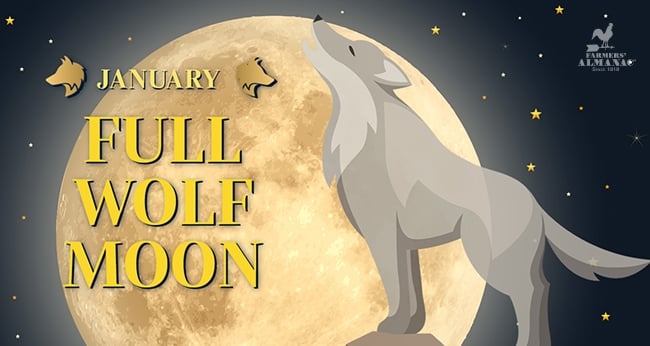
Quick Reference: Wolf Moon 2026
- Date: Saturday, January 3, 2026
- Peak illumination: 5:03 a.m. EST (2:03 a.m. PST, 10:03 UTC)
- Most common name: Wolf Moon
- Alternate names: Old Moon, Moon After Yule, Ice Moon, Manidoo-Giizisoons (Little Spirit Moon)
- Rule of thumb: the Wolf Moon is the first full Moon of the calendar year
- Sky bonus the same week: Quadrantids meteor shower peaks the night of January 3 into the morning of January 4
The Wolf Moon arrives on Saturday, January 3, 2026 at 5:03 a.m. Eastern Standard Time (2:03 a.m. PST, 10:03 UTC). It is the first full Moon of 2026 and a low, bright lantern over the longest nights of the year. The full Moon in January happens when there are cold, long nights in the Northern Hemisphere, a time when the ground is frozen and winds whip the snow around. Trees and shrubs are deep into their dormancy and wildflower seeds wait for warmer weather to sprout. It is time for the soil to rest before the next season of life-giving growth. Above ground, howls break the silent nights, and that is how this Moon got its widely used name.
Full Moon January 2026: Saturday, January 3
Peak Illumination: 5:03 a.m. Eastern Standard Time

When Is the Wolf Moon 2026?
The Wolf Moon reaches peak illumination on Saturday, January 3, 2026 at 5:03 a.m. EST. That is 4:03 a.m. CST, 3:03 a.m. MST, 2:03 a.m. PST, and 10:03 Coordinated Universal Time. The Moon will look full to the naked eye for two to three nights either side of that peak, so the evenings of Friday, January 2 and Saturday, January 3 are both prime viewing windows. For exact moonrise and moonset times in your town, the U.S. Naval Observatory’s Sun and Moon Data tool is the authoritative reference. NASA also publishes a plain-language monthly Moon guide that confirms the date.
Because the lunar cycle averages 29.5 days and a calendar month is a few days longer, the date of the Wolf Moon shifts year to year. In 2025 it fell on January 13. In 2026 it lands ten days earlier, on January 3. In 2027 it will fall on January 22. The rule that does not shift: the Wolf Moon is the first full Moon of the calendar year, and 2026’s lands almost as early in January as the math allows.
Why It Is Called the Wolf Moon
The name traces to several Algonquian-speaking peoples of the northern woodlands, where January was the lean month and the howls of hungry wolf packs carried far across the cold, still air. Old farm-country settlers, hearing the same chorus on the same January nights, kept the name and passed it down. The name for the January full Moon is also often linked to Celtic and Old English roots, which European settlers then brought to the New World.
No matter where the settlers landed in North America, they encountered the familiar call of the wolf. At one point, gray wolves were among the most widespread land mammals on the planet. According to the Wolf Conservation Center, gray wolves “inhabited most of the available land in the Northern Hemisphere.” Habitat destruction and persecution by humans have reduced their range by about a third worldwide and 90 percent in the lower 48 states.
The wolf’s adaptable nature to survive in a wide range of habitats and its ability to prey on the largest mammals living in those regions made it widespread. If there are enough deer, moose, elk, caribou, bison, and musk ox, wolves can survive. Predation of domestic animals caused friction with European settlers and early Americans who aggressively hunted the wolves.
Werewolf myths can be found in ancient Greek and Roman societies, throughout European history, and among some Native American tribes. In modern storytelling the transformation from man to wolf has been closely tied to the full Moon in films like “The Wolf Man” and “An American Werewolf in London.” Worth a measured caveat: the cinematic full-Moon trigger is a 20th-century Hollywood invention, not an ancient rule. The older folk wolf is hungrier and quieter than the screen version.
“Howl at the Moon” is a phrase that means to waste energy pursuing something unattainable. It is shorthand for doing something crazy. Howling is hardly a waste of energy among wolf packs, and they are not howling at the Moon. The Moon just happens to be shining during the hours when wolves most often howl. A wolf’s howl can carry for miles. The vocalization helps wolves locate separated pack members and even communicate between packs, marking territory. One study recorded that spontaneous howls and responses happen most often between 11 p.m. and 6 a.m., which is exactly when a January full Moon sits high and bright in the sky.
The cry of wolves does not play into the Sioux name for the January full Moon, which is known as “The Time When Wolves Run Together.” Wolves do plenty of running to defend territory that can stretch hundreds of square miles to find enough prey to support the pack.
Other January Full Moon Names
Wolf Moon is the name most American almanacs and most search results use today, but it is one of many. Different cultures and different regions of North America gave the January full Moon their own names, each one tuned to a local truth about the month.
- Old Moon (Anglo-Saxon and Colonial American): a quiet nod to the fact that this Moon caps the end of the old solar year and opens the new one.
- Moon After Yule (European, Christian-era): the first full Moon after Yule, the old Germanic winter festival now folded into Christmas.
- Ice Moon (European and Colonial American): straightforward weather naming. Ponds glaze, eaves drip and freeze, breath turns to fog.
- Manidoo-Giizisoons, the Little Spirit Moon (Anishinaabe / Ojibwe): a contemplative name for a contemplative month, when families stay near the fire and tell stories.
In other regions of the United States, different native peoples have their own names for the January Moon. The Potawatomi in the Great Lakes refer to it as the “Bear Moon,” while the Haida in Alaska call it the “Bear Hunting Moon.” In the Pacific Northwest, the Tlingit know it as the “Goose Moon.”
Most other names for the Moon in January indicate the cold nature of the month. The Celtic name is “Stay Home Moon.” The Algonquin name is “Sun Has Not Strength To Thaw Moon.” The Arapaho name is “When Snow Blows Like Spirits in the Wind Moon.” The Cherokee name is “Cold Moon.” The Cheyenne name is “Moon of the Strong Cold.” The Omaha name is “Moon When Snow Drifts Into Tipis.”
If you want to know what a culture worried about in January, read the Moon name. Cold, hunger, ice, shelter. Everywhere the same answer in different words.
January Sky Highlights Around the Wolf Moon
The same week as the Wolf Moon, the sky throws in a bonus. The Quadrantids meteor shower peaks the night of January 3 into the morning of January 4, 2026. Under perfect dark skies, the Quadrantids can produce 60 to 120 meteors per hour at peak, with a sharp few-hour maximum. The catch in 2026: a nearly full Wolf Moon will wash out the dimmer streaks. Plan for the brightest fireballs and pre-dawn viewing windows when the Moon sits lower in the west and the radiant rises in the north-northeast.
The constellation Orion sits high and bright in the southeast through the night, with Betelgeuse and Rigel as easy anchors. Sirius, the brightest star in the night sky, follows Orion up over the horizon a couple of hours after sunset. The winter circle of Capella, Aldebaran, Rigel, Sirius, Procyon, Castor, and Pollux is at its showy best in January.
- Best night to look up: Saturday, January 3, after moonrise around sunset.
- Best pre-dawn window for Quadrantids: 2 a.m. to 5 a.m. on Sunday, January 4.
- Easiest constellations to find: Orion (south), Taurus and the Pleiades (high overhead), Ursa Major (north).
- Dress for it: ground-level cold drops fast under a clear sky. Wool socks, layered base layers, and a thermos beat fashion every time.
Wolf Moon Folklore and Weather Lore
The Wolf Moon carries a stack of small folk rules. A bright halo around the January full Moon, old farmers said, meant a storm in three days. The number of stars seen inside the ring told you how many days of snow to expect. A red or copper Wolf Moon was a sign of a thaw on the way. None of these rules are weather forecasts in the modern sense. A halo around the Moon is caused by ice crystals high in the atmosphere, and those ice crystals do often arrive ahead of a frontal system, so the old eye for the sky was not completely wrong. Treat folklore as a pattern your great-grandparents noticed, not a substitute for the Long-Range Forecast.
In old farmhouse tradition, January was the month for indoor work. Mending harnesses, sharpening tools, planning the spring garden, putting up firewood for the second half of winter. The Wolf Moon was both a reminder that the hardest weeks of cold were here and a small comfort that the year had turned. The light is already creeping back. By the next full Moon, the Snow Moon in February, daylight will have stretched almost an hour longer.
Gardening by the Wolf Moon
The Wolf Moon falls in the middle of dormancy for most of North America, but the gardening calendar does not actually stop in January. Under the old Gardening by the Moon system, the days around a full Moon are not planting days. They are the days for tasks that pull energy down into roots and away from new top growth. That makes early January a textbook window for:
- Pruning dormant fruit trees and grape vines.
- Cutting back dead perennial stems if you left them up for winter interest.
- Starting seed orders, soil tests, and your planting calendar for the year.
- Sharpening, cleaning, and oiling garden tools so they are ready for the first thaw.
- Sowing the earliest cold-hardy seeds (onions, leeks, parsley) indoors under lights, far from any south-facing window draft.
For day-by-day picks, the Best Days tables in the 2026 Almanac match each task to a date and a Moon sign, the same system rural gardeners have used for generations. The science is thin, the tradition is deep, and the planning rhythm it builds is genuinely useful.
How to See and Photograph the Wolf Moon
The Wolf Moon rises in the east as the Sun sets in the west on Saturday, January 3, and tracks high across the sky through the night. No telescope, no binoculars, no app required. The single best moment is the first 30 minutes after moonrise, when the Moon sits low on the horizon and looks oversized because of the well-known “Moon illusion.” Find an open eastern horizon, give your eyes a couple of minutes to adjust, and look.
- Where to stand: an open field, a hilltop, a lakeshore, or any spot with a low eastern horizon line.
- What to wear: insulated boots, two pairs of socks, a windproof outer layer, and a hat that covers your ears. Frostbite happens fastest where the blood vessels are thinnest.
- What to bring: a thermos of hot coffee or cocoa, a small folding chair, and a flashlight with a red lens or red filter to preserve your night vision.
- For phone photos: tap and hold to lock focus on the Moon, then drag the exposure slider down until you can see the dark seas (maria) on the surface. A small tripod (or wedging the phone against a fence post) sharpens the shot.
- For DSLR or mirrorless: start at ISO 100, f/8, 1/125 second, and adjust from there. The Moon is sunlit, so it is a daylight exposure, not a long one.
If clouds win on January 3, try again on the 4th or 5th. The Moon will still look full to the naked eye, and the Quadrantids may give you a few bright streaks for the trouble. The sky always reopens. Patience is the only equipment a stargazer truly needs.
The Wolf Moon is a working person’s Moon. Bright enough to walk by, cold enough to remember, named for an animal that still owns these woods in places. Step outside on January 3, look up, and you have done what farmers, hunters, and stargazers have done on the same night for as long as anyone has been counting Moons.

Wolf Moon 2026 FAQ
When exactly is the Wolf Moon in 2026?
The Wolf Moon peaks on Saturday, January 3, 2026 at 5:03 a.m. Eastern Standard Time. That is 4:03 a.m. CST, 3:03 a.m. MST, 2:03 a.m. PST, and 10:03 Coordinated Universal Time. The Moon will look full to the eye on the evenings of January 2 and 3.
Why is January’s full Moon called the Wolf Moon?
Several Algonquian-speaking peoples of the northern woodlands named January’s full Moon for the howls of hungry wolf packs that carried across the still, cold air. Early American settlers heard the same chorus and kept the name. It is the oldest and most widely used English name for the first full Moon of the year.
Do wolves really howl at the Moon?
No. Wolves howl to locate pack members and to mark territory between packs. The Moon happens to be bright during the late-night hours (roughly 11 p.m. to 6 a.m.) when wolves are most vocal, so the link looks tighter than it is. The Moon is the spotlight, not the prompt.
What other names does the January full Moon have?
Old Moon, Moon After Yule, and Ice Moon in European tradition. Manidoo-Giizisoons, the Little Spirit Moon, in Anishinaabe / Ojibwe tradition. Bear Moon (Potawatomi), Bear Hunting Moon (Haida), Goose Moon (Tlingit), Cold Moon (Cherokee), and many more. Each name captures a local truth about the month.
Is the Wolf Moon a supermoon in 2026?
No. The 2026 Wolf Moon is not classified as a supermoon. The three supermoons of 2026 fall later in the year. The Wolf Moon will still look big and bright at moonrise because of the Moon illusion, the optical effect that makes a low Moon appear larger than a high one.
What is the best time to see the Wolf Moon?
The first 30 minutes after moonrise on Saturday, January 3, 2026 (around local sunset). Find an open eastern horizon, dress for the cold, and look low in the east. No telescope or binoculars needed.
Will the Wolf Moon ruin the Quadrantids meteor shower?
It will dim the show. The Quadrantids peak the night of January 3 into the morning of January 4, the same nights the Moon is brightest. You will still see the brightest fireballs. The best window is 2 a.m. to 5 a.m. on January 4, when the Moon sits lower in the western sky.
When is the next full Moon after the Wolf Moon?
The Snow Moon on Sunday, February 1, 2026 at 5:09 p.m. Eastern Time. See our full Moon dates and times page for the full 2026 calendar.
Join the Discussion
What is your favorite name for January’s full Moon?
If you could rename the Wolf Moon, what would you call it?
Related Articles
- Full Moon Dates and Times
- When Is the Next New Moon?
- January Birth Month Symbols
- Winter Solstice: The First Day of Winter
- Moon Phases Calendar
- Subscribe to the Farmhouse, our members-only community.


Daniel Higgins
Daniel Higgins is a lifestyle writer with two decades of experience who covers a wide variety of interests, from folklore to food and drink. Higgins writes for The New York Times, USA Today, and Yahoo News.
- Daniel Higgins

- Daniel Higgins
- Daniel Higgins
- Daniel Higgins



I love the Wolf Moon and Stay at Home Moon
Isn’t it the Wolf Conservation Center and not, as you have it, the Wolf Conversation Center? I admit, I did not click on the link but I have been to the Wolf Conservation Center!
Thank you! We made the edit!
I like the Cherokee name, Cold Moon” because it is COLD during January and I’m part Cherokee myself.
We love that name as well, but it is more widely used for December’s Full Moon.
I like the Wolf Moon much easier to say than the rest. Also more fitting for a representation of nature.
Interesting. I am a January 2nd, baby
A wealth of information for everyone.
Horoscopes are priceless and the moon phases
are interesting..
Today’s a full moon complete with gusty winds
and rain. Batten down the hatches!
Red skies at morning,sailors take warning.
It’s super fun, isn’t it, D3? Spread the word!
Love any, and all information on the moon and its phases. I am a July baby, also known as a moon child.
Me too am July baby 07/11
God has left us a wealth of information, love the way farmers use it, amazing.
I have been a fan of FA for manyyears both in print and now on line. I always check the FA for gradening info as well as weather for my area and of course I find wonderful recipes also. Thank you for all the wonderful information.
I always look forward to the full moon information you provide each month, as well as the many other bits of information.