

Buck Moon 2026: July Full Moon Date, Name Origin, and Alternative Names
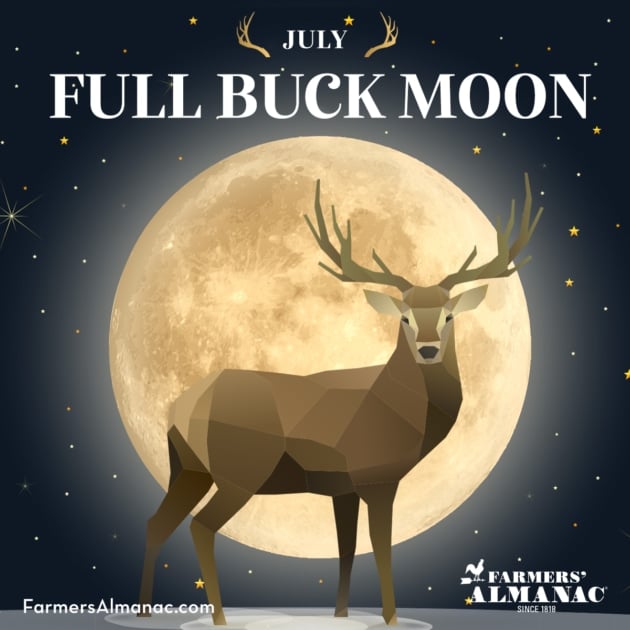
Quick Reference: July Buck Moon
- 2026 peak: Wednesday, July 29, 2026 at 10:36 a.m. ET.
- Traditional name: Buck Moon.
- Origin: named for the new antler velvet that bucks (male deer) push out each July.
- Zodiac sign at peak: Capricorn.
- Best viewing: 30 minutes after sunset on the night of peak, clear horizon to the east.
- Pair with: the Almanac’s Best Days calendar for moon-aligned planting and projects.
The Buck Moon is July’s full moon, peaking on Wednesday, July 29, 2026 at 10:36 a.m. ET. The name and the meaning behind it goes back centuries, rooted in what Native American tribes, Colonial American farmers, and European traditions observed in nature each July. Here is where the name comes from, the alternative names that survived in different regions, when to see it in your sky this year, and what farmers and gardeners traditionally did under its light.
Why Is the July Full Moon the Buck Moon?
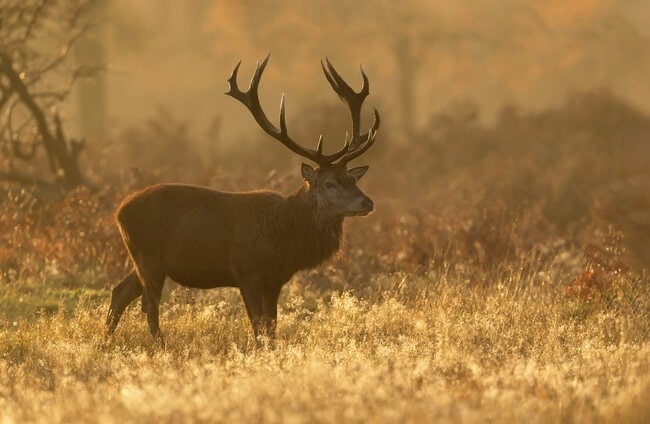
Each July, male white-tailed deer push fresh velvet-covered antlers out of their skulls, a sudden and visible growth that Native American tribes used to mark the season. The Algonquin name for the July full moon, recorded in colonial writings, was Buck Moon for this reason. The name spread across colonial New England and remains the most common English-language name for the July full moon.
By late July a buck’s antlers can grow up to half an inch a day, one of the fastest tissue-growth rates in mammals. The full moon at the peak of that growth was a useful seasonal anchor for hunters preparing for the fall.
Alternative Names for the July Full Moon
Many Native American tribes, Colonial Europeans, and Celtic peoples named the July Full Moon for what they observed at this time of year. Names vary by region and tradition.
| Name | Origin |
|---|---|
| Thunder Moon | Colonial American name, for the frequent thunderstorms of mid-summer. |
| Hay Moon | European name, marking the cut and curing of hay in fields. |
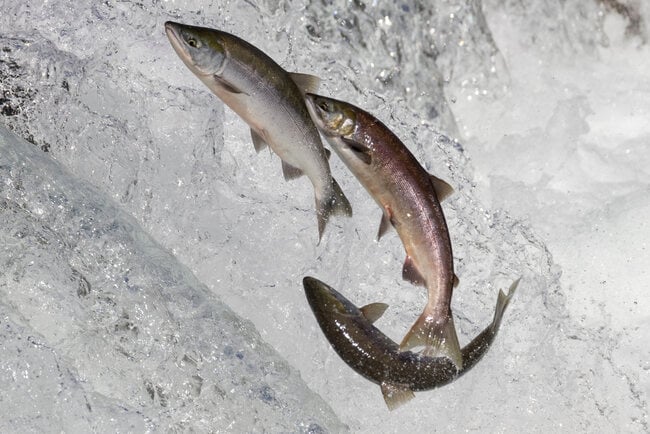
| Salmon Moon | Pacific Northwest and Great Lakes name, when salmon begin their upstream runs. |
| Berry Moon | Anishinaabe name (Mko Giizis variant), for ripening wild berries. |
| Ripe Corn Moon | Cherokee name, when corn reaches the milky-kernel stage. |
| Halfway Summer Moon | Anishinaabe name marking the midpoint of summer. |
How to See the Buck Moon in 2026
The Buck Moon reaches peak fullness on Wednesday, July 29, 2026 at 10:36 a.m. ET Eastern Time. It will appear full to the naked eye for two nights on either side of the peak. Best viewing is 30 minutes after sunset, looking east, with a clear horizon. Binoculars sharpen the craters; a telescope is not required.
- East Coast: moonrise within 15 minutes of local sunset on the night of peak. Look due east.
- Midwest: moonrise 30-45 minutes after sunset. Watch above tree lines for the orange “moon illusion” near the horizon.
- Mountain and West Coast: peak fullness time falls before moonrise. The moon will still appear full when it rises an hour after sunset.
- Canada and Northeast: earliest moonrise; coastal locations get the cleanest horizon view.

Gardening and Growth-Related July Full Moon Names
In farming traditions, the July Full Moon also carries names tied to what was planted, growing, or harvested at this point in the season:
- Mead Moon: European name for the honey-collecting and mead-brewing season.
- Wort Moon: Old English name; “wort” meant herbs gathered for medicinal use.
- Raspberry Moon: Iroquois name for ripening wild raspberries.
Spiritual and Astrological Read of the Buck Moon
In astrological tradition, the Buck Moon at peak in Capricorn pairs the growth energy of new antlers with the structure of an earth sign. It is read as a moon for setting practical, durable plans: contracts, harvest preparation, the framework you want in place by the end of summer.

Buck Moon FAQ
When is the Buck Moon in 2026?
The Buck Moon reaches peak fullness on Wednesday, July 29, 2026, at 10:36 a.m. Eastern Time. It will look full to the naked eye for two nights either side of the peak.
Why is the July full moon called the Buck Moon?
Because male deer (bucks) push out velvet-covered new antlers in early July. The Algonquin name was Buck Moon, and the name spread through colonial New England.
Are there other names for the July full moon?
Yes, more than a dozen. The most common alternates are Thunder Moon (Colonial), Hay Moon (European), Salmon Moon (Pacific Northwest), Berry Moon (Anishinaabe), and Wort Moon (Old English).
Does the Buck Moon affect gardening or planting?
In moon-phase gardening tradition, the days right after a full moon are best for planting root crops and transplanting. See the Almanac’s Best Days calendar for the specific days inside the Buck Moon window.
What zodiac sign is the Buck Moon in?
In 2026, the Buck Moon is full in Capricorn. The sun is in Cancer at the time of the July full moon, which is why the full moon (always opposite the sun) lands in Capricorn.
Is the Buck Moon a supermoon?
Not in 2026. The Buck Moon falls near apogee (the farthest point from Earth) this year, which makes it slightly smaller in the sky than average. Supermoons usually happen in late summer or early fall.
For more moon and seasonal reading, see Sturgeon Moon (August Full Moon), Harvest Moon (September Full Moon), Best Days Calendar, Full Moon Horoscope for July.


Daniel Higgins
Daniel Higgins is a lifestyle writer with two decades of experience who covers a wide variety of interests, from folklore to food and drink. Higgins writes for The New York Times, USA Today, and Yahoo News.
- Daniel Higgins

- Daniel Higgins
- Daniel Higgins
- Daniel Higgins




This is very interesting information. Thank you for sharing.
I sit and watch the moon it charges me up
We love this! Enjoy!
Like setting on porch watching the full moon ? and planting in garden it is a good time of the year
Melvin, we agree!
The moon and the earths gravitational pull is what keeps us here. Without the moon being here neither would We. The design is so fascinating, it’s beyond our comprehension.
I HAVE ALWAYS BEEN A MOON FREAK CONSISETING MY BIRTHDAY IS JULY THE 9TH. IAM THE MOON CHILDI THINK THAT THE MOON IS SOOOO AMAZING MY MPM TOLD ME ONCE THAT I WAS CONVERGED BY THE MOON!!! GO FIQUIRE HAPPY 4TH OF JULY EVERYONE!!! BE SAFEBOK SS
Thank you for the research & the facts. My friend, Scott Buch, from NY was out walking the city parking lots in ATL tonight looking for this Buck Thunder Hay July moon he has known about his entire life. It must have been behind clouds until 11:30pm. I see it now over my window. So, I came in & began research. Your article is well~written. Thank you.
Love these articles on the full Moons 🙂
Thank you Michelyn, we are glad you enjoy them!
Thanks..Interesting Article
Thank you for the great information about the moon. I have a question to ask and it is when is it the right time of the year to go looking for deers antlers when they start knocking off and also where are some of the best places to look for them? I live in Townsend, Tennessee close to Cave Cove.
Have a great week 🙂
Star
Whitetail bucks typically shed their antlers in March so late March and April are usually the best time to look for them.
As for “blood moons”, back in 1998 our area had a blood moon in early Sept. I remember that I had never seen a moon like that. An elderly relative called everyone and said there would be death and destruction because of the blood moon. During the early morning hours of the next day, we had horrific thunderstorms and winds. Next morning we woke up to no power over the region( almost a week), trees down everywhere,damage to homes and unfortunately some loss of life. We commonly refer to this as our Labor Day Storm. The blood moon story made believers of all of us!