

What Are Ice Volcanoes?
A volcano that spews ice? Wait until you see how, why and where these awesome wintry structures form.
Quick Reference
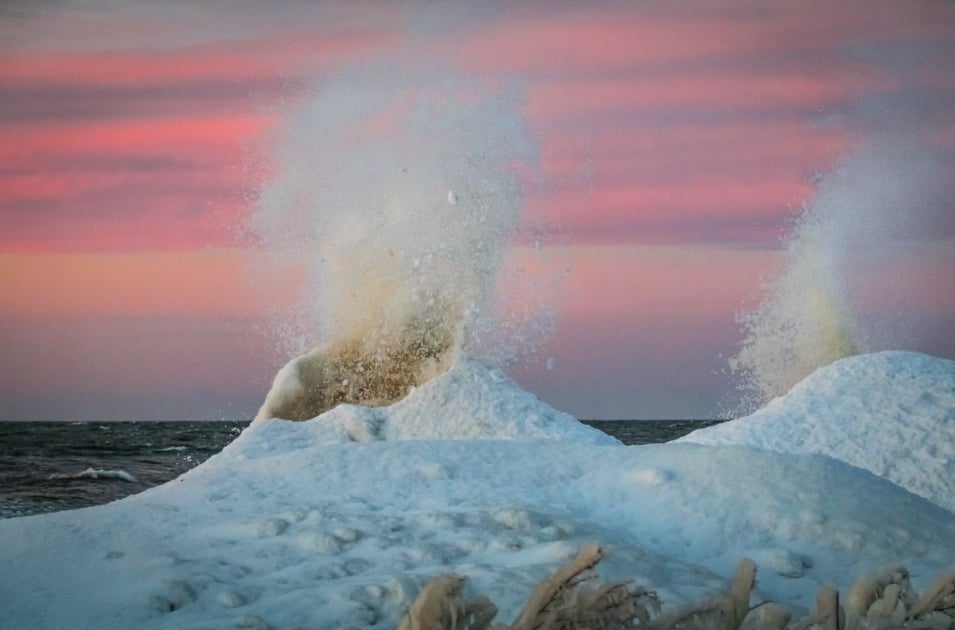
- What: Cone-shaped mounds of ice that spray water through their tops, like miniature volcanoes.
- Where: Along partially frozen freshwater shorelines, especially the Great Lakes.
- Conditions: Below 32 F, partial ice cover, strong wind, breaking waves.
- Size: Most are 2-3 feet tall. The biggest reach 25 feet.
- Cousin in space: Cryovolcanoes on Pluto, Enceladus, and Europa do the same thing at -300 F.
Move over, icicles. Ice volcanoes are quickly becoming one of winter’s most awe-inspiring icy structures. These mini mountains of ice are named for their resemblance to real volcanoes (like Mount St. Helens or Hawaii’s Kilauea), but rather than spewing hot, fiery lava, ice volcanoes spew a wintry mix of water and ice.

Where and How Do Ice Volcanoes Form?
Ice volcanoes only form along waterways, and only during winter. Weather conditions have to be just right, too:
- Air temperatures should be chilly (below 32 degrees F is best).
- The water surface on which they form should be partially frozen over and dotted with floating sheets of ice.
- There should be high wind and wave action.
Ice volcano mounds develop when winds push waves toward the shoreline. As these wind-driven waves crash against the bottom of the ice shelf, water gets pushed up through holes or cracks in the ice (like water from a whale’s blowhole). As the water sprays out of the hole, it freezes and falls on top of the ice shelf. When they are just beginning to form, the volcanoes look more like flat, Yellowstone geysers, but as more and more frozen spray heaps around the top side of the hole, it creates a cone-shaped crater.
Most ice volcanoes grow 2 to 3 feet high, but some can reach 25 feet, as tall as a two-story house. How long they “live” depends on air temperatures (they melt when the mercury rises above freezing), and coastal storms as they can be swallowed up by storm surges.
Where to View These Winter Wonders
Do not expect to see an ice volcano at any ocean or lake. If conditions are too cold and a waterway wholly freezes over, ice volcanoes cannot form. Nor can they form if water is too warm to freeze at all (because of its salt content, most seawater does not get cold enough to freeze).
One location that does offer this necessary mix of frozen and unfrozen is the chilly shores of the Great Lakes. While it typically gets cold enough for freshwater in Lakes Superior, Erie, and Michigan to freeze, they rarely freeze entirely thanks to their vast size.
Best Great Lakes Ice-Volcano Spots
- Sleeping Bear Dunes National Lakeshore, Michigan. Lake Michigan north shore, often photographed by the National Park Service.
- Lake Erie shoreline at Erie, Pennsylvania. Field trips run through Presque Isle State Park each February.
- Oval Beach, Saugatuck, Michigan. Frequent ice volcano formations after deep cold snaps.
- Marquette and Munising, Michigan. Lake Superior shoreline reliably grows them in late winter.
- Sandbanks Provincial Park, Ontario. Lake Ontario formations reported most years.
The National Weather Service Marquette and Buffalo offices regularly post ice-volcano photos to their public outreach feeds when conditions are right.
Otherwordly Oddities
Ice volcanoes also form on Earth’s neighboring planets and icy moons, including Pluto. These ice volcanoes, which scientists call “cryovolcanoes” (“cryo-” meaning cold), are more like actual volcanoes, except the ash and gases they eject freeze in mid-air due to the planet’s extreme cold temperatures (as cold as -300 to -400 degrees Fahrenheit on Pluto).
Now that is cool.
Like what you read? Read about Frost Flowers and the wintry conditions they need to form.

Frequently Asked Questions
What is an ice volcano?
A cone-shaped mound of ice that forms along a frozen shoreline. Wind-driven waves push water up through holes in the ice shelf, where the spray freezes around the opening and gradually builds up a volcano-like cone.
Where do ice volcanoes form?
Along partially frozen freshwater shorelines, especially the Great Lakes. They need a combination of below-freezing air, partial ice cover, and strong wind-driven waves.
How tall do they get?
Most reach 2 to 3 feet. The biggest can reach 25 feet, about the height of a two-story house.
How long do ice volcanoes last?
Days to weeks, depending on air temperature and storm activity. They melt when temperatures rise above freezing and can be torn apart by storm surge.
Why do they only form on freshwater?
Because most seawater is too salty to freeze at typical winter temperatures. The Great Lakes’ freshwater freezes at 32 F, but their volume is too large to freeze completely, so the open-water area continues to push waves under the shoreline ice.
Are they dangerous?
Yes. The ice shelf around an active volcano can be paper-thin and the spout can erupt without warning. Stay back at least 25 feet and view from a safe stretch of solid shore.
What is a cryovolcano?
A volcano on a planet or moon that erupts cold material like water-ice slurry, ammonia, or methane instead of molten rock. Found on Pluto, Enceladus, Europa, and Triton, where surface temperatures fall as low as -300 F.
Tell Us
Spotted an ice volcano on the Great Lakes? Tell us in the comments. For more weather-oddity reads, see our frost flowers and diamond dust entries.


Tiffany Means
Tiffany Means is a freelance writer and a degreed meteorologist. She specializes in weather forecasting and enjoys making the subject of weather (and the science behind it) more relatable. She currently resides in the Blue Ridge Mountains of North Carolina.
- Tiffany Means

- Tiffany Means
- Tiffany Means
- Tiffany Means




The Great Lakes are awesome in so many ways!