

Why the Moon Looks Bigger on the Horizon: The Moon Illusion, Explained
Ever notice how big the Moon appears at times or in pictures? It's called Moon Illusion. Learn more.
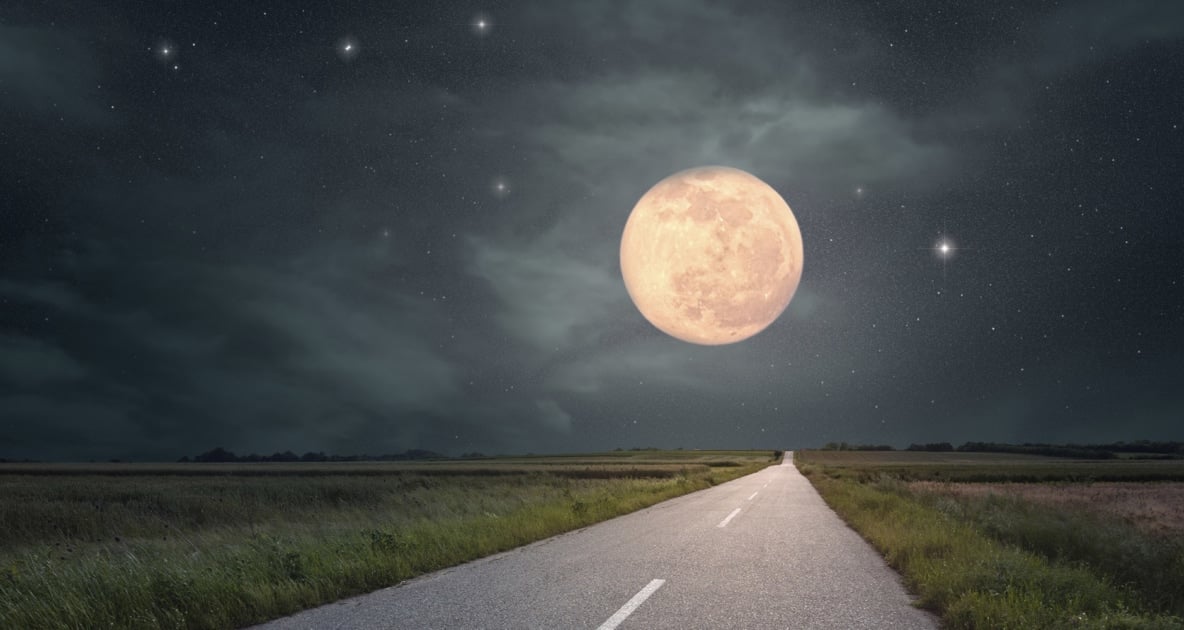
Quick Reference: The Moon Illusion
- What it is: the moon looks much larger when low on the horizon than when high overhead.
- Why: a brain effect, not an optical or atmospheric one. The moon is the same size in both positions.
- Proof: measure with a coin held at arm’s length on both nights. The size is identical.
- Best night to see it: the Harvest Moon (closest to autumnal equinox), which rises bright orange just after sunset.
- Photographable? Only with a long telephoto lens that compresses foreground, the effect does not show up on a wide-angle phone camera.
The full moon rising orange just above the rooftops looks twice as big as the same moon will look hours later when it climbs overhead. It is one of the most striking sights in the natural world, and it is also one of the oldest puzzles in human perception. The moon is not actually bigger at the horizon, and it is not magnified by the atmosphere. Your brain does it.
Prove It With a Coin
Hold a small coin (a US dime works well) at arm’s length and cover the moon when it is low on the horizon. Then go inside, wait two hours, come back out, and cover the same moon when it is high overhead. The coin will cover the moon equally in both positions. The moon has not changed size. Your brain has changed how it interprets size.
The Leading Explanations
The moon illusion has been documented since at least the 4th century BC (Aristotle wrote about it), and there is still no single agreed cause. The two leading theories are:
- Apparent distance theory: the horizon contains familiar objects (trees, buildings, hills) that we know are far away. The brain perceives the horizon moon as similarly far, and a far-away object that takes up the same retinal area must therefore be larger. Overhead, with no distance cues, the brain perceives the moon as closer and therefore smaller.
- Oculomotor theory: when looking up, the eye muscles tense in a way that compresses our perceived size. When looking forward (at the horizon), the muscles relax, and the same retinal image registers as larger.
Why It Looks Most Dramatic at the Harvest Moon
The Harvest Moon (the full moon closest to the autumnal equinox) rises just after sunset, fully lit, on the eastern horizon. The bright color (warm orange from atmospheric scattering), the slow rise, and the maximum moon-illusion effect all combine to produce the most striking moonrise of the year. The 2026 Harvest Moon is September 15.

Frequently Asked Questions
Is the moon really bigger when low?
No. The moon is the same size in both positions. The illusion is a perceptual effect, not a physical one.
Why does the moon look orange when it is low?
Atmospheric scattering. The same effect that makes sunsets red, but applied to reflected moonlight.
Will the moon illusion show up in photos?
Only if you shoot with a long telephoto lens that compresses foreground objects close to the moon. A wide-angle phone shot of a horizon moon will look much smaller than what you saw in person.
Does the illusion work for the sun too?
Yes. The sunset and sunrise sun look much larger to us than the noon sun, for the same reason.



Joe Rao
Joe Rao is an esteemed astronomer who writes for Space.com, Sky & Telescope, and Natural History Magazine. Mr. Rao is a regular contributor to the Farmers' Almanacand serves as an associate lecturer for the Hayden Planetarium in New York City.
- Joe Rao

- Joe Rao
- Joe Rao
- Joe Rao

Since the moon appears bigger when lower (often redder also), I always assumed that the thicker the atmosphere near the surface of the earth, compounded with the amount of moisture, dust, etc, affected the appearance of the moon. The atmosphere acts like a magnifying glass, making the moon larger, the lower it is and darker and redder, depending upon the amount of dust, ash, etc. in it.
My Dad taught me that the reason the moon and sun appear larger on the horizon is that we have earth object in our line of sight to compare them with. So the illusion is really an illusion which is why photographs don’t pick it up.
Somewhere in my lifetime (69 years) I remember a hypothesis that the reason for the exaggerated size of celestial bodies near the horizon is the effect of warmer air across the ground surface between the observer and the and the celestial body (sun and/or moon.) This is the same effect I have observed here in the American west when viewing mountain ranges from afar on very cold days (-10 degrees F.) during winter. Both of these phenomena bring to mind the “mirage” effect in the desert or northern plains on very hot days (+85 degrees F.) Of course these are my speculation and not intended as a scientific fact. Comments welcome.
GOD knew exactly what he was creating when he gave us the Moon.! Thank you heavenly Father for all you have blessed us with.!
Although an illusion, there are few things so spectacular as a huge moon
looming over the horizon. I have seen the rising and setting sun – I guess
another illusion – so huge and beautiful it seems like if you would walk just
a bit you could reach out and touch it. Imagine a life without the awesome
beauty of nature … life certainly would not be worth living.
Thank you, I didn’t know. I know often when I take a pic of the moon very it looks so much smaller than what I thought I saw in the sky. And yes, I have noticed that the moon looks so very much larger on the horizon. I always accepted it without realizing.