

What The Heck Is Kuchen?
Kuchen means "cake" and this one is delicious! Learn the origins of this traditional German dessert and how to make it!
Quick Reference: Kuchen
- Pronounced: “KOO-ken.” German for “cake,” but the American sense is a yeast or pastry crust topped with fruit and custard.
- Where it’s from: Germany. Brought to the upper Midwest by Volga-German and 19th-century immigrants.
- Official state dessert: South Dakota (since 2000), in tribute to its German-Russian heritage.
- The tradition: “Kaffee und Kuchen” (coffee and cake), Sunday afternoon 3 to 5 p.m., 400 years old.
- Classic toppings: peaches, apples, plums, apricots, berries, figs, plus a simple egg-yolk-and-cream custard.
- Time on a typical kuchen: about 45 minutes start to finish, 15 minutes prep.
Kuchen (pronounced “koo-ken”) is the German word for “cake,” but a real kuchen is so much more than that. Traditional kuchen is like a delicious mash-up of cake and pie, topped with creamy custard. This dessert is very popular in Germany, and you will find that many communities in the United States carry on the tradition of baking kuchens. Kuchen is the official state dessert of South Dakota. So where did it come from, and how do you make it? Read on. The Britannica entry on German cuisine places kuchen at the heart of the country’s baking culture.
The Origins of Kuchen
It is unclear exactly how long custard-topped kuchens have been around. We do know that kuchen is part of a 400-year-old “Kaffee und Kuchen” (coffee and cake) tradition. Much like teatime in Great Britain, on Sundays between 3:00 and 5:00 p.m., many Germans gather with friends and family to enjoy cakes, kuchens, and other sweets over a hot cup of coffee or tea. In South Dakota, the dessert was preserved in living memory by Germans-from-Russia who settled the Dakotas in the 1880s and brought their grandmother’s recipes with them.
How Kuchen Differs From Cake
You might think that cake is cake, no matter where in the world you happen to be eating it, but that just is not so. German cakes are quite a bit different from those we are familiar with in the United States. In fact, German Chocolate Cake is actually an American invention, first made by a Texas woman in 1957, and named for a chocolatier by the name of Samuel German.
In general, true German cakes tend to have much less sugar and a bit more butter or shortening than the cakes we are most familiar with. That is why you will quite often see German desserts topped with fruit, streusel, or whipped topping. When you eat a traditional kuchen, you will notice the dough itself is not particularly sweet. It is more like plain pastry dough, sometimes with extras like oats for more flavor and texture, or yeast to make it a bit puffier.
When it comes to kuchen toppings, anything goes. Peaches are among the most popular, but historically, kuchens were made with whatever fruit was abundant at the time. You will find recipes that include apples, plums, apricots, berries, figs, and more. Custard is an optional topping; most recipes include it, but not all. Like the dough, the custard is simple and unsweetened, made with only egg yolks and cream or milk.
Kuchen Around the World
| Where | What it is called | How it got there |
|---|---|---|
| Germany, the origin | Kuchen, simply the German word for cake | Kaffee und Kuchen. Many families gather between 3 and 5 p.m. on Sundays over coffee and cake, much like British teatime |
| United States, the Dakotas | Kuchen | Carried by Germans-from-Russia who settled the Dakotas in the 1880s. South Dakota made kuchen its official state dessert in 2000. Also common in North Dakota, Minnesota and Indiana |
| Chile, the Lake District | Kuchen, the same word | German settlers arrived around Valdivia, Osorno and Llanquihue in the mid-1800s. Chileans have their own words for cake, torta and pastel, but reserve “kuchen” for the richest ones. It is on cafe menus across the region |
| Brazil, the southern states | Cuca, a corruption of Kuchen | Brought by 19th-century German immigrants to Rio Grande do Sul and Santa Catarina, where it is still an everyday bake, often with fruit and a streusel top |
Peach Custard Kuchen
Ingredients:
Crust:
- 1/4 cup unsalted cold butter, softened
- 1 cup all-purpose flour
- 1/8 tsp baking powder
- 1/4 tsp salt
- 2 tbsp granulated sugar
Filling:
- 16 ounces sliced canned peaches, drained (or 1 1/2 cups sliced fresh peaches)
- 1/3 cup sugar
- 1 tsp cinnamon
Custard Topping:
- 1 cup whipping cream
- 2 egg yolks
Instructions:
- Preheat your oven to 400°F.
- Stir together flour, 2 tablespoons sugar, the salt, and baking powder.
- Add the butter until the mixture is crumbly.
- Place the mixture into the bottom and sides of an ungreased square pan (8x8x2 is best).
- Mix the sugar and cinnamon together. Pour over the peaches, then place the peaches into the pan.
- Bake for 15 minutes.
- Blend egg yolks and whipping cream.
- Pour over warm peaches.
- Bake for an additional 25 to 30 minutes or until custard is set and edges are light brown.
- Serve warm with ice cream if desired. Refrigerate leftovers.
Check out this recipe for Apple Kuchen!

Kuchen FAQ
What is kuchen?
A German pastry. In the U.S. (especially South Dakota and the Dakotas), kuchen usually means a yeast or shortcrust base topped with fruit and a thin, unsweetened egg-and-cream custard. In Germany, the word covers nearly every kind of cake.
How do you pronounce kuchen?
“KOO-ken.” Two syllables, accent on the first. The “ch” softens to something between “k” and “h” in German; “koo-ken” is the standard American simplification.
Why is kuchen South Dakota’s state dessert?
Because of the Germans-from-Russia who settled the Dakotas starting in the 1880s. Kuchen survived in family recipe books for over a century, and the state legislature made it official in 2000.
What fruit is best for kuchen?
Whatever is in season. Peaches and plums are the classics. Apples, apricots, sour cherries, prunes, raspberries, and figs all work. The custard mellows the fruit’s acidity.
Can I make kuchen with yeast dough?
Yes. A yeast-based kuchen rises into a soft, bread-like base; a shortcrust kuchen (like this recipe) stays buttery and tender. Both are traditional.
How long does kuchen keep?
Two days at room temperature under a cloth, or four to five days in the fridge. The custard tightens as it cools, so warming a slice for 15 seconds in the microwave brings it back to life.
What is “Kaffee und Kuchen”?
A 400-year-old German Sunday afternoon ritual, akin to British afternoon tea. Between 3 and 5 p.m., friends and family gather over coffee and a slice of cake. Kuchen is the star.
For more dessert reading from the Almanac kitchen, see our companion guides: make your own ice cream pie, what the heck is poutine?, and discover fresh figs.



Amber Kanuckel
Amber Kanuckel is a freelance writer from rural Ohio who loves all things outdoors. She specializes in home, garden, environmental, and green living topics.
- Amber Kanuckel

- Amber Kanuckel

- Amber Kanuckel
- Amber Kanuckel





Yes, I can confirm that Kuchen is in fact the Official State Dessert here in South Dakota. However… there are many people here who I’d venture to say have no idea what kuchen really is, or have ever seen or tasted some. This weekend was the 21st annual Kuchen and Harvest Festival here in the southeastern corner of our state. This two day festival showcases the farm community, tractors, equipment, the land, the farm house and other buildings – all of which are, of course, MUCH older than the festival itself. I heard there was a volunteer team of 15 people who made approximately 900 pans of kuchen in the last two days to have ready to sell – fresh and cold! 🙂 My family and I attended today; everyone had a good time – lots of reminiscing and sharing of stories going on. Thank you, FarmersAlmanac.com and writers (Amber Kanuckel – Ohio). After my experiences today, I would say the information in this article is very accurate. Lovely!
We are very happy to hear all of this! Thank you so much for sharing your experience and giving us helpful feedback. Best wishes from all of us at FA! 🧡
It says to blend the whipping cream and the eggs but does that mean you just stir them till they are combined or do you beat with a mixer to make thicker?
To beat, as with a mixer (or hand beater!) The whipping cream and egg yolks need to be thoroughly combined, plus some -ha. I’m not sure how long to beat these, but yes it gets much thicker.
Here’s another version of kuchen… my German grandmother baked white yeast bread every week. She would take a portion of the unsweet dough for kuchen. In a 9×13 pan, press down all around the bottom. Let raise to the top of the pan. Mix a custard of milk, eggs, sugar to taste. When dough has risen to height, poke holes with finger 1.5” apart. Pour custard mixture over dough. Sprinkle some sugar and cinnamon over the dough. Dot with butter. Bake at 350 or 375 20-30 degrees. Best served warm.
Kuchen comes in many forms and I’ve made many types. One of my favorites is made with rhubarb. One recipe is made with a sour cream base which is delicious!
Ain’t no way it’s pronounced koo-ken.
It definitely is said as you have typed. What makes you say it isn’t? Come to Wisconsin!!
I grew up with it pronounced (koo-ken) as well from my PA Deutsch grandmother. Perhaps other dialects pronounce it differently.
I’m 80 years old and my German born (Leipzig) grandmother made the most wonderful kuchen, using whatever fruit was available I was looking for something else when I stumbled across this recipe. I think it made be close to her (unwritten) recipe and I can’t wait to try it.
We hope you enjoy it!
Did you get to make some? We have a handwritten recipe from my great-grandmother 🙂
(Delmont, South Dakota area)
I used to go to a small family grocery in Minot North Dakota that made Kuchen at least once per week. It was very like homemade, and I have seldom had better. Old German families are a treasure for the community! They used a round pie pan, and the first time I thought I was buying a pie.
My grandmother made her kuchen round as well!
kuchen is the best food i have ever tasted the flavor is crazy to me it tastes like apple pie
My mom, who was from Germany, made kuchen often when I was young. We kids loved it. When I grew older and mentioned kuchen to my friends they wanted to know what planet I was from. Glad I stumbled onto this site. I’ll try this.
Your friends have small minds…glad you woke them up.
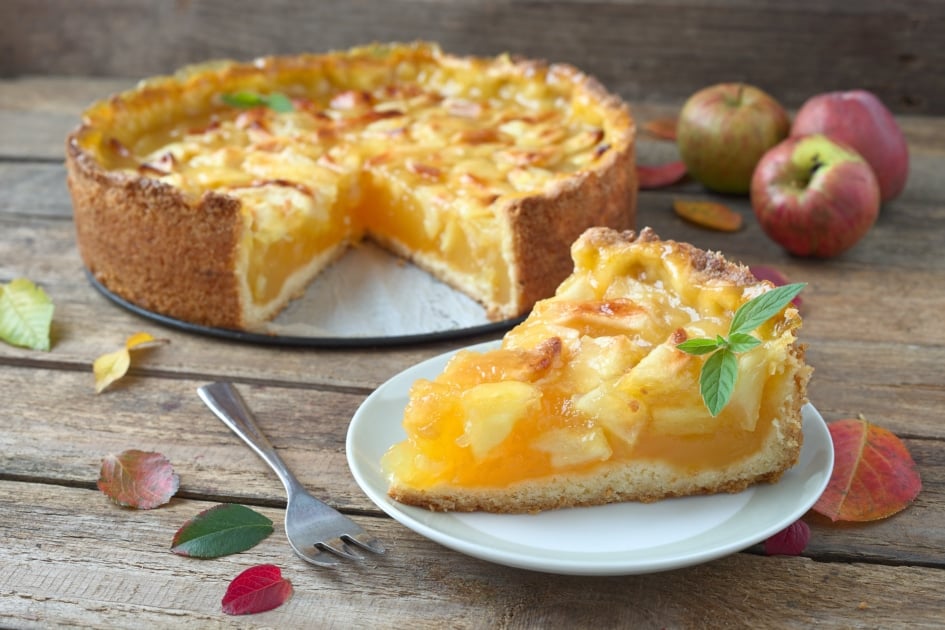
I made this recipe and it does not look at all like the picture. It was good, but it looks like many of the other kuchen recipes that are online. In order to achieve this, I think I would need more custard, less crust and more peaches. Is this really a picture of the result some got making this recipe?
What you’re seeing in the picture is an apple kuchen, not a peach kuchen.