
Quick Reference: Hanukkah 2026
- Hanukkah 2026 begins: Sundown, Friday, December 4, 2026
- Hanukkah 2026 ends: Sundown, Saturday, December 12, 2026
- Length: 8 nights
- Hebrew calendar rule: Begins on 25 Kislev
- Meaning of the name: “Dedication”
- Core ritual: Lighting the menorah (chanukiah) one candle per night
- Traditional foods: Latkes, sufganiyot, foods fried in oil
Hanukkah 2026 begins at sundown on Friday, December 4 and ends at sundown on Saturday, December 12, 2026. The festival runs eight nights, one candle added to the menorah each evening, and the date is set by the Hebrew calendar: Hanukkah always begins on the 25th of Kislev. Because the Hebrew calendar is lunisolar and the Gregorian calendar is solar, the holiday lands on a different stretch of late November or December each year.
When Is Hanukkah 2026?
Hanukkah 2026 begins at sundown on Friday, December 4, and ends at sundown on Saturday, December 12. The first candle is lit on the evening of December 4. Each night after that, one additional candle is added to the menorah, until all eight are burning on the final night. The shamash, a ninth helper candle, is lit first every evening and used to light the others.
The festival commemorates the rededication of the Second Temple in Jerusalem after the Maccabean victory over the Seleucid Greeks in 165 BCE. The Hebrew word Hanukkah means “dedication.” It is sometimes spelled Chanukah, Chanukkah, Hanukah, or Hanuka; the variants reflect different transliterations of the Hebrew letter chet. The holiday is also known as the Festival of Lights.
Hanukkah is widely observed but, in traditional Jewish terms, it is a minor festival. Work is permitted on every day of the holiday. The major Jewish holidays, by contrast, place restrictions on work and eating; they include Passover, Rosh Hashanah, Yom Kippur, and Sukkot. Some rabbis argue that Hanukkah’s “minor” classification is purely technical: the holiday carries enormous cultural and historical weight, especially in North America.
Hanukkah Dates for the Next Five Years
| Year | Begins at sundown | Ends at sundown |
|---|---|---|
| 2026 | Friday, December 4 | Saturday, December 12 |
| 2027 | Friday, December 24 | Saturday, January 1, 2028 |
| 2028 | Tuesday, December 12 | Wednesday, December 20 |
| 2029 | Saturday, December 1 | Sunday, December 9 |
| 2030 | Thursday, December 19 | Friday, December 27 |
Hanukkah 2027 is the next year the holiday and Christmas overlap on the calendar: the first night of Hanukkah falls on the evening of Christmas Eve. Before 2024, the last time the first day of Hanukkah aligned with December 25 was in 2005 and, before that, in 1959 and 1921. According to our friends at NorthJersey.com, the overlap “occurred in 2001, 1959 and 1921. It will happen next in 2035.” The Almanac’s Christmas calendar page tracks Christmas dates and customs alongside Hanukkah’s drift.
The History of Hanukkah
The story begins in the second century before the common era. Judea was under the rule of the Seleucid Greek empire, and King Antiochus IV Epiphanes had moved to suppress Jewish religious practice. He outlawed observance of Shabbat, circumcision, and the reading of Torah. He installed an altar to Zeus inside the Second Temple in Jerusalem and ordered the sacrifice of pigs there. For a community whose identity was bound up with the Temple, this was desecration of the highest order.
The Maccabean Revolt began in 167 BCE in the village of Modi’in, when a Jewish priest named Mattathias refused to make a pagan sacrifice and killed a Seleucid officer. His five sons, led by Judah Maccabee, carried on the fight. Over three years of guerrilla warfare, an outnumbered Maccabean force defeated successive Seleucid armies. In 164 BCE (the year given as 165 BCE in some older sources), Judah and his followers retook Jerusalem and the Temple.
The Maccabees cleared the Temple of pagan altars and prepared to rededicate it. According to the Talmud (Shabbat 21b), when they came to relight the Temple’s menorah, they could find only one small jar of ritual oil bearing the seal of the High Priest, enough to burn for a single day. Pressing more pure oil would take a full week. They lit the menorah anyway, and the oil burned for eight days. The festival of Hanukkah, set for 25 Kislev each year, commemorates that rededication and the miracle of the oil.
The historical accounts in the books of First and Second Maccabees, written shortly after the events, emphasize the military victory and the rededication itself. The oil miracle is the rabbinic tradition recorded later in the Talmud. Both threads sit inside the holiday today: a fight for religious freedom and the small light that refused to go out. For a deeper history of the revolt and its sources, My Jewish Learning walks through both the Maccabean accounts and the Talmudic story.
Why Is Hanukkah on Different Dates Each Year?
Hanukkah falls on different Gregorian dates each year because it is set by the Hebrew calendar, not the calendar most of North America uses to plan the week. The festival always begins at sundown on the 25th of Kislev, the ninth month of the Hebrew year, and runs through the 2nd or 3rd of Tevet. That part is fixed.
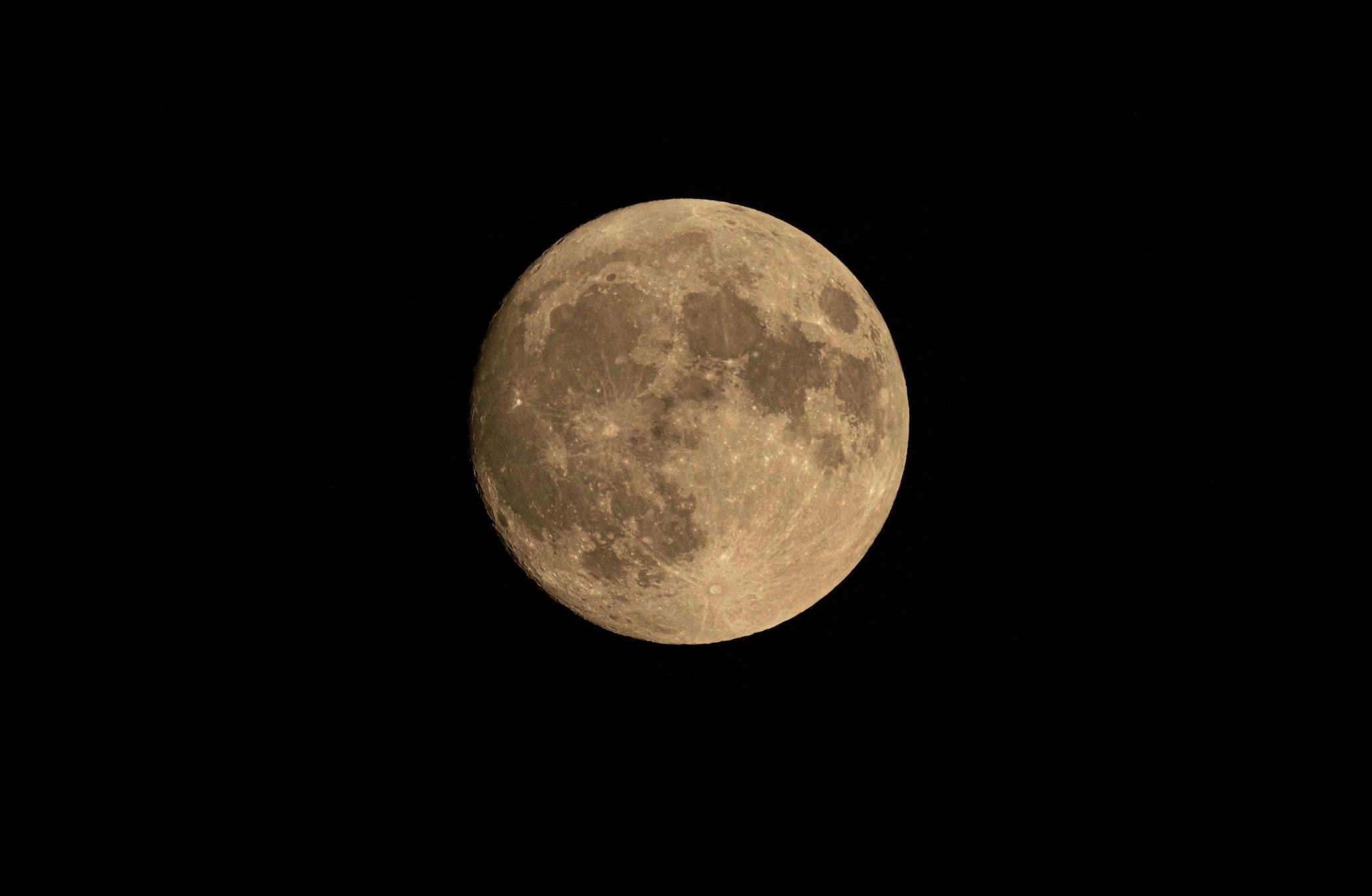
What moves is the relationship between the Hebrew and Gregorian calendars. The Hebrew calendar is lunisolar. Each month begins with the new Moon, so the months are roughly 29 or 30 days long, and a normal Hebrew year has 354 days, about eleven days shorter than the 365-day Gregorian year. Left alone, the Hebrew months would drift through the seasons the way the Islamic lunar calendar does. To keep Passover in the spring and Sukkot in the autumn, a leap month called Adar II is added in seven out of every nineteen years. The leap month is the lever that keeps Hebrew holidays anchored to their seasons.
The practical effect on Hanukkah is that the holiday slides earlier on the Gregorian calendar most years (the eleven-day gap) and then jumps forward roughly nineteen days the year the leap month is inserted. Over a nineteen-year cycle, the average lines back up. Hanukkah lands anywhere from late November to late December.
The Hebrew calendar is also the calendar that governs the Torah reading cycle and the timing of every Jewish holiday from Rosh Hashanah through Tisha B’Av. The current Hebrew year overlaps Hanukkah 2026: the festival’s first night, December 4, 2026, falls in the year 5787.
How Hanukkah Is Celebrated
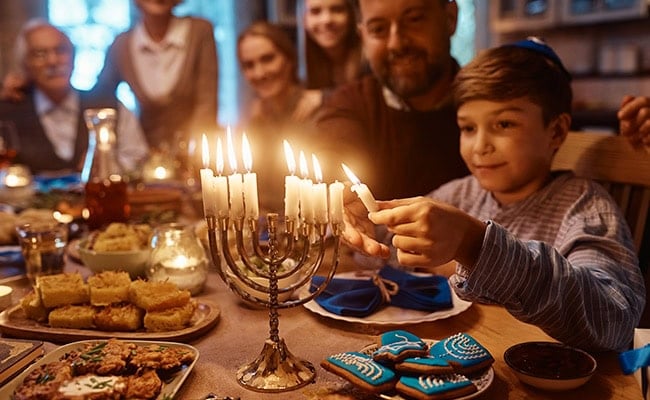
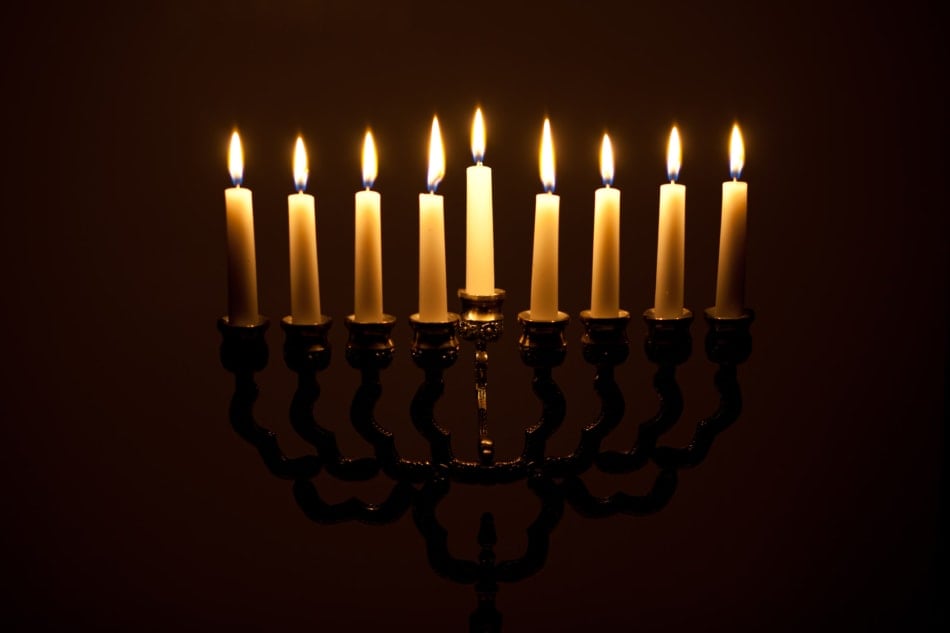
The central ritual of Hanukkah is lighting the menorah, also called the chanukiah. The menorah has eight branches plus a ninth holder for the shamash, the helper candle. Each evening at nightfall, the shamash is lit first and then used to light the other candles. One candle is lit on the first night, two on the second, and so on, until all eight burn together on the final night. Many families place the menorah in a window so the light is visible from the street: the rabbis call this pirsumei nisa, publicizing the miracle.
Two short blessings are recited as the candles are lit, with a third (the Shehecheyanu) added on the first night. After the candles are burning, many families sing “Maoz Tzur” or “I Have a Little Dreidel,” eat the night’s meal, and let the candles burn down on their own.
- The menorah (chanukiah). Nine branches, eight for the nights of Hanukkah and one for the shamash. The shamash sits higher than the others or off to the side.
- The shamash. The helper candle. Lit first each evening, used to light the others, and never counted among the eight.
- Dreidel. A four-sided spinning top with the Hebrew letters Nun, Gimel, Hei, and Shin on its faces. Outside Israel the letters stand for Nes Gadol Hayah Sham, “A great miracle happened there.” In Israel the fourth letter is Pei instead of Shin, and the phrase changes to Nes Gadol Hayah Po, “A great miracle happened here.”
- Gelt. Coins, the traditional Hanukkah gift. Gelt is often given to children and used as stakes in the dreidel game. The chocolate-coin version covered in gold foil dates to the early 20th century in North America.
- Fried foods. Foods cooked in oil are eaten in memory of the oil that lasted eight days. Latkes (potato pancakes) are the staple in Ashkenazi households; sufganiyot (jelly-filled donuts) are the Israeli favorite.
- Gifts. Gift-giving on each of the eight nights is a more recent custom, especially common in North America where Hanukkah falls near Christmas. The only traditional gift is gelt.
The dreidel game itself is simple. Each player starts with a pile of gelt and antes one piece to the pot. Players take turns spinning. Nun means nothing happens. Gimel means take the whole pot. Hei means take half. Shin (or Pei in Israel) means add one to the pot. When the pot is empty or down to one, everyone antes again. The game is the children’s part of the evening.
Traditional Recipes for Hanukkah
For many families, Hanukkah is anchored as much by the kitchen as by the menorah. The festival’s signature foods are fried in oil, a culinary echo of the oil that lasted eight days. If you are setting a Hanukkah table this December, here are four Almanac recipes our readers come back to year after year.
Best-Ever Potato Latkes
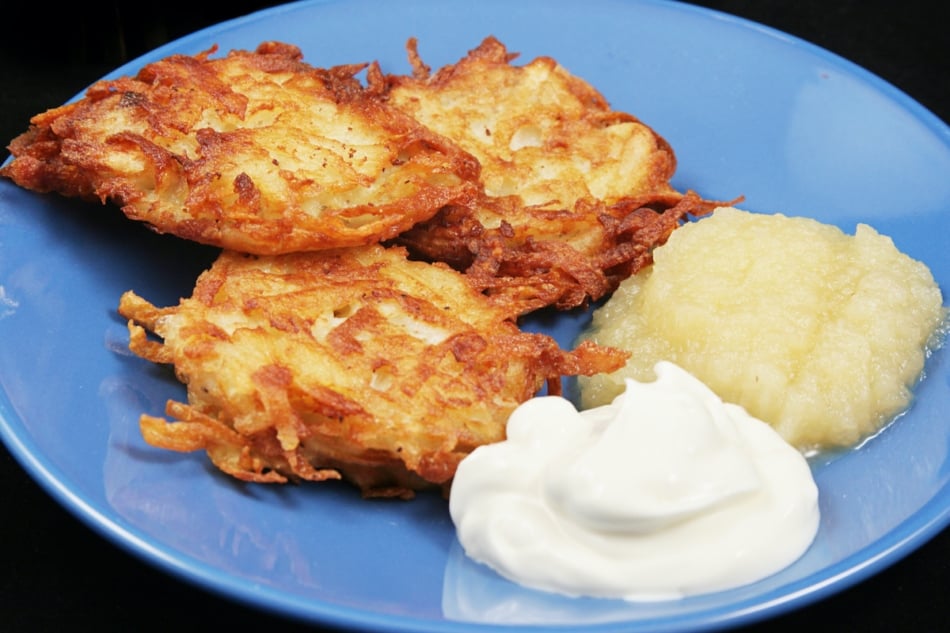
Potato latkes have become tastefully ubiquitous. Savory and sweet variations turn up across Austria, Switzerland, Czechoslovakia, Poland, Russia, Sweden, and Germany (where they are topped with blueberries, sugar, and cinnamon), but the latke tradition has long been associated with the Jewish holiday of Hanukkah. The fried-in-oil connection ties them to the miracle of the cruse of oil that lasted eight days. Whether they should be served with applesauce or sour cream is the friendliest argument at any Hanukkah table.
Ingredients:
3 medium Russet potatoes (1 lb.), the best choice of potato for latkes
3 beaten eggs
1/4 cup matzo meal
1/4 shredded onion
1/4 cup vegetable oil
Applesauce and/or sour cream as garnish
Directions:
Peel and coarsely shred the potatoes (you should have 3 cups). As you work, put the shredded potatoes in a bowl of cold water to prevent darkening and to ensure a crispy latke. Drain. Rinse and drain again thoroughly. Make sure the shredded potatoes and onions are very dry before mixing.
In a mixing bowl, stir together eggs, potatoes, matzo meal, onion, 1/4 teaspoon of salt, and 1/4 teaspoon of pepper. In a 12-inch skillet heat 2 tablespoons of oil over medium-high heat.
Work in batches. For each latke, drop 2 tablespoons of the potato mixture into the hot oil. Press to flatten slightly. Fry 2 to 3 minutes or until edges are crisp; turn. Fry 2 to 3 minutes more (or longer depending on your desired doneness). Drain on paper towels. Cover; keep warm.
Repeat with the remaining mixture, adding oil to the skillet as needed. Serve warm with applesauce and/or sour cream. Makes 24 latkes.
Sweet Potato Latkes
Ingredients:
1 1/2 lbs. sweet potatoes (orange flesh variety)
1 medium onion
2 large eggs
3/4 teaspoon salt
1/4 teaspoon freshly ground white pepper
5 tablespoons flour
1/2 cup vegetable oil (approximately)
Directions:
Peel the sweet potatoes and grate using the grating disc of a food processor or the large holes of a hand grater. As in the recipe above for basic potato latkes, squeeze out all possible liquid in a towel. Grate the onion and add it to the sweet potatoes. Transfer to a large bowl. Beat the eggs with salt and pepper and add to the potato mixture. Add flour and mix well.
Heat 1/4 cup oil in a heavy 10- to 12-inch skillet, preferably non-stick. Fill a 1/4-cup measure with the sweet potato mixture, pressing to compact. Turn out in a mound into the skillet. Quickly form 3 more mounds. Flatten each with the back of a spoon so each cake is about 2 1/2 to 3 inches in diameter, pressing to compact.
Fry over medium heat for 3 minutes. Turn carefully with 2 slotted spatulas and fry the second side for about 2 1/2 minutes or until golden brown and crisp. Drain on paper towels. Stir the potato mixture before frying each new batch and add a little more oil to the pan. Serve hot. Makes 4 servings.
Sufganiyot (Little Donuts)
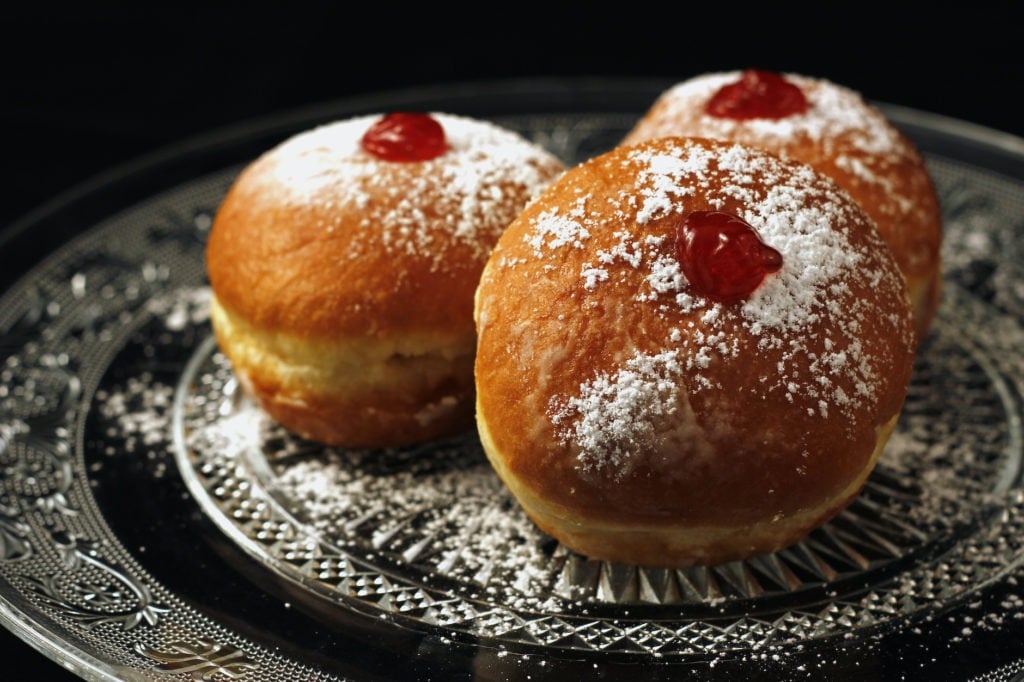
In Israel, sufganiyot, or little donuts, are said to have become even more popular than traditional latkes. They are sold street-side and made or served with jelly, chocolate sauce, or honey to sweeten the holiday even more.
Ingredients:
1 package dry yeast
4 tablespoons sugar
3/4 cup lukewarm milk
2 1/2 cups all-purpose flour
pinch of salt
1 teaspoon ground cinnamon
2 eggs, separated
2 tablespoons butter or margarine, softened
apricot or strawberry preserves
vegetable oil
sugar for coating
Directions:
Mix together the yeast, 2 tablespoons of the sugar, and the milk. Let it sit to make sure it bubbles. Sift the flour and mix it with the remaining sugar, salt, cinnamon, egg yolks, and the yeast mixture.
Knead the dough until it forms a ball. Add the butter or margarine. Knead some more until the butter is well absorbed. Cover with a towel and let rise overnight in the refrigerator.
The next day, roll out the dough to a thickness of 1/8 inch. Cut the dough into 24 rounds with a juice glass, or any object about 2 inches in diameter. Take 1/2 teaspoon of preserves and place it in the center of 12 rounds. Top with the other 12. Press down at the edges, sealing with egg whites. Crimping with the thumb and second finger is best. Let rise for about 30 minutes.
Heat 2 inches of oil to about 375 degrees F. Drop the doughnuts into the hot oil, about 5 at a time. Turn to brown on both sides. Drain on paper towels. Roll in sugar.
Traditional Poppy Seed Cookies (Mohn Kichlach)
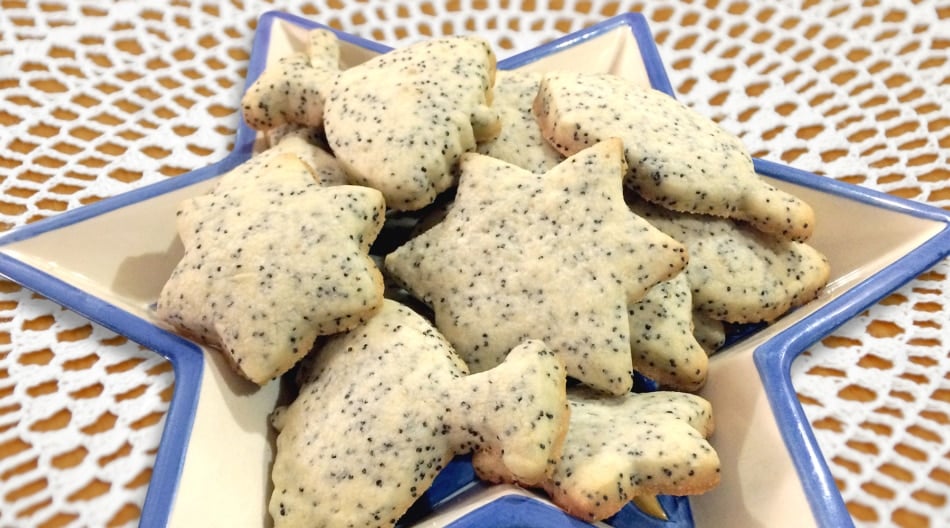
Known as mohn kichlach (or kichelach, which means “cookies” in Yiddish), these date back to 16th-century Eastern Europe, where they were a staple in Jewish homes. Traditionally, poppy seed cookies are served any time of year, but most families make them for Hanukkah celebrations. They are perfect with coffee, tea, or a tall glass of cold milk.
Ingredients:
1 cup melted butter or margarine, cooled slightly
1 cup sugar
2 eggs
3 cups flour
1 teaspoon baking powder
1 teaspoon vanilla
1/2 cup poppy seeds
1 teaspoon almond extract
Directions:
Preheat the oven to 350 degrees F.
Using an electric mixer on medium speed, beat the melted butter or margarine and sugar together in a large mixing bowl. Add the eggs, one at a time, beating after each one.
Add the baking powder and 1 cup of the flour, beating until smooth. Then, using a wooden spoon, stir in 1 cup of flour and the vanilla, and mix well. Add the remaining cup of flour and the rest of the ingredients, mixing well.
Chill the dough in the refrigerator in wax paper for at least 2 hours. Then divide the dough into 4 parts.
Roll out each piece of dough, one at a time, between 2 pieces of wax paper, approximately 1/8 inch thick. Use cookie cutters to cut out shapes. Traditional dreidel, Star of David, or Chanukah-themed cookie shapes make them festive. Gather up scraps of dough and re-cool in the refrigerator, then roll out the scraps and continue cutting out cookies until you have used up all the dough.
Carefully transfer the cookies to a greased cookie sheet or one lined with parchment paper, leaving some space in between, and bake for 12 to 15 minutes. Remove from the oven and cool slightly, then transfer to a wire rack. The cookies will harden as they cool.
Cookies may be stored in an airtight container at room temperature for the 8 days of Hanukkah, if they last that long. Or freeze them, well wrapped, for up to 2 months.
Four Things Worth Knowing About Hanukkah
- Hanukkah, while widely observed in North America, is not what the Jewish tradition classifies as a major holiday. Some rabbis argue that the only reason it carries the “minor” label is that it does not require restrictions on work or eating. The recognized major holidays include Passover, Rosh Hashanah, Yom Kippur, and Sukkot.
- There are nine candles on the menorah (also called chanukiah), even though Hanukkah runs for eight nights. The ninth candle is the shamash, the helper. It sits at a different height than the others, is lit first, and is used to light the rest.
- Gift-giving is not a traditional part of Hanukkah, but it has become more common in recent generations, especially in households where Jewish families live in close contact with Christian neighbors who exchange gifts at Christmas. The only traditional Hanukkah gift is gelt, small amounts of money.
- Hanukkah means “dedication.” The holiday honors and celebrates one of the first recorded fights for religious freedom and the success of that fight. It commemorates the rededication of the Holy Temple in Jerusalem following the Jewish victory over the Syrian-Greeks in 165 BCE. When the victors regained the Temple, they wanted to purify it by burning ritual oil for 8 days, but they only had enough oil for one night. The miracle of the holiday is that the oil lasted for the full 8 days. That is why we burn candles and celebrate for 8 days.
Plan Your Hanukkah
Mark sundown on Friday, December 4, 2026 as the first candle of Hanukkah. A few small habits that make the eight nights run smoothly:
- Buy candles by mid-November. A standard box holds 44 candles, which is exactly enough for one menorah across all eight nights (1+2+3+4+5+6+7+8 = 36 candles plus 8 shamash candles). Households with more than one menorah will need more.
- Decide on the menorah’s spot ahead of time. The traditional placement is in a window facing the street, with the menorah set somewhere it cannot fall and well clear of curtains.
- Plan the meal around foods fried in oil. Latkes, sufganiyot, and the night’s main dish travel well across the eight evenings; many families rotate one or two fried items per night rather than cooking everything in one go.
- Keep a small bag of gelt within reach for the dreidel game. Chocolate gelt is the children’s currency; nickels and dimes work too.
- If Hanukkah crosses Shabbat (which 2026 does: the first night is Friday and the eighth night is Saturday), light the Hanukkah candles before the Shabbat candles on Friday, and after Havdalah on Saturday night.
How your family marks Hanukkah is yours to shape: the rhythm of the menorah lighting, the songs around the table, the recipes pulled from the back of a notebook, the cousins on a video call from another time zone. The date is the one fixed point.

Frequently Asked Questions
When is Hanukkah 2026?
Hanukkah 2026 begins at sundown on Friday, December 4, 2026 and ends at sundown on Saturday, December 12, 2026. The festival runs eight nights. The first candle is lit on the evening of December 4.
Is Hanukkah the Jewish Christmas?
No. Hanukkah and Christmas are separate holidays with separate origins. Hanukkah commemorates the Maccabean rededication of the Second Temple in 164 BCE and is set by the Hebrew calendar. Christmas commemorates the birth of Jesus and is set by the Gregorian calendar. The two often land in the same general stretch of December, which is a coincidence of the calendar, not a connection of the holidays. Gift-giving on each of the eight nights is a relatively recent Hanukkah custom in North America; traditionally the only gift was gelt.
Why is Hanukkah eight nights?
When the Maccabees rededicated the Second Temple in 164 BCE, they found only enough ritual oil to keep the menorah burning for a single day. According to the Talmud (Shabbat 21b), the oil burned for eight days, the time needed to press and prepare more pure oil. The festival was set for eight nights to commemorate the miracle.
What is the shamash?
The shamash is the ninth candle on the menorah, often translated as “the helper” or “the attendant.” It is lit first each evening and used to light the other candles. The shamash is set at a different height than the eight Hanukkah candles, traditionally higher or off to the side, so it is clearly distinguished from them and not counted among the eight.
Why does Hanukkah fall on a different date each year?
Hanukkah always begins on the 25th of Kislev in the Hebrew calendar. The Hebrew calendar is lunisolar and runs about eleven days shorter than the Gregorian calendar in a normal year. A leap month (Adar II) is added in seven of every nineteen years to keep the holidays in their seasons. The eleven-day gap and the periodic leap month are what cause Hanukkah to land on a different Gregorian date each year, anywhere from late November to late December.
What are the rules of the dreidel game?
Each player starts with a pile of gelt (chocolate coins or real coins) and antes one piece into the pot. Players take turns spinning the dreidel. Nun means the player takes nothing. Gimel means take the whole pot. Hei means take half. Shin (or Pei in Israel) means add one to the pot. When the pot is empty or down to one piece, everyone antes again. The four Hebrew letters Nun, Gimel, Hei, Shin stand for Nes Gadol Hayah Sham, “A great miracle happened there.”
Is Hanukkah spelled Chanukah or Hanukkah?
Both spellings are correct. The Hebrew name begins with the letter chet, which has no exact equivalent in English. Common transliterations include Hanukkah, Chanukah, Chanukkah, Hanukah, and Hanuka. Hanukkah is the most common spelling in North American English; Chanukah is the more common transliteration in older texts. The pronunciation is the same.
When is Hanukkah 2027?
Hanukkah 2027 begins at sundown on Friday, December 24, 2027 and ends at sundown on Saturday, January 1, 2028. The first night coincides with Christmas Eve.
Join the Discussion
How does your family mark Hanukkah? The menorah in the window, a favorite latke recipe, the songs around the table, the dreidel game on the rug, the cousins on a video call? Share your traditions in the comments below and tell us what you would like us to add to this page next year.
