

Like Snow? Count the Number of Fogs in August
What does fog in August have to do with snow? Check out some fascinating weather lore that is not only whimsical but also wise.
Quick Reference
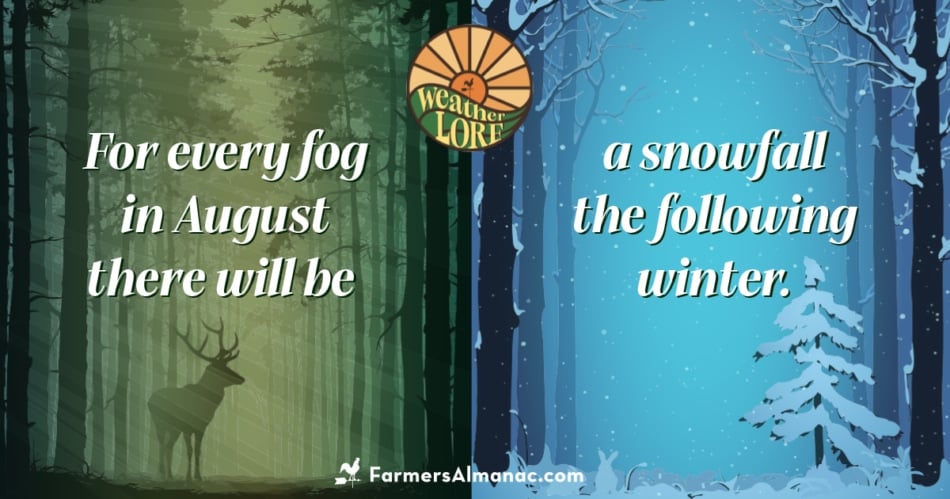
- The rule: “For every fog in August, there will be a snowfall the following winter.”
- When to count: Every morning August 1 through 31.
- What counts as fog: Visible mist that reduces visibility below one mile.
- Companion rules: A warm first week of August signals a snowy long winter. A cold August after a hot July signals a hard dry winter.
- FA position: We respect the lore but do not use it in our math-based long-range forecast.
At the Farmers’ Almanac we collect old weather sayings the way other publications collect statistics. Each month has its own lore, and August has one of the most famous: For every fog in August, there will be a snowfall the following winter. Get the calendar out, grab a pen, and start counting on the first.
How the August Fog Count Works
- Start on August 1. Check outside at first light. A heavy ground mist or low-visibility fog counts.
- Tally one mark per foggy day. A morning that clears to bright sunshine by 9 a.m. still counts if there was real fog at dawn.
- Continue through August 31. Skipping days breaks the count.
- Total the marks. That number is your forecast for snowfalls between November and March.
- Note where the fogs fell. Some old farmers also tracked the date of each fog. The folklore says the day of the August fog corresponds, in calendar order, to the date of the matching winter snowfall.
Other August Weather Lore Worth Watching
- If the first week in August is unusually warm, the coming winter will be snowy and long.
- If a cold August follows a hot July, it foretells a winter hard and dry.
- As high as the weeds grow in August, so will the bank of snow.
- If ant hills are high in August, winter will be deep.
- See how high the hornet’s nest, ’twill tell how high the snow will rest.

Is Fog Counting Actually Accurate?
The honest answer: sometimes. Many sayings prove themselves time and again. Examined closely, weather lore rests on careful observation of cause and effect in the natural world over many generations. A foggy August on a Pennsylvania farm in 1840 had real predictive value for the family that recorded it: rural folks watched the same skies, same soil, same patterns for decades and noticed what lined up. The signal is real, but it is a short-range, local-area signal, not a national long-range forecast.
The Almanac respects the August fog count. It is a fine tradition. It is not, however, how the Farmers’ Almanac itself makes long-range predictions. We do not count acorns or fogs. We use a mathematical and astronomical formula refined since 1818, built on solar activity, lunar position, and historical pattern matching. Read how the Farmers’ Almanac forecasts the long-range weather. Curious about our forecast accuracy? Check it out.
Where the Fog Count Rule Comes From
The fog count appears in American almanacs and farm journals as far back as the early 1800s, with parallel versions in British, German, and Slavic farming traditions. The reasoning was simple: August fog generally indicates a particular pattern of cold morning air over warm surface water or vegetation. Some climatologists have argued that a foggy August in much of the continental U.S. does correlate weakly with active winter weather, because both signals reflect a southerly-shifted jet stream. Whether that link is real or just a folk pattern that lingered, the rule has earned its place in the August calendar.

Frequently Asked Questions
What does “count the fogs in August” mean?
It refers to an old folk rule: every foggy morning in August predicts one snowfall in the winter that follows. Tally a mark each foggy day from August 1 through August 31. The total is your forecast for the winter.
How accurate is the August fog count?
It is regional and not foolproof. It works better in the Mid-Atlantic, Appalachians, and Midwest than in the Desert Southwest or coastal California where fog has different drivers. Treat it as one data point alongside the Farmers’ Almanac long-range forecast.
Does the Farmers’ Almanac use fog counts in its forecast?
No. The Almanac respects weather lore and publishes it, but our long-range forecast comes from a mathematical and astronomical formula refined since 1818. We do not count fogs, acorns, or wasp nests.
What counts as fog for the purposes of the rule?
Visible ground mist or fog that reduces visibility to less than one mile at dawn. Light haze or dew alone does not count. The fog should be thick enough that you could call it “foggy” without hesitation.
Are there similar rules for other months?
Yes. Many farm cultures track September fogs and October frosts in similar ways. The August rule is the most widely cited in U.S. lore. See 20 Signs of a Hard Winter for the full catalog.


This article was published by the Staff at FarmersAlmanac.com. Any questions? Contact us at [email protected].
- Farmers' Almanac Staff
- Farmers' Almanac Staff
- Farmers' Almanac Staff
- Farmers' Almanac Staff

I wish you had posted this the beginning of August!
My Daughter says if the old Wives tale about the Foggy mornings in August and Snowfall in Southeastern Ohio we will have 14 snowfalls. Hoping this is not true, but we will see. lol.
whatever happen to Indian Summer?
We’ve had 4 thick fogs in august. We may need to get snow shovels handy. I will have to cut a persimmon in half to see if there’s a spoon shape in it! We live in western Kentucky.
Sue – did the winter turn out as you thought? Curious because we just had an unusual fog here in Montana and 90 days from today is early august. [email protected]
When are dog days in North Western Virginia
When are dog days in North Eastern Virginia
For Abri farms,
Where are you? I see you are getting fog everday? Maybe this is a back east thing? Here in southeastern Wyoming, we merely got 3 or 4 days of fog, total. Maybe this means we dont get much, if any moisture?
http://www.rawhidestudios.com
Patti Padgett,
We are north of you, Torrington, Wyoming. didnt get the rains you did. Gardens here this year have been disappointing. . in fact, not much at all in rain really and a cold spring With our luck, another cold but DRY winter!
We have a saying here in TX regarding August weather, “hot today, hot tamale”. This actually usually starts in June and continues until November. Snow would be nice for a change!
After reading all your comments I am afraid to say this my peeps, We have birds bunching up, Our fruit trees are full and happy, we have dense fog every Morning….even the nut trees are flourishing…..so all I have to say is, if you like skiing and winter activities…come on up, over, or where ever you live cause we apparently are going to have snow here in Vermont!!! LOL