

Cat Weather Lore: Can Cats Really Predict the Weather?
We know cats are a lot of things, but weather predictors? See what folklore says about these furry felines' forecasting abilities.
Quick Reference
- Most reliable cat sign: a cat that suddenly seeks heat (back to the fire, behind the stove) ahead of a cold snap.
- Why cats sense weather first: sensitive whiskers, ears, and inner-ear pressure detection that picks up changes humans cannot.
- Lead time: typical behavior change is 6 to 24 hours before a measurable weather shift.
- What lore holds up: sleeping pattern changes (snoring, curling tightly) ahead of cold weather.
- What lore is folk fiction: cat sneezing as rain forecast (sneezes are caused by allergens or irritants, not pressure changes).
Long before Doppler radar, weather apps, and the National Weather Service, people watched their cats. Centuries of close observation produced a small but specific body of cat weather lore, most of it built around how cats sleep, where they sit, and how they groom in the hours before a storm. Some of it tracks neatly with what modern animal behavior research has confirmed about feline sensitivity to atmospheric pressure. Some of it does not. Here are six classic cat weather rules, what each one means, and how the lore lines up with what cats are actually doing.
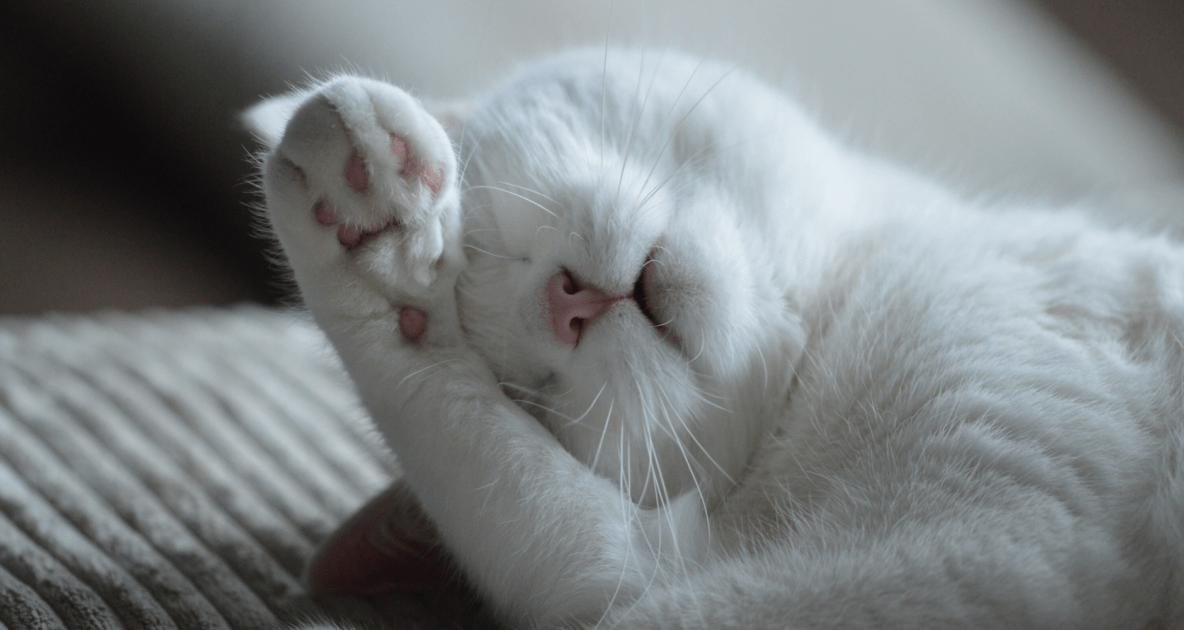
1. When a Cat Washes Behind Her Ears, Expect Rain
This rule appears in nearly every English-language cat lore tradition. The mechanism most often suggested: cats become more sensitive to ear pressure when humidity rises ahead of rain, and they groom the area as a kind of self-soothing response. The rule has limited scientific backing. Cats groom for many reasons, and ear-washing is part of routine daily grooming for any healthy cat. The rule survives because the visual is memorable and the lore predates modern measurement.
That said, an unusually intense or prolonged grooming session, especially focused on the ears and head, often does correlate with a barometric pressure drop. The lore captures a real pattern at the extreme end of the behavior spectrum, even if routine ear-washing is no signal at all.
2. When Cats Lie on Their Head with Mouth Turned Up, Expect a Storm
The “head-down with mouth up” sleeping position is a sign of deep relaxation, the opposite of the alert curl most cats use during the day. The lore suggests this deep-sleep posture appears more often ahead of a major weather system because the cat senses the approaching low pressure and settles in for the duration. Modern feline-behavior research has not validated the specific posture as a forecast, but veterinary studies do confirm cats sleep more, and more deeply, in the hours before storms. The pattern is real even if the specific position is not the point.
3. When the Cat Lies in the Sun in February, She Will Creep Behind the Stove in March
This rule is essentially a long-range forecast. Cats are notoriously sensitive to temperature trends, and a cat that is heat-seeking in February (lying in every available sunbeam) is responding to a cold late-winter snap. The lore says: that cold pattern often extends into March, when the cat will continue heat-seeking behavior, this time behind the wood stove. Modern climatology supports the underlying pattern: a cold February correlates moderately well with a continued cool March across most of the temperate United States.
4. If a Cat Sits With Its Back to the Fire, Frost and Hard Weather Can Be Expected
Cats orient toward the heat source they need most. A cat curled with its belly to the fire is keeping warm; a cat with its back to the fire is using the warmth most aggressively to defend its core temperature. The lore reads the back-to-fire posture as a signal that the cat is sensing approaching cold, often a frost or a cold snap. The reading lines up with veterinary research: cats consistently shift body orientation, sleeping location, and activity patterns 12 to 24 hours before significant temperature drops.
5. When Cats Sneeze, It Is a Sign of Rain
The sneeze rule is the weakest in the cat-lore catalog. Cats sneeze for the same reasons humans do: dust, allergens, viral infections, or sudden sharp temperature changes. None of those track reliably with rain. The rule probably entered the folklore because some people noticed that cats sneeze more often during pollen-heavy spring weather, which also happens to be the rainiest part of the year in most US zones. The correlation is coincidental, not causal. If your cat is sneezing repeatedly, the more likely answer is allergies or a respiratory bug, not the forecast.
6. When Cats Are Snoring, Foul Weather Follows
Snoring in cats happens during deep sleep, when the airway relaxes enough to vibrate. Cats sleep more deeply ahead of storms, and snoring is more likely under deep sleep, so the lore captures a real pattern by indirect connection. The cat is not snoring because of the storm. The cat is snoring because it is sleeping deeply, and it is sleeping deeply because pressure is dropping. Read the snoring as a layered signal: a cat that has gone from light napping to deep snoring within a few hours often has registered an approaching front before the household has.
Why Cats Sense Weather Better Than We Do
Three biological features make cats unusually sensitive to atmospheric changes:
- Whiskers (vibrissae). A cat’s whiskers are not just face-decoration. They are densely innervated mechanoreceptors that detect subtle air movement and pressure changes. A small drop in barometric pressure produces a measurable shift in the air around a cat’s face that the whiskers register before any other body system does.
- Inner ear sensitivity. Cats have unusually well-developed inner-ear structures that detect both balance and pressure. The same mechanism that makes them excellent jumpers also makes them excellent barometers.
- Behavioral flexibility. Unlike many domestic animals, cats can shift behavior in subtle ways: choosing a different sleeping spot, grooming more, eating less, sleeping deeper. The shifts are easy for an attentive owner to notice but rarely show up on instruments.
Veterinary behavior studies consistently document weather-related changes in feline activity 6 to 24 hours before measurable shifts in temperature, humidity, or pressure. The lead time is short compared to a long-range forecast but long compared to the seven-day forecast for any given storm system.
Can Cats Predict Earthquakes?
The earthquake-prediction question is more contested than the weather one. Cat owners across centuries have reported their animals behaving strangely in the minutes or hours before earthquakes: hiding, vocalizing, fleeing the house, refusing to enter certain rooms. Modern research is divided. Studies in Japan, Italy, and California have documented unusual pet behavior preceding measurable seismic activity, but the correlation is weaker than the weather correlation, and the alerting behavior is rarely consistent enough to function as a usable warning.
The leading hypothesis is that cats and other small mammals detect P-waves (the faster, less destructive primary seismic waves) before the larger S-waves arrive, giving them a few seconds to a few minutes of advance notice. Some research also points to detection of low-frequency electromagnetic disturbances that precede some earthquakes. The science is unsettled. The lore continues regardless. For more on the broader question, see our animals predicting earthquakes piece.
How to Read Your Own Cat for Weather
The trick to using cat behavior as a weather signal is knowing what is normal for your specific cat. Once you have that baseline, the deviations are the signal.
- Sleep location: a cat that has been sleeping on the windowsill for weeks suddenly moving to the bed pile or behind the stove signals approaching cold weather.
- Sleep depth: a cat that normally light-naps suddenly going into deep, snoring sleep often signals a storm coming within hours.
- Grooming intensity: a sudden bout of intensive ear and head grooming, especially out of routine, can correlate with a pressure drop.
- Restlessness: a cat pacing, vocalizing, or moving from spot to spot often signals atmospheric instability the cat is registering.
- Eating behavior: a cat that suddenly eats less, or eats faster, around a normal meal time often correlates with weather changes.
None of these is a precise forecast tool. They work best as a layered signal alongside the seven-day forecast and the long-range outlook. The cat is one input. The forecast is the other. Both together produce a sharper read on the day ahead.
More Animal-Weather Lore Worth Knowing
- Animal weather folklore: the broader collection across wolves, cows, geese, deer, donkeys, squirrels, and more.
- Bird weather lore: ten bird behaviors that signal incoming weather.
- Woolly bear caterpillar: the band-thickness rule for predicting winter severity.
- Persimmon seed prediction: fork, spoon, knife shapes for winter forecasts.
Watch the cat. Read the day. The forecast is curled on the chair.
Frequently Asked Questions
Can cats really predict the weather?
Cats can detect changes in barometric pressure, humidity, and temperature that humans cannot, and they shift their behavior in response. Veterinary studies have documented behavioral changes 6 to 24 hours before significant weather shifts. The lore captures a real pattern, though specific rules vary in reliability.
How do cats sense changes in air pressure?
Through their whiskers (which are densely innervated and detect subtle air-pressure changes around the face) and their inner-ear structures (which are unusually well-developed in cats and pick up pressure shifts that human ears cannot).
Why does my cat curl up tightly before a cold snap?
A tight curl conserves body heat against approaching cold. Cats are highly sensitive to falling temperatures and shift their sleeping posture in response, often 12 to 24 hours before the cold weather actually arrives.
Is the cat-sneezing-rain rule actually true?
No. Cat sneezes are caused by dust, allergens, or respiratory bugs, none of which track reliably with rain. The lore probably entered circulation because cats sneeze more during pollen-heavy spring weather, which also happens to be a rainy season in most US zones.
Why do cats sleep more before a storm?
Falling barometric pressure produces deeper sleep in many domestic animals, including cats. The drop in air pressure reduces oxygen pressure slightly, which encourages drowsiness. Cats also tend to seek shelter and reduce activity ahead of storms, which is part of the same response.
Can cats predict earthquakes?
The evidence is mixed. Cats and other small mammals do detect P-waves (the faster primary seismic waves) before the destructive S-waves arrive, which gives them a few seconds to minutes of advance notice. Some studies also point to detection of low-frequency electromagnetic disturbances. The behavior is documented but not consistent enough to function as a reliable warning system.
Should I rely on my cat for weather forecasting?
Use it as a layered signal, not a replacement for the forecast. The seven-day forecast and the long-range outlook are more reliable. The cat is best as a backup that confirms or contradicts the forecast in your specific household.


This article was published by the Staff at FarmersAlmanac.com. Any questions? Contact us at [email protected].
- Farmers' Almanac Staff

- Farmers' Almanac Staff

- Farmers' Almanac Staff

- Farmers' Almanac Staff



I’ve always heard that if a cat is cleaning itself and their paws go up over their ears it means it’s going to be windy! 💨
We haven’t heard that one – thank you for sharing! We love it!
Does your cat go into a room by itself and meow loudly and repeatedly? I think they use the echo feedback to check for mice like a bat, which rhymes with cat or maybe they are talking to ghosts.
MY CAT LIVES OUTSIDE SLEEPS UNDER OUR SHED TELL HOW DOES HE STAND THE COLD HE WONT COME IN THE HOUSE HE EAYTS OUTSIDE TWICE A DAY WE FEED HIM OUTSIDE HIS NAME IS BOOTS
We have a 1 year old tuxedo female cat she’s had 2 litters.
She left the kittens in the box that we made for them all.
She hide under the bed. Couldn’t get her out with in a half hour it halled they was the size of a golf balls.
I watch her close now.
WE NAVE A CAT THAT LIVES UNDER OUR SHED HE WONT COME IN THE HOUSE WE FEED HIM MORNING AND AT 3 T0 4PM IN THE AFTERNOON HE COMES OUT FROM UNDER THE SHED EATS AND SITS BY THE SHED AND THEN GOES UNDER THE SHED ADD GOES TO SLEEP WE NAMED HIM BOOTS BECAUSE HE HAS WHITE ON THE BOTTOM OF HIS PAWS HE IS SO CUTE HE WONT COME ON ARE DECK
My cats do all of the above and no changes in weather
Oh the cats I lived in Iceland for a couple of years my son was given two cats. One night I returned home they both acted as if I was the devil. At 4 a.m. the floors rolled and the walls shook. It was the first of the awaking of a volcano. Fast forward a year I am living in California those same two cats started acting strangely again. I had learned from Iceland this was the indicator of a impending earthquake. That night I started putting away anything breakable. My friends are shaking their heads thinking I am crazy. The next day we had two small earthquakes. I was no longer the crazy cat lady. Lol. To this day I trust all the signs my animals give me. My horses tell me how cold of a winter we will have they also tell me when spring is here to stay. Just by their coats. The leaves tell me when it’s going to rain and the weeds that grow will tell you what type of summer you will have. I trust that nature knows better than man when it comes to weather
Wow, Pandora, that’s amazing! Thanks for sharing!
We used have a cat, you knew a storm was coming, she’d hide under the kitchen sink, in cabinet. My husband being fully raised country boy was sure it was a tornado, but just storms. I had a chihuahua that “chased” thunder trying to chase it away. She’d hear it before me.
My daughters cat loves canned green peas but no other veggies.
My youngest would only eat green peas when sick. Good thing they stayed down.
Greta my black cat chews my cut flowers! She loves pineapple leaves and pork!