

Does the Moon Rise in the East? The Honest Answer
Ever wonder if the moon follows the same rise and set pattern as the sun?
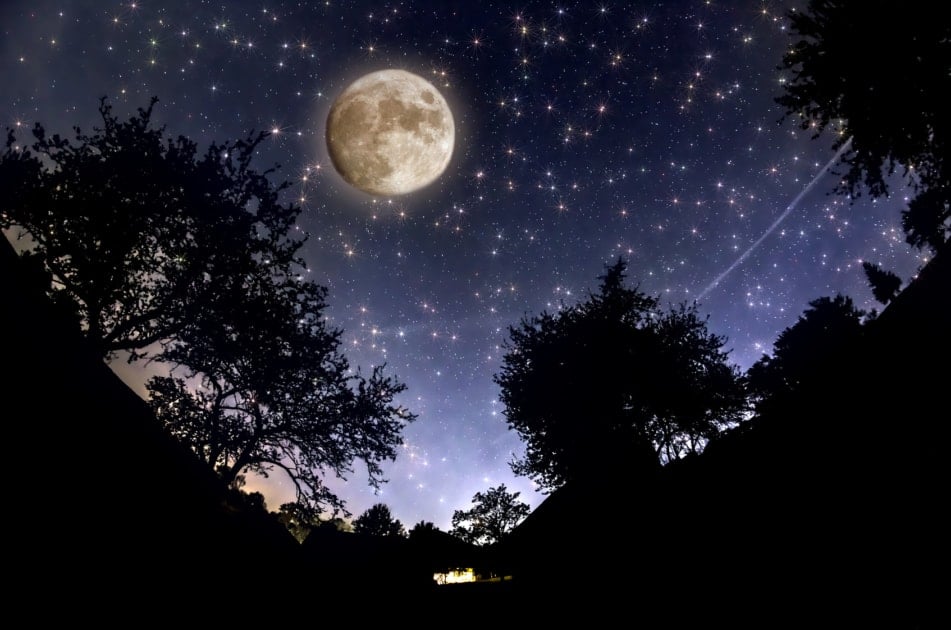
Quick Reference: Where Does the Moon Rise?
- Short answer: yes, the moon always rises in the east and sets in the west.
- Why: Earth rotates west to east, so every celestial body appears to move east to west across the sky.
- Catch: the exact compass bearing of moonrise shifts every night, sometimes 5-10 degrees north or south of due east.
- Tonight’s moonrise direction: check the Almanac’s moon phases page for your ZIP code.
- Full moon: rises closest to due east near the autumnal equinox; farthest north near summer solstice.
Yes, the moon always rises in the east and sets in the west, the same as the sun. But unlike the sun, the moon’s exact rising point on the horizon shifts noticeably from night to night, and across a month it sweeps a wide arc from northeast to southeast. Here is why, and how to figure out where to look tonight.
Why the Moon Rises in the East
Earth rotates from west to east. That rotation makes the sun, moon, planets, and stars appear to march from east to west across the sky each day. The moon is no exception: a moonrise always happens somewhere along the eastern horizon, and moonset happens somewhere along the western horizon.
What changes night to night is the exact compass bearing. The moon orbits Earth on a path tilted about 5 degrees from the plane of Earth’s orbit around the sun (the ecliptic). That tilt, plus the moon’s monthly trip around Earth, means the moonrise point shifts roughly 12 degrees of arc per night against the background stars and several degrees on the horizon.
How to Predict Tonight’s Moonrise Direction
The simplest tool: the Almanac’s moon phases page accepts a ZIP code and returns the exact moonrise time and azimuth (compass bearing) for tonight. “Azimuth 90” means due east; 60 means east-northeast; 120 means east-southeast.
A rough rule of thumb without the page: at the full moon nearest the autumnal equinox (Harvest Moon), moonrise is closest to due east. At the full moon nearest the summer solstice, the full moon rises farthest north of east. At the full moon nearest the winter solstice, the full moon rises farthest south of east. New moons rise within an hour of the sun and follow the sun’s seasonal pattern.

Frequently Asked Questions
Does the moon ever rise in the west?
No. The moon always rises in the east and sets in the west. Apparent movement is governed by Earth’s rotation, which is fixed.
Why does the moonrise direction look different each night?
The moon orbits Earth on a tilted plane, so its rising point on the horizon sweeps from northeast to southeast and back across the month. The full sweep takes 18.6 years and is called the lunar standstill cycle.
Does the moon rise in the same direction everywhere on Earth?
Roughly yes, in the eastern half of the sky for everyone north of about 23 degrees latitude. Within the tropics the geometry is different, and observers in the far south see the moon along a more northern arc.
Why does the full moon look different at moonrise?
The atmosphere scatters blue light when the moon is low, leaving the warm reds and oranges to reach your eye. The shape and color change have nothing to do with the moon itself, only the air it is seen through.



This article was published by the Staff at FarmersAlmanac.com. Any questions? Contact us at [email protected].
- Farmers' Almanac Staff

- Farmers' Almanac Staff

- Farmers' Almanac Staff

- Farmers' Almanac Staff



I had noticed this morning that before daylight savings it set almost due West here in Louisiana, but today it was almost due South. So I looked it up and hear your article was. Thank you, I’m a teacher who definitely learned something today
“Here” your article was
wtf kind of brainless garbage is this
“you might be surprised to learn this thing that only ever happens this way ever”
LOLOLOLOL.
It’s generally referred to as “satire” …aka: a joke!!
@WRE … is that your real name? Interesting. That was my Daddy’s middle name and people called him Wre!
WRE … is that your real name? Interesting. That was my Daddy’s middle name and people called him
To be fair, it may be awkwardly written, but sometimes the moon does NOT rise directly east or set directly in the west. Tonight, in early January, the moon is setting markedly north of true west. In July it will set west-southwest.
Yes. A simple Bing search that brought me here mentions, of course, that depending on the moon’s phase and the time of year the moon doesn’t always rise due east and set due west. E.g. East/ South East or West/ Northwest and so on.
Troll. It was well written for those with understanding. What a sad, pitiful, friendless human.
Nicely said and informative.
It changes daily.