Maple Syrup Facts: 7 Things to Know for the 2026 Sap Season
How many of these maple syrup facts do you know?
Quick Reference
- Best maple syrup facts in one line: a sugar maple gives sap for about 100 years, must be roughly 45 years old before the first tap, and takes 40 gallons of sap to make 1 gallon of finished syrup.
- Top producer: Quebec, Canada makes about three-quarters of the world’s maple syrup, worth roughly $141 million USD a year.
- Sap-flow weather: frosty nights paired with warm sunny days.
- Season cutoff: when buds appear on the trees, in late March or April, the sap turns bitter.
- 2026 Maine Maple Sunday: Sunday, March 22, 2026 (the fourth Sunday in March).
- Sources: University of Vermont Proctor Maple Research Center, Maine Maple Producers Association, and Statistics Canada.
Maple syrup is one of the few foods on a North American table that still depends on weather you can feel: a frosty night, a warm sunny morning, sap rising in a tree that’s been quietly storing sugar all winter. Sunday, March 22, 2026 is Maine Maple Sunday, the official kickoff weekend for the spring sap run across New England. Below are seven maple syrup facts to know before tap season, what the sugar makers are actually watching for, and where the world’s syrup really comes from.
Maple Syrup Facts: Why March Is the Sap Month
March is the month when the sap flows from maple trees. Without a slow, jagged transition from winter to spring, we’d have no maple syrup in this country at all. The sap inside a sugar maple is mostly water, with a small fraction of sugar the tree has been storing since the previous summer. To get it moving, you need the same weather pattern that drives every sugar bush from Vermont to Quebec: nights that drop below freezing, days that climb above. The tree’s vascular system swings between contraction and expansion, and the sap rides that swing up through the trunk. Slow springs are the good ones. A rushed spring shortens the season.
Something good and very sweet does come out of a lazy spring start. If you watch the long-range forecast through February and March, you’re really watching the sap clock. For most regions, the sap window opens any time between mid-February and early April, depending on latitude and elevation. Our Spring 2026 forecast walks through that freeze-thaw window region by region.

7 Maple Syrup Facts
- A maple tree can yield sap (used for making syrup) for 100 years.
- A maple tree must be around 45 years old before it is tapped for syrup making.
- It takes an average of 40 gallons of sap to produce one gallon of syrup.
- Although maple trees are found on other continents, no other continent’s maples can compare in sweetness to the sugar maple trees in North America.
- Frosty nights and warm sunny days encourage the sap to flow.
- When buds appear on the trees, in late March or April, the sap turns bitter in flavor.
- Quebec, Canada is the world’s largest producer of maple syrup and is responsible for about three-quarters of the world’s output, approximately $141 million USD annually.
Who Makes the World’s Maple Syrup
The maple belt is a narrow ribbon. It runs from southern Quebec and Ontario down through Vermont, New Hampshire, Maine, upstate New York, and pockets of Wisconsin, Michigan, and Pennsylvania. Quebec alone keeps the world supplied. The table below uses long-running figures from Statistics Canada and the US Department of Agriculture’s National Agricultural Statistics Service to put the regions in order.
How Sugar Makers Read the Weather
Ask a sugar maker what they’re watching, and you’ll get the same answer in three different accents: nights in the 20s F, days in the 40s F. That swing pumps the sap up the trunk. If the nights stay above freezing, the run stops. If the days never warm, the sap doesn’t move. A long, cold March with reluctant afternoons is the sugarbush’s dream.
Signs the season is closing arrive on the tree itself. Once buds break, the sap chemistry shifts and the syrup picks up an off-flavor sugarhouses call “buddy.” That is the cue to pull the taps for the year. In a typical year, that’s the last week of March in Pennsylvania and Ohio, the first or second week of April in central Vermont and New Hampshire, and the third or fourth week of April in northern Maine and the Eastern Townships of Quebec.
Why North American Sugar Maples Are Different
Maple species grow on every continent except Antarctica. North America has the sugar maple (Acer saccharum) and the red maple (Acer rubrum). Both can be tapped, but the sugar maple’s sap runs roughly twice as sweet as the red maple’s, around 2% to 2.5% sugar versus 1% to 1.5%. The University of Vermont’s Proctor Maple Research Center has spent decades documenting that gap, plus how individual trees in the same stand can swing from 1% to 5% depending on soil, sun, and weather. Sweeter sap means less boiling, less fuel, and more syrup per tap. The European maples are mostly Norway maples and sycamore maples, neither of which carries that sugar content.
Maine Maple Sunday
In the state of Maine, maple syrup is a big deal. Maine Maple Sunday is always the fourth Sunday in March, an opportunity to celebrate syrup at the source. In 2026, that falls on Sunday, March 22. Most sugarhouses in Maine offer free maple syrup samples and demonstrations of how pure Maine maple syrup is made. Many farms add games, activities, treats, sugarbush tours, and music, and the larger producers run the whole weekend rather than the single day. For the official farm map and 2026 schedule, see the Maine Maple Producers Association.
If you’d rather make the syrup yourself, our guide to backyard maple sugaring walks through tapping, collecting, and boiling on a home scale.
Grades and What to Buy
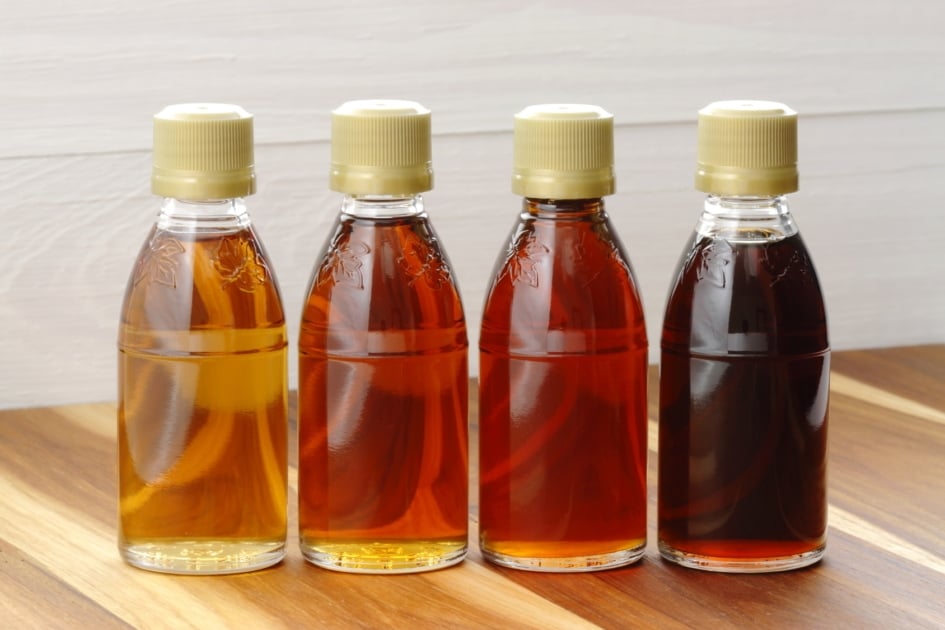
Both Canada and the US moved to a unified four-grade system years back. All four grades are pure maple syrup, and the difference is color and flavor depth, not quality. Early-season sap makes the lightest syrup. Later sap makes a darker, stronger one. None of it is reduced or refined.
- Grade A Golden, Delicate Taste: first sap of the season, lightest color, gentle flavor. Pour-on-pancake favorite.
- Grade A Amber, Rich Taste: mid-season, a touch deeper, the all-purpose pick most home cooks reach for.
- Grade A Dark Color, Strong Taste: later-season, deeper maple character. Good for baking and glazes.
- Grade A Very Dark, Strong Taste: last of the run, deep and pronounced. Best for cooking, marinades, and barbecue sauces.
Shelf life on an unopened bottle is about 18 months. Once opened, keep it in the refrigerator and use within six months. If a thin layer of mold ever forms, the syrup is usually fine after a strain and a brief reboil, since pure maple syrup is too high in sugar to harbor most pathogens.
A Brief History of the Sap Bucket
Indigenous peoples in the Northeast were tapping maples long before European arrival, using slashes in the bark and hot stones dropped into wooden vessels to boil the sap down. Early settlers in New England and Quebec adopted the practice almost immediately, and by the late 1700s, a tin tap and a wooden bucket were standard. Modern sugarhouses now use food-grade plastic tubing, vacuum pumps, and reverse-osmosis machines to remove water from the sap before the boil. The flavor target hasn’t changed in 200 years. The fuel bill has.
Plan Your Sugaring Visit
If you want to see a sugar bush running, the safest weeks are the last week of March through the second week of April for southern New England, and the first three weeks of April for northern Maine, Vermont, New Hampshire, and Quebec. Pick a weekend with a forecast of cold nights and sunny afternoons. Visiting on a warm, drizzly day usually means the buckets are empty and the evaporator is idle. The Best Days calendar can help with the picnic side, but the sap chooses its own day.

Frequently Asked Questions
What are the most important maple syrup facts to know?
A sugar maple must be roughly 45 years old before it can be tapped, yields sap for about 100 years, and takes 40 gallons of sap to finish 1 gallon of syrup. Frosty nights with warm sunny days drive the sap run. Quebec, Canada makes around three-quarters of the world’s supply, and the season closes once buds appear and the sap turns bitter.
How many gallons of sap make one gallon of maple syrup?
Roughly 40 gallons of sap boil down to 1 gallon of finished maple syrup. The exact ratio depends on the sugar content of the sap that season. Sweet sap (closer to 2.5%) takes fewer gallons. A run of low-sugar sap (closer to 1.5%) needs more.
What weather makes the sap flow?
Frosty nights and warm sunny days. Sugar makers want overnight lows in the 20s F and afternoon highs in the 40s F. That freeze-thaw swing pulls sap up the trunk and into the tap.
When is Maine Maple Sunday 2026?
Sunday, March 22, 2026. The event is always held on the fourth Sunday in March. Most Maine sugarhouses run open-house tours, free samples, and demonstrations of how pure Maine maple syrup is made.
How old must a maple tree be before it is tapped?
About 45 years old. Sugarbush owners look for a trunk at least 10 to 12 inches in diameter at chest height before they put a tap in. A healthy sugar maple can yield sap for around 100 years once it reaches tapping size.
Who produces the most maple syrup in the world?
Quebec, Canada. The province makes about three-quarters of the world’s maple syrup, worth roughly $141 million USD a year. Vermont is the largest US producer, followed by New York and Maine.
Why does maple syrup taste different later in the season?
Once buds appear on the trees, in late March or April, the chemistry of the sap shifts and the syrup picks up a stronger, slightly off flavor sugarhouses call “buddy.” That is the signal to pull the taps for the year. The earliest sap of the season makes the lightest, mildest syrup.
Can I tap a maple tree in my own yard?
Yes, if you have a sugar maple, red maple, or silver maple at least 10 inches in diameter. Tap on the south side of the trunk in late February or early March, collect sap as the temperatures swing, and boil it down outside on a wood fire or propane burner. Our guide to backyard maple sugaring walks through the steps.


Deborah Tukua
Deborah Tukua is a natural living, healthy lifestyle writer and author of 7 non-fiction books, including Pearls of Garden Wisdom: Time-Saving Tips and Techniques from a Country Home, Pearls of Country Wisdom: Hints from a Small Town on Keeping Garden and Home, and Naturally Sweet Blender Treats. Tukua has been a writer for the Farmers' Almanac since 2004.
- Deborah Tukua

- Deborah Tukua
- Deborah Tukua
- Deborah Tukua