

Why Do Fireflies Glow? 10 Illuminating Facts About Lightning Bugs
Check out these "illuminating" facts about these fascinating insects.
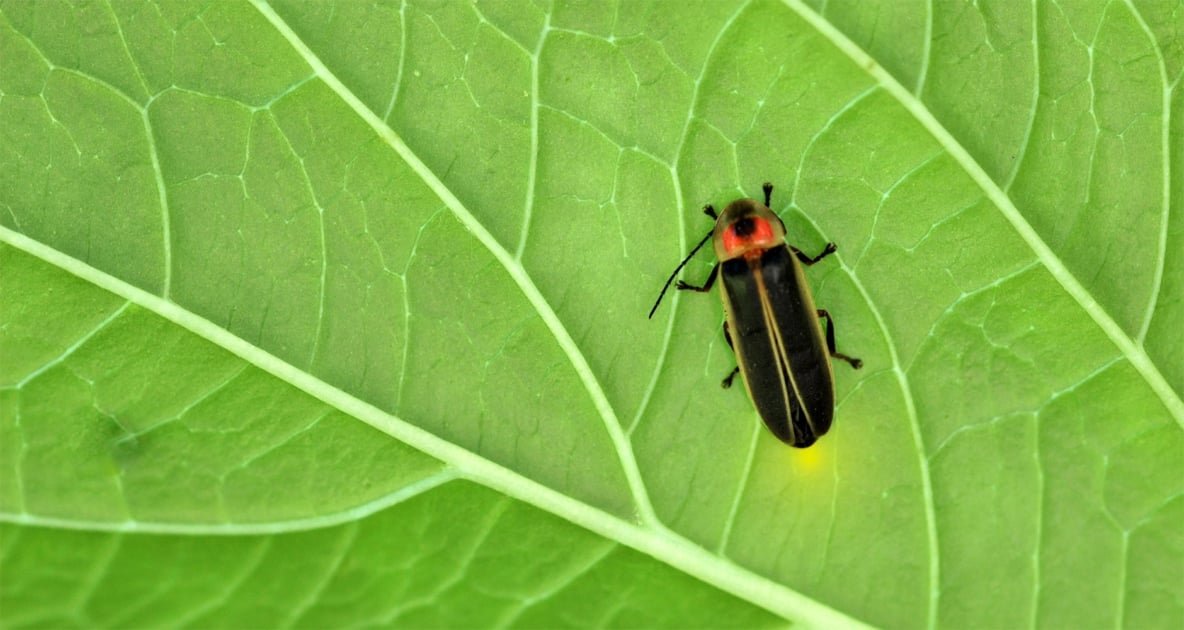
Quick Reference: Fireflies
- Family: Lampyridae. They are actually beetles, not flies. About 2,000 species worldwide, roughly 175 in North America.
- How the glow works: a chemical reaction of luciferin + luciferase + ATP + oxygen + magnesium. Efficiency is near 100 percent (no waste heat).
- Why they flash: mating code. Each species has its own pattern (J-shape, single flash, double, triple). The glow also warns predators they taste bitter.
- Where to see synchronous fireflies (U.S.): Photinus carolinus peaks late May to mid-June at Great Smoky Mountains National Park (TN), Congaree (SC), and Allegheny National Forest (PA). Lottery only at GSMNP.
- Best night to look: warm (above 70°F), humid, no moon, no breeze. First two hours after dusk.
- Why fewer this year: light pollution, lawn pesticides, and habitat loss are the main suspects. Leave the porch light off and let a corner of the yard go wild.
Many backyards are already aglow with magical fireflies, or lightning bugs as many people call them. On warm evenings, there is nothing better than sitting and watching them light up the night. Here are a few fascinating facts about fireflies you may not know, along with where to catch the rare synchronous show in the eastern U.S. (the National Park Service page on Smoky Mountain fireflies publishes the predicted peak window each year).
10 Fascinating Facts About Fireflies
- It is not just the adult firefly that lights up. Among some species, the eggs glow, and the eggs of certain species will flash if you tap them gently. Most larvae, often called glowworms, are also capable of producing light.
- They are energy efficient. No man-made light source can claim to be entirely energy efficient, but a firefly’s glowing tail uses 100 percent of the energy it produces to emit light. By comparison, the average incandescent lightbulb releases 90 percent of its energy as heat and 10 percent as light, while fluorescent bulbs release 30 percent as heat and 70 percent as light.
- The flashing is more than just a pretty light show. Among the species of fireflies that produce a glow, each one has its own unique flash pattern, and they use the flashes to attract mates. Females wait in tall foliage, flashing to attract males. The males flash in response as they move closer to the females. The glow is also a handy way to repel predators. Since fireflies produce bitter chemicals as a response to predators, most insect-eating animals know that if it lights up, it tastes bad.
- It is easy to identify fireflies by their flash patterns. Photinus pyralis is one of the more common types found in the United States, and this species always makes a J-shaped flash by lighting up as they fly in an arc. Photinus brimley flies in a straight line and produces one flash every three to eight seconds. Photinus consimilis makes a double flash every five seconds, and Photinus collustrans flashes three times in two to three seconds.
- Some fireflies are tricksters. While adults of most species eat pollen or smaller insects, some females of the Photuris genus prey on male lightning bugs of other species. They will lure the males in by mimicking their flash patterns. And, since female Photuris fireflies gravitate toward the flash patterns of different species, male Photuris fireflies mimic those species to attract the females.
- Not all fireflies make yellow or green light. Pyractomena lightning bugs, for instance, create orange light. In the southern United States, you may chance across Phausis reticulata, or the Blue Ghost lightning bug. Blue Ghosts do not flash at all; instead, they produce a soft but steady blue glow. Others, particularly those that live in the western United States, do not light up at all.
- Some fireflies can actually synchronize their flashes. In the United States, there is only one synchronous species, Photinus carolinus, and there are only a few spots to watch as they put on one of nature’s greatest light shows. You can catch a glimpse in the Allegheny National Forest in Pennsylvania or the Congaree National Park in South Carolina. The best place to watch, however, is the Great Smoky Mountains National Park in Tennessee. People flock to this park every May and June to watch as thousands of lightning bugs produce perfectly timed flashes.
- Lightning bugs glow because their tails contain just the right chemicals and enzymes (calcium, adenosine triphosphate, luciferin, and luciferase) to create a bioluminescent chemical reaction. These insects control the flashing by adding oxygen to start the chemical reaction within the light-producing organ in their tails.
- They help save lives. Researchers have discovered that the luciferase produced by fireflies is useful for anything from detecting blood clots to tracking the efficacy of cancer medications. Scientists have learned how to make synthetic luciferase, which means the medical industry no longer needs to harvest this bioluminescent chemical from them.
- They have surprisingly short lifespans, only one season. They spend most of their adult lives searching for a mate. Once mated, the females lay their eggs and die shortly thereafter. New crops hatch the following spring and the cycle starts over.
Read: Are fireflies disappearing?
Where to See Synchronous Fireflies in the U.S.
| Location | State | Primary species | Peak viewing window | Access and notes |
|---|---|---|---|---|
| Elkmont, Great Smoky Mountains National Park | TN/NC | Photinus carolinus | Late May to mid-June (exact dates vary roughly two weeks year to year) | Most well-known synchronous firefly event in the US. NPS runs a ticketed vehicle lottery via Recreation.gov for a roughly two-week viewing window. Shuttle buses operate from a designated parking area. Demand far exceeds capacity; apply early in the season. |
| Congaree National Park | SC | Photinus carolinus | Mid-May to early June | Free entry. NPS recommends arriving early in the evening. Significantly less crowded than the Smokies. The synchronous display occurs in the floodplain old-growth forest. Ranger-led programs offered during peak season. (NPS Congaree) |
| Allegheny National Forest (Allegheny Highlands area) | PA | Photinus carolinus and other species | Late May to mid-June | No lottery required. Pennsylvania Wilds program hosts guided evening events. Multiple viewing sites available across the forest. Good option for self-guided visitors who want flexibility. (Pennsylvania Wilds) |
| Rocky Fork State Park | TN | Photinus carolinus | Late May to mid-June | State park with no lottery system as of recent seasons. A quieter alternative to the Smokies event, located in the Unicoi Mountains. Viewing is accessible from park trails. |
| Watoga State Park | WV | Photinus carolinus | Late May to early June | West Virginia Highlands Conservancy hosts an annual firefly festival here. Backcountry camping available. Less commercialized than the Smokies experience. |
| Grandfather Mountain | NC | Photinus carolinus and Photuris species | Late May through June | Private attraction; admission required. Elevation variation across the site extends the effective viewing season compared to lower-elevation locations. Multiple species are present, extending the overall display period. |
| Natchez Trace Parkway (Jeff Busby Site and Tishomingo area) | MS | Local Photinus species; synchrony less pronounced than P. carolinus | Late May to June | NPS land; free access. Lesser-known option in the Deep South. The flashing pattern is coordinated but not the millisecond-simultaneous display of P. carolinus. Good for visitors seeking firefly viewing without traveling to Appalachia. (NPS Natchez Trace Parkway) |
| Guided tours via Firefly Conservation and Research (firefly.org) | PA, OH, and other states | Multiple species (guided for species-level ID) | June (varies by site) | Organized through firefly.org. Private landowner access arranged through the organization. Excellent for species-level identification and education. Contact firefly.org for current event calendar. |

Firefly FAQ
Why do fireflies glow?
A bioluminescent reaction in a light-producing organ in the tail. Luciferin (the substrate) and luciferase (the enzyme) react with ATP, oxygen, and magnesium. The reaction is nearly 100 percent efficient, almost no waste heat.
Are fireflies actually flies?
No. They are beetles in the family Lampyridae, related to soldier beetles and click beetles. The “fly” in firefly is a misnomer.
When and where can I see synchronous fireflies?
Great Smoky Mountains National Park (lottery only) is the famous spot, peaking late May to mid-June. Congaree NP in South Carolina and Allegheny National Forest in Pennsylvania also host Photinus carolinus peaks.
Are fireflies disappearing?
In many regions, yes. The main causes are light pollution (males and females cannot find each other through artificial light), lawn pesticides killing larvae, and habitat loss in damp meadows and forest edges.
How long do fireflies live?
As adults, only two to four weeks, just long enough to mate and lay eggs. As larvae they can live for one to two years underground or in leaf litter, eating snails, slugs, and worms.
How can I attract fireflies to my yard?
Turn off outdoor lights at night. Skip the lawn pesticides. Leave a corner of the yard “messy” with leaf litter and tall grass. Plant native shrubs near a damp spot. Adults need darkness; larvae need slugs and snails.
Why do some fireflies flash different colors?
The exact mix of luciferase variants and the temperature of the abdomen tunes the glow color. Most species glow yellow-green; Pyractomena glows orange; the southern Blue Ghost glows steady blue.
Watch this footage of the Tennessee Fireflies lighting up the sky in the Great Smoky Mountains. For more backyard nature reading: animal weather forecasters, facts about spring peepers, and what the cardinal in your yard might mean.



Amber Kanuckel
Amber Kanuckel is a freelance writer from rural Ohio who loves all things outdoors. She specializes in home, garden, environmental, and green living topics.
- Amber Kanuckel

- Amber Kanuckel

- Amber Kanuckel
- Amber Kanuckel





This is the first year I have seen fireflies in my back yard and they flash orange! It’s nice to see them again! I’ve been here since 2003!
I spy a lighning bug 2021 interlachen fl. April 14th
I have enjoyed 31 summers of lighting bugs all thru an over 200 yr old oak in my front yard & pasture. Watching my kids & now grand kids catch & release them.
I have noticed that the fire flies have declined a bunch this year. It might because of all the rain and cool tempatures this spring. I really miss them.
I live in luray va. I have been watching the lighting bugs for the last few weeks, and I noticed that they come up from the ground, and go straight up in the trees and stay there all night, not very many flying around, but the trees are pretty, looks like Xmas lites, does anyone know why ,they mostly stay in the tree
Mating and laying eggs
I have seen synchronous firefly displays in northern Ohio.
I have seen fireflies (or as we Kansan’s call them lightning bugs) every evening for the last few weeks. Coincidentally it has been very humid here, a wet spring to say the least. So I was wondering, do fireflies become active as the rain moves through the area? Or is it just a coincidence? Either way I’ve been chasing them around for over 50 years and now I watch my grand kids as they experience the great lightning bug chase in the dark.
You look tasty x
All us normal people call them lightning bugs. Only geeks call them fireflies.
I enjoyed reading this article and I was excited to see the video of all the lightning bugs, as we called them. I still sometimes see lightning bugs but there doesn’t seem to be as many as there once was. So sad.
Hi Gary, we’re so glad you enjoyed it! Yes, we called them lightning bugs, too. We also ran another story in early spring about what causes them to “appear” and it’s all about the weather — this might answer the question about why you haven’t seen as many. Take a look: Are Fireflies Disappearing?
There really are flashing fireflies in the west but you have to know where to look. It has often been said that there are none west of Kansas or none west of the Rocky Mountains but I have seen 8 different locations within 30 minutes drive from my home in Utah. They are just being rediscovered here but older people I know who grew up on farms here used to catch them when they were children. One of those was catching them 80 years ago. I only learned about fireflies in Utah about 4 years ago when there was a local newscast about it. I have lived here since the 1960’s and was always told that there are no fireflies. Now I go out many nights during the summer to help discover new locations. The Utah Museum of Natural History website started a map that shows more than 100 reported locations all over the state. Do a Google search for Utah Firefly map. They are even in southern Utah in the desert near Moab and Lake Powell but always near water as expected. There are many reports in all of the other western states too but I haven’t seen them there myself yet. Another good map of fireflies in the U.S. is found by googling Museum of Science Firefly Watch.
My wife and I, here in SE Wisconsin, notice that every time a firefly glows it is rising — never flying level or descending. Can anyone tell us why?
Well start breeding fireflies to light up Tenney Mountain for night Skiing