Summer Triangle: How to Spot Vega, Deneb, and Altair
No, it's not a summer romance at the Box Office, but a celestial event you don't want to miss. Learn more about this shining asterism now showing during August evenings at a sky above you!
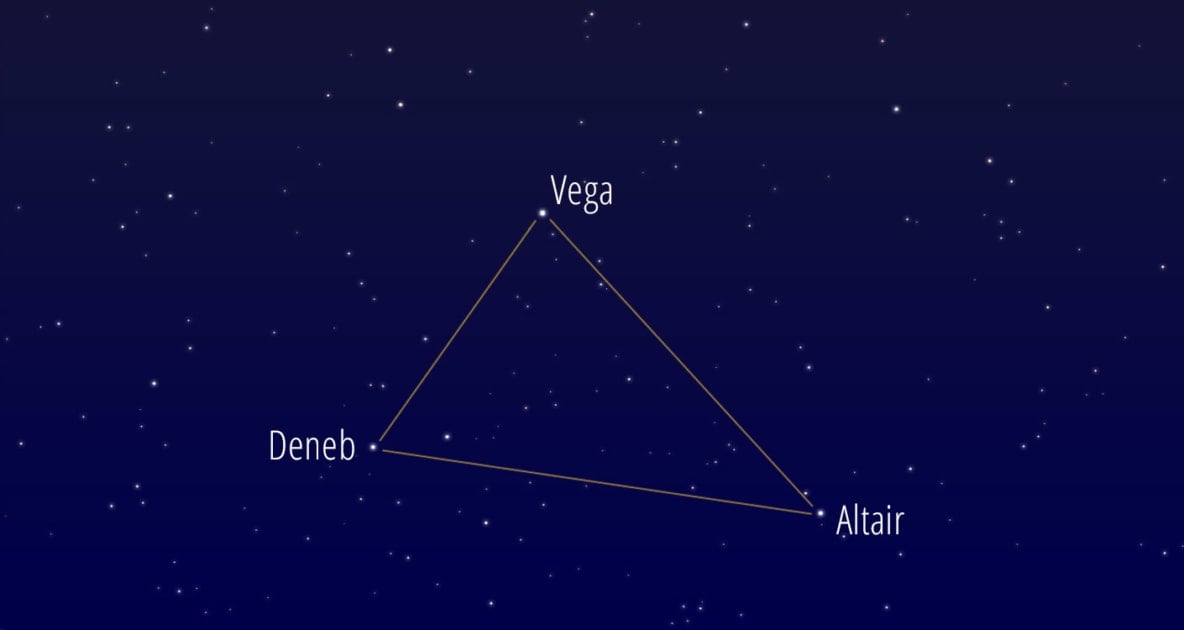
Quick Reference: The Summer Triangle
- What it is: an asterism, or star pattern, formed by three bright stars in three different constellations.
- The three stars: Vega in Lyra the Lyre, Altair in Aquila the Eagle, and Deneb in Cygnus the Swan.
- When to look: visible somewhere in the night sky all year from the Northern Hemisphere, and at its highest and most prominent on summer evenings.
- Where to look: toward the south as soon as it gets dark, climbing high overhead by late evening.
- Brightest star: Vega, which appears twice as bright as Altair and more than three times brighter than Deneb.
Skip the screen tonight and step out into the yard instead. On just about any clear evening this summer of 2026, you can look up and trace the Summer Triangle, one of the easiest star patterns to learn. It is not a summer romance at the box office. It is a shining pattern of stars that has hung over August nights for as long as people have watched the sky.
Joe Rao, Farmers’ Almanac’s contributing astronomer, tells us that those of us living in the Northern Hemisphere can see the famous Summer Triangle asterism at some point during the night any time of year. But summer is when it is at its most prominent. It appears toward the south as soon as it is dark and climbs high overhead by late evening.
“You can’t miss it because the triangle is composed of three of the brightest stars in the sky, each of which is the brightest star in its own constellation,” says Rao.
What Is an Asterism?
An asterism is a recognizable pattern of stars that is not an official constellation on its own. The Big Dipper is the most famous example. The Summer Triangle is another. Its three corners belong to three separate constellations, so the shape stitches together a big piece of the summer sky rather than sitting inside one named figure. That is part of why it is such a handy guidepost. Once you find the Triangle, the smaller constellations around it are easier to pick out.
The 3 Stars of the Summer Triangle
The brightest is the bluish-white star Vega, in the constellation Lyra the Lyre. Next in brightness is yellow-white Altair in the constellation Aquila, the Eagle. Finally, there is white Deneb, in Cygnus, the Swan. Each one is the brightest star in its home constellation, which is why the pattern is so simple to trace even under a suburban sky.
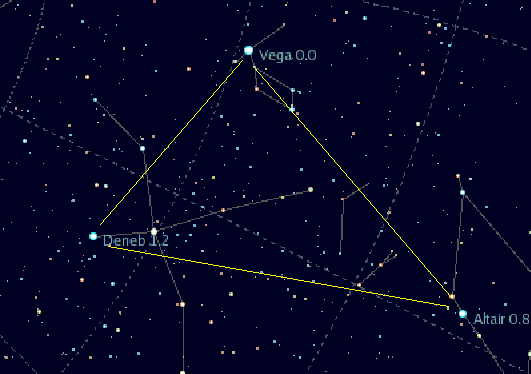
Cygnus the Swan is worth a second look. Its long neck and outstretched wings also form a shape many stargazers know as the Northern Cross, with Deneb marking the tail of the swan and the top of the cross. If you enjoy learning the summer sky this way, our roundup of constellations to know and our astronomy guides will help you keep going once the Triangle is fixed in your memory.
How Far Away Are the Three Stars?
From our viewpoint, Vega appears twice as bright as Altair and more than three times brighter than Deneb. But sometimes things are not always what they seem. Astronomers know, for instance, that Vega clearly is more luminous compared to Altair, because it is situated at a greater distance from us. Altair is 17 light-years away, while Vega is 25. The light you see from Vega tonight started on its journey to Earth in 1994.
Vega actually pales in comparison with Deneb, one of the greatest supergiant stars known. Deneb’s distance measures 1,467 light-years from Earth, with a luminosity computed to be more than 80,000 times that of our Sun. But because its light takes nearly 15 centuries to reach us, Deneb merely appears as a fairly conspicuous but by no means particularly notable star. In other words, the dimmest corner of the Triangle is by far the most powerful star of the three. It only looks modest because it sits so far out in the galaxy.
A light-year is the distance light travels in one year, roughly 6 trillion miles, so these numbers double as a small time machine. When you look at Deneb, you are seeing light that left the star around the year 559, give or take, long before almost any building you know was standing.
How to Find the Summer Triangle Tonight
You do not need a telescope or a star app. Wait until the sky is fully dark, then find the brightest star nearly overhead. That is Vega. From there, look for the two other bright points that complete a wide triangle. Altair sits lower in the south, and Deneb lies off to the northeast, toward the horizon you face away from the city glow.
- Give your eyes 15 to 20 minutes to adjust to the dark before you start.
- Get away from porch lights and streetlights when you can. Darker skies make Deneb and the Milky Way easier to see.
- Look up around 10 p.m. in July and August, when the Triangle rides high overhead.
- A pair of binoculars turns the star field between the three corners into a dusting of hundreds of faint stars.
The band of the Milky Way runs right through the Summer Triangle, passing close to Deneb and down toward the southern horizon. Under a dark country sky, that hazy river of light is one of the finest sights of the season. A brighter Moon washes it out, so check the Full Moon dates and times and plan your best viewing for the nights around a New Moon.

What Else to See Near the Summer Triangle
The Triangle is a front-row seat for the best of summer. In August, the Perseid meteor shower throws its streaks across this part of the sky, and the Triangle makes a handy frame for watching. For the full season of shooting stars, our meteor shower calendar lists the peak nights, and our guide to the visible planets tracks what is up each month. The Triangle rides high through the dog days of summer and stays with us into autumn.
Want a closer look at the pattern itself? Check out this NASA picture of the day of the Summer Triangle (mouse over the picture to see it appear). NASA’s own skywatching guides are a good companion if you want to keep learning what is overhead each month.
Check it out. Tonight, when the sky is dark, see if you can spot this triangle. Once you have found it, it is yours for every summer to come.

The Summer Triangle: Frequently Asked Questions
What is the Summer Triangle?
The Summer Triangle is an asterism, a recognizable star pattern that is not itself an official constellation. It is formed by three bright stars, Vega, Deneb, and Altair, each of which belongs to a different constellation. Because the shape spans a big piece of sky, it works as a guidepost for finding other summer stars.
What are the three stars of the Summer Triangle?
They are Vega in the constellation Lyra the Lyre, Altair in Aquila the Eagle, and Deneb in Cygnus the Swan. Each star is the brightest one in its home constellation, which makes the Triangle easy to trace. Vega is bluish-white, Altair is yellow-white, and Deneb is white.
When can you see the Summer Triangle?
From the Northern Hemisphere you can catch it at some point during the night any time of year, but summer is when it is most prominent. It appears toward the south as soon as it gets dark and climbs high overhead by late evening. July and August nights around 10 p.m. are ideal.
Which star in the Summer Triangle is the brightest?
Vega is the brightest of the three. From our viewpoint on Earth it appears twice as bright as Altair and more than three times brighter than Deneb. Vega is 25 light-years away, and Altair is closer at 17 light-years.
Why does Deneb look dim if it is so powerful?
Deneb is one of the greatest supergiant stars known, with a luminosity more than 80,000 times that of our Sun. It looks modest only because it is so far away. Deneb’s distance measures 1,467 light-years from Earth, and its light takes nearly 15 centuries to reach us, so it appears as a conspicuous but not especially notable star.
How do I find the Summer Triangle without a telescope?
You do not need any equipment. Once the sky is dark, look nearly overhead for the brightest star, which is Vega. From there, find the two other bright points that complete a wide triangle, with Altair lower in the south and Deneb off to the northeast. Darker skies away from streetlights make the whole pattern, and the Milky Way running through it, much easier to see.


This article was published by the Staff at FarmersAlmanac.com. Any questions? Contact us at [email protected].
- Farmers' Almanac Staff

- Farmers' Almanac Staff

- Farmers' Almanac Staff

- Farmers' Almanac Staff