

29 Spring Weather Lore Sayings About Rain and Harvest
Quick Reference
- What this is: 29 traditional spring weather lore sayings, sorted by rain, March, April, May, and June.
- Headline rain rule: Rain before 7 means clear before 11. Rain after 7 means rain all day.
- Spring saint days to watch: St. Joseph (March 19), Lady Day (March 25), All Fool’s Day (April 1), May Day frost (May 1).
- Animal signs: Loud robins call rain. Loud frogs call more rain. Ants closing their hills call rain within two days.
- Farmer’s rule of thumb: A cold wet April fills the barn. A dry May and a wet June makes the farmer whistle.
- Best companion read: The Almanac Spring Forecast and Average Frost Dates.
“April showers bring May flowers” is the spring weather saying that everyone knows. There are dozens more behind it, most of them older than the country, all of them carried forward by farmers who needed to read the season the way modern households read a phone. Read these out loud, test them against the spring you are watching, and tell us which ones still hold up.

Weather Lore Sayings About Rain
- Rain before 7 – clear before 11.
Rain after 7 – rain all day. - If it rains on the first Sunday of the month, every Sunday except one usually will be wet.
- When the ants close up their hills, we will have rain in a day or two;
if the ant hills are open, it will continue to be fair. - When leaves turn over, it’s a sign of rain.
- Variable wind indicates a coming storm.
- When robins call loudly and steadily, it will rain soon.
- Three foggy mornings and then a rain.
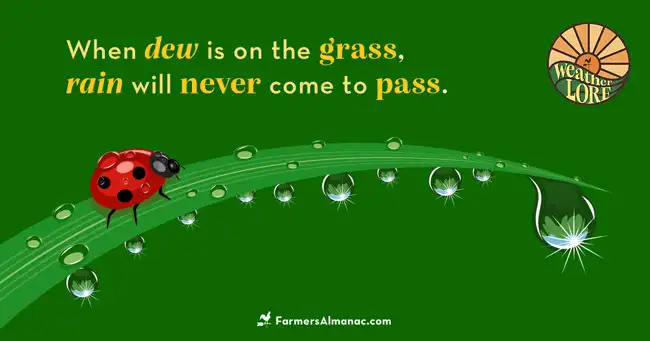
- No dew in the morning indicates rain.
- Low banks of haze in the south indicate rain.
- Step on a spider and it will surely bring rain.
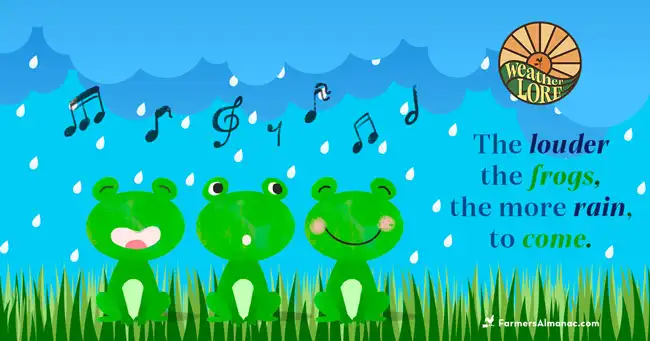
- The louder the frog, the more rain to come.
RELATED: Spring Peepers: Why Frogs Sing
March Weather Lore Sayings
- Is’t on St. Joseph’s day (19th) clear,
So follows a fertile year;
Is’t on St. Mary’s (25th) bright and clear,
Fertile is said to be the year.
RELATED: Spring Weather Forecast
April Sayings
- If it thunders on All Fool’s Day, it brings good crops of corn and hay.
- A cold May and a windy April, a full barn.
- March’ll search ye, April try ye; May’ll tell, whether live or die ye.
- If the oak is out before the ash then we are in for a splash;
But if the ash is out before the oak we are in for a soak. - April cold and wet fills barn and barrel.
- When April blows its horn
Then it stands good with hay, rye, and corn. - A cold and moist April fills the cellar and fattens the cow
May Sayings
- A dry May and a leaking June
Make the farmer whistle a merry tune. - Look at your corn in May,
And you’ll come sorrowing away;
Look at it again in June,
And you’ll come singing another tune. - A dewy morning brings a good haying day.
- A heavy dew at night promises a good day to follow.
- Hoar-frost on the 1st of May indicates a good harvest.
RELATED: Average Frost Dates – See Yours!
June Sayings
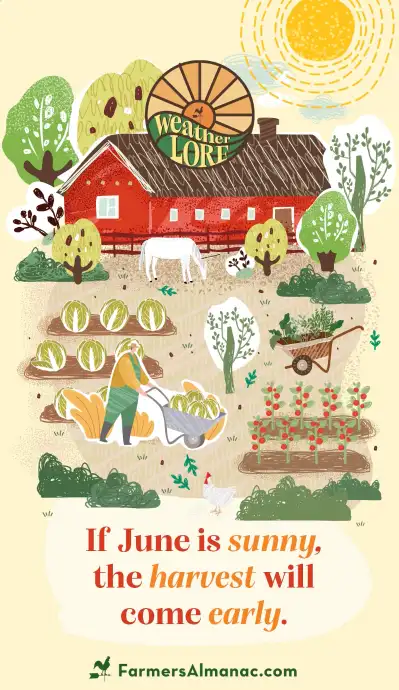
- If June is sunny, the harvest will come early.
- In June, when there is no dew, it indicates rain.
- A cold and wet June spoils the rest of the year.
- June, damp and warm, does a farmer no harm.
- A good rain in June sets all in tune.
RELATED: More June Weather Sayings
Do These Sayings Actually Hold Up?
Some yes, some no, some only in the place they were written. The rain-before-7 rule is a fair read on warm-front passage in the eastern United States. Loud calling robins and frogs are tied to falling barometric pressure, which animals sense before people do. Saint-day signs are pure folklore, but they survived because farmers needed a fixed date to score the season against, and the church year gave them one.
The National Weather Service publishes its monthly outlooks at the Climate Prediction Center, which is a fair scientific check on any folk reading you make. The Farmers’ Almanac pairs the lore with our own math-based long-range forecast, so the two systems agree more often than not.
Three Buckets the Sayings Fall Into
- Animal sayings. Robins, ants, frogs, and spiders read pressure and humidity changes before people feel them. The folk reading is right; the timing window is short, usually a few hours to a day.
- Saint-day sayings. St. Joseph (March 19), Lady Day (March 25), All Fool’s Day (April 1), and May Day frost (May 1) all fix the calendar. The accuracy varies by region.
- Farmer-economy sayings. A cold wet April fills the barn. A dry May and a wet June makes the farmer whistle. These are not really weather predictions. They are crop-yield observations dressed in weather language.
Spring Across the United States and Canada
| Region | Typical spring shape | Lore that fits best |
|---|---|---|
| Northeast (US) | Late frost, mud season, peak peeper chorus | Frog sayings, oak-and-ash sayings, May Day frost |
| Midwest + Great Lakes | Cold wet Aprils, big June thunderstorms | April-fills-barn, June rain sayings |
| South (US) | Early warm-up, thunderstorm season | Thunder sayings, ant-hill sayings |
| Mountain West | Late snow, fast melt, dew-driven mornings | Dew sayings, hoar-frost-on-May-1 |
| Pacific Northwest | Long wet shoulder season into June | Three-foggy-mornings, June-damp-and-warm |
| Southern Canada | Late thaw, robin return, short planting window | Robin sayings, oak-and-ash, Lady Day clear |

Frequently Asked Questions
Is spring weather lore actually accurate?
Animal-pressure sayings work reasonably well within a short window of a few hours to a day. Saint-day sayings vary by region and have to be tested year over year. Farmer-economy sayings are crop observations more than weather forecasts, but they hold up across long stretches of farm history.
Why do ants close their hills before rain?
Ants react to falling barometric pressure and rising humidity. Closing the entrance protects the colony from flooding. The signal is real, but the lead time is usually only a few hours, not a day or two as some folk versions say.
What does “the oak before the ash” mean?
The English oak and the European ash leaf out at slightly different times depending on spring temperatures. The folk reading is that an early oak means a dry summer and an early ash means a wet one. In North America, the same observation can be made with red oak and white ash, with the same caveats.
When is May Day frost most likely in the United States?
In the northern tier of the United States and most of Canada, a hoar frost on the morning of May 1 is not unusual. See our average frost dates for your zip code to gauge how late your last frost typically falls.
Should I plant by spring weather lore?
Treat the lore as a nudge, not a planting calendar. Combine it with your local frost-date map, soil temperature, and the Almanac’s Gardening Calendar to time the rows.
Where do these spring sayings come from?
Most are British, Irish, German, and French farm rhymes that came over with settlers. The Farmers’ Almanac has carried versions of them since 1818, paired with the math-based long-range forecast that is the publication’s distinct contribution.
Why does the louder frog mean more rain?
Frogs call more loudly when humidity is high and air pressure is dropping, both of which often precede rain. The sound carries farther on humid air too, which makes the chorus seem louder than it actually is.
Join the Discussion
Do any of these spring weather lore sayings ring true where you live? Tell us which ones your grandparents swore by, which ones still play out in your fields, and any local sayings we missed. Comment below and we will fold them into the next round.

This article was published by the Staff at FarmersAlmanac.com. Any questions? Contact us at [email protected].
- Farmers' Almanac Staff

- Farmers' Almanac Staff

- Farmers' Almanac Staff

- Farmers' Almanac Staff

I heard a meteorologist say one time if the cows are lying down it’s means rain.
Red sky in the morning sailors warning. Red sky at night sailors delight.
My mother taught us that when we were quite young and I found it to always be true.
My grandmother taught me this when I was about 4 years old. That was in 1947.
If it rains and the suns out it will rain tomorrow!
True! My grandparents told me this and I’ve found it to be true more than not.
If it’s raining and the sun is shining, the devil’s beating his wife.
My Dad said; “When hornets build their nests near the ground, expect a cold and early winter.”
I heard that there are 3 winter spells before summer, endogwood winter, blackberry winter and linen breeches winter. It this correct?
Wash your car and it will rain
April showers bring May Flowers!
If it rains on Easter Sunday it will rain seven Sunday’s in a row immediately following Easter.
heard that more than a few times and also experienced it.
March always borrows 12 days of April.
I heard growing up: “A dry June will scare you to death and a wet June will starve you to death.”