

7 Scary Christmas Characters: Krampus and Other Legends
These Christmas legends from around the world are so sinister, you'll want to be good, for goodness' sake!
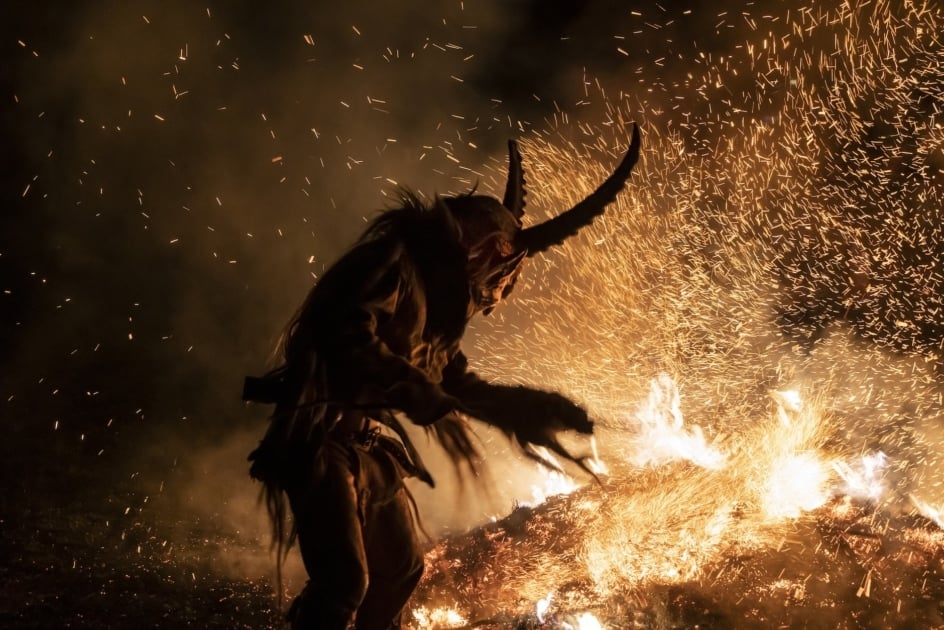
Quick Reference: 7 Scary Christmas Characters
- Krampus (Alpine Europe): horned companion to St. Nicholas who swats naughty children with birch sticks on December 5.
- Belsnickel (Germany to Pennsylvania Dutch country): fur-clad visitor carrying candy in one hand and a switch in the other.
- Frau Perchta (Germany and Austria): the “Witch of Christmas” who rewards the tidy and guts the lazy.
- Mari Lwyd (Wales): a hooded horse skull that challenges households to a battle of rhymes.
- Grýla and the Yule Cat (Iceland): a child-eating ogress and a cat that hunts anyone without new clothes.
- La Befana (Italy): a broom-riding witch who fills stockings on Epiphany Eve, January 5.
- Hans Trapp (Alsace, France): a scarecrow-clad hermit who carries off misbehaving children.
Be good, for goodness’ sake, or a horned creature named Krampus may come looking for you. Long before twinkling lights, jingle bells, and jolly St. Nick, the darkest days of the year belonged to a cast of frightening visitors who kept children in line. Here are seven scary Christmas characters from European folklore, where they came from, and the old beliefs that gave them their bite.
End-of-Harvest Legends and Lore
For centuries, pre-Christian cultures marked the end of the harvest in the darkest days of the year with raucous celebrations, and some truly terrifying figures from their religious and cultural heritage worked their way into the festivities. With the long nights came an old belief that the veil between this world and others was at its thinnest, letting these creatures cross over and deal with people for good or for ill.
As Christianity spread, many of these legends softened over the years to sit more easily beside the new faith. Yet in the hearts of people across Europe, belief in the old characters held on. So while St. Nicholas visits on Christmas Eve, ancient creatures from Europe’s forests and mountains still play their part, reminding young children to be on their best behavior.
Where These Legends Come From
Most of these figures are older than the holiday they now share. They grew out of midwinter customs tied to the winter solstice, the shortest day of the year, when farming communities feasted through the long nights and told stories to explain the cold and the dark. The threat of a punishing visitor was, in plain terms, a way to keep restless children close to the hearth during the most dangerous stretch of the calendar.
The belief spread across at least four European countries and regions as travelers, traders, and later emigrants carried the stories with them. German-speaking lands gave us Krampus, Belsnickel, and Frau Perchta. Wales kept the Mari Lwyd. Iceland raised Grýla and her Yule Cat, and Italy softened its witch into the beloved La Befana. Many of these customs cluster around fixed dates on the old calendar, from St. Nicholas Eve to Twelfth Night and the Twelve Days of Christmas. Here is a quick map of who appears where, and when.
| Character | Region or Country | When They Appear |
|---|---|---|
| Krampus | Alpine Austria, Germany, and Central Europe | December 5, St. Nicholas Eve |
| Belsnickel | Southwestern Germany, France, Switzerland, and Pennsylvania Dutch country | The weeks before Christmas |
| Frau Perchta | Germany and Austria | The last three Thursdays before Christmas, through Twelfth Night |
| Mari Lwyd | Wales | Christmas through January 6 |
| Grýla, the Yule Lads, and the Yule Cat | Iceland | The 13 days before Christmas |
| La Befana | Italy | Epiphany Eve, the night of January 5 |
| Hans Trapp | Alsace-Lorraine, France | The dark days before Christmas |
7 Scary Christmas Characters
Here is a closer look at seven of these truly terrifying Christmas characters, the ones who make sure “you better be good, for goodness’ sake.” Each one carries its own region, its own rules, and its own way of dealing with children who stray off the nice list.
1. Krampus
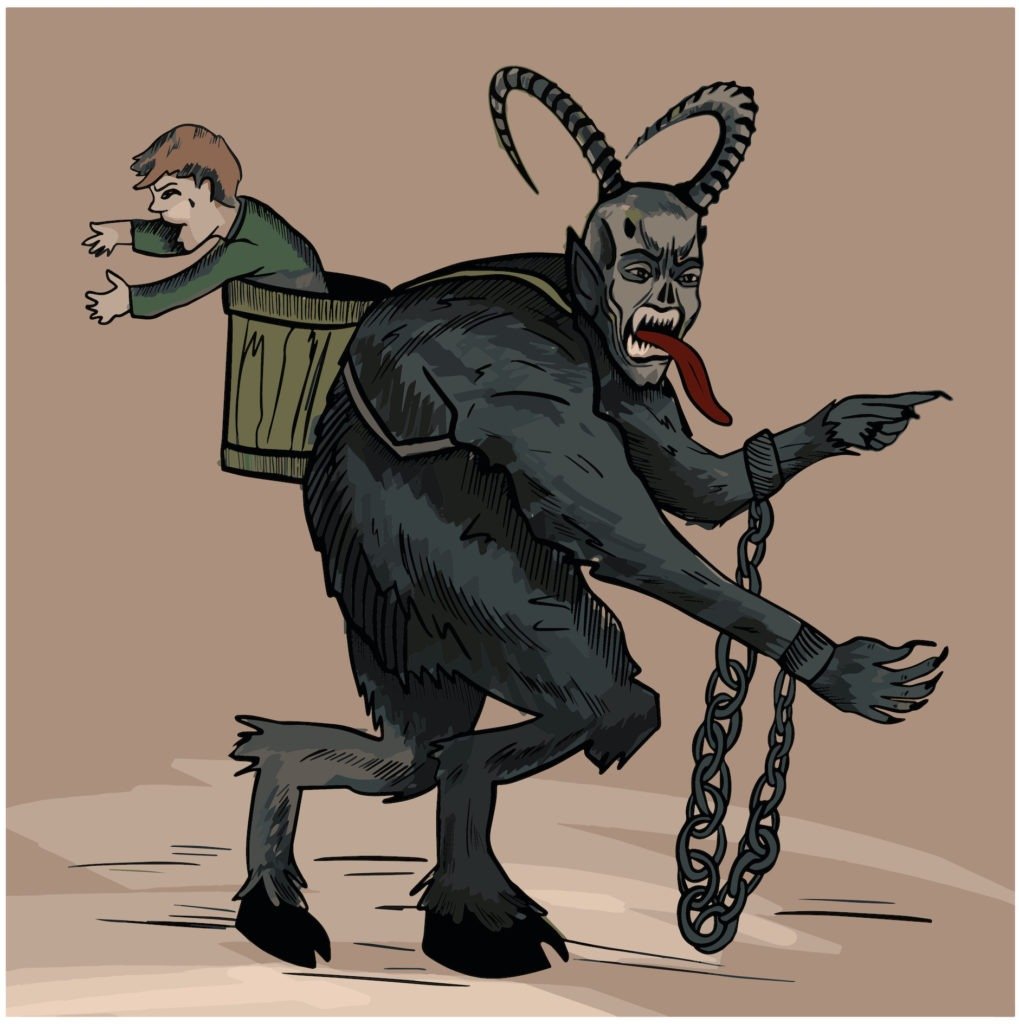
The Germans don’t mess around when it comes to bad behavior. According to the modern story, on December 5, St. Nicholas Eve, jolly old St. Nick leaves candy and gifts in children’s shoes while Krampus tags along behind and hands out punishment to those who misbehave.
This devilish half-goat, half-man creature with dark, shaggy hair, horns, fangs, and cloven hooves takes his name from the German word krampen, which translates to “claw.” Krampus has been part of the seasonal story since pre-Germanic traditions, and he held his ground despite an early push to banish this pagan emblem from the now-Christian celebration. For a fuller history of the figure, the entry at Britannica traces his Alpine roots and his link to St. Nicholas.
The tradition of St. Nicholas leaving coal for naughty children is nothing next to Krampus’s job. For more serious offenders, he would swat them with birch sticks or stuff them in his sack to carry away.
Today, a parade of sometimes hundreds of Krampuses raises a ruckus during the Krampuslauf, or Krampus Run, in many Central and Eastern European countries. Bundled-up crowds line the streets to watch the horned figures rattle chains and shake bells through the cold December night.
2. Belsnickel
Belsnickel was another helper to St. Nicholas, though instead of riding along on his rounds, this fur-clad, short-tempered man visited the children beforehand to whip them into shape. Rather than sneaking down the chimney, he rapped on the window and shook his bells, carrying a sack of candy in one hand and a switch in the other.
Even when children swore they had been good all year, he would ask them to recite a poem or a Bible verse. Those who stumbled or had behaved badly were whacked with the stick as a reminder to change their ways. The tradition took shape in the region of southwestern Germany, France, and Switzerland, then followed emigrants across the ocean to the Pennsylvania Dutch communities of the New World, where this slightly terrifying character is still remembered today.
3. Frau Perchta
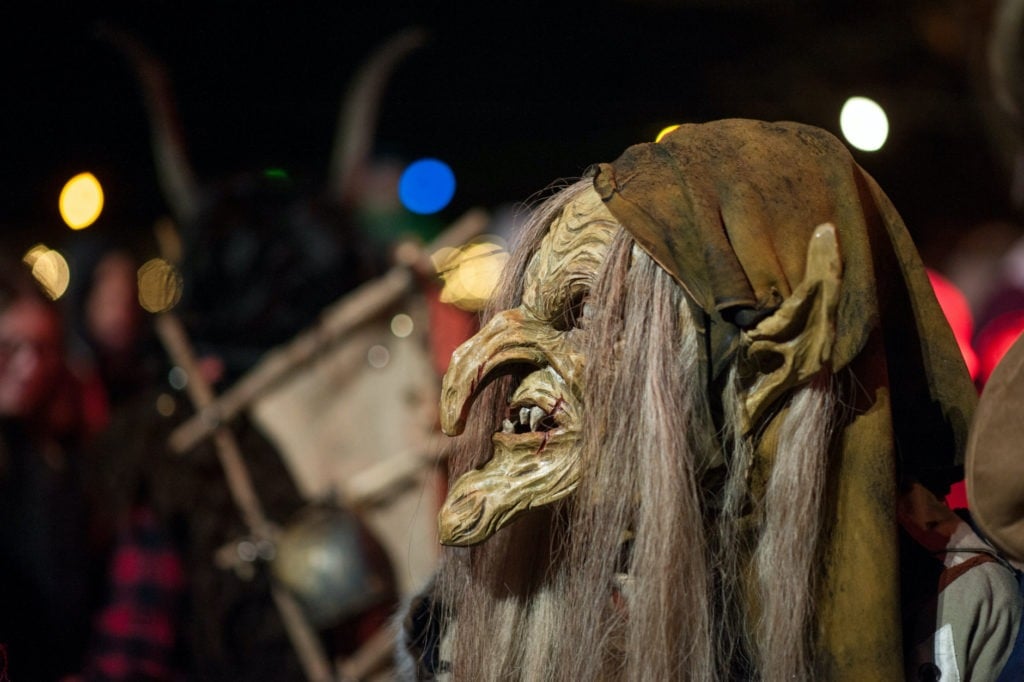
During the last three Thursdays before Christmas, folklore holds that Frau Perchta flies through the air on her Wild Hunt, with demon-like creatures and lost souls for company. Virtually unknown in the West, this “Witch of Christmas” comes from the German-Austrian region and dates back centuries before the arrival of Christianity.
With the look of a ragged old crone, complete with a long, hooked nose, she wears a rightfully frightening face, and it pays to heed her, because Perchta means business. Anyone who behaved well received a silver coin as a reward. But for unruly children, or even women who did not keep a tidy home or still had unspun flax by the Twelfth Night, she would cut open the abdomen with the long knife she kept beneath her skirt and replace their innards with pebbles or straw.
Another custom of the day was for the family to eat a special porridge called Perchtenmilch, setting out a portion for her to eat on the night she visits. And you had best make sure it was hot and buttered, because it is never wise to trifle with Frau Perchta.
4. Mari Lwyd
In Wales, between Christmas and Twelfth Night on January 6, a knock at the door might bring a challenge of rhymes or song from a strange sight: a hooded horse skull decked out in ribbons, bells, and baubles. Translated as “grey mare,” the Mari Lwyd is a tradition whose origins are unknown, though most believe it dates long before Christianity. Even so, over the years an association grew with Mary, the Blessed Mother, on her journey to Bethlehem to give birth to Jesus.
As the Mari Lwyd and its companions travel through town with a group of revelers, they stop at various homes to trade songs and, teasingly, a few rude verses. In the end, the Mari Lwyd is welcomed inside for cookies and ale, bringing good luck upon the household. It is one of the rare figures on this list you actually want knocking at your door.
5. Grýla and Leppalúði, and their Yule Cat
As if a pair of cannibalistic trolls and their 13 mischievous offspring were not terrifying enough, this family also keeps the cat from Hell in otherwise idyllic Iceland.
As the legend goes, every Christmas, Grýla, the 13-tailed and horribly ugly matron, and her husband, Leppalúði, come down from their mountain home to scour the countryside for children to snatch up for a stew. Meanwhile, their maladjusted sons, the Yule Lads, take turns pulling pranks or simply being mean to children on each of the 13 days before Christmas.
As if this ogress mother and her kin were not enough, Jólakötturinn, the Yule Cat, pounces on and eats children who are not wearing new clothes, because only good, industrious children earned that reward. This is why it is an Icelandic tradition to receive a new item of clothing at Christmas, even something as simple as socks.
6. La Befana
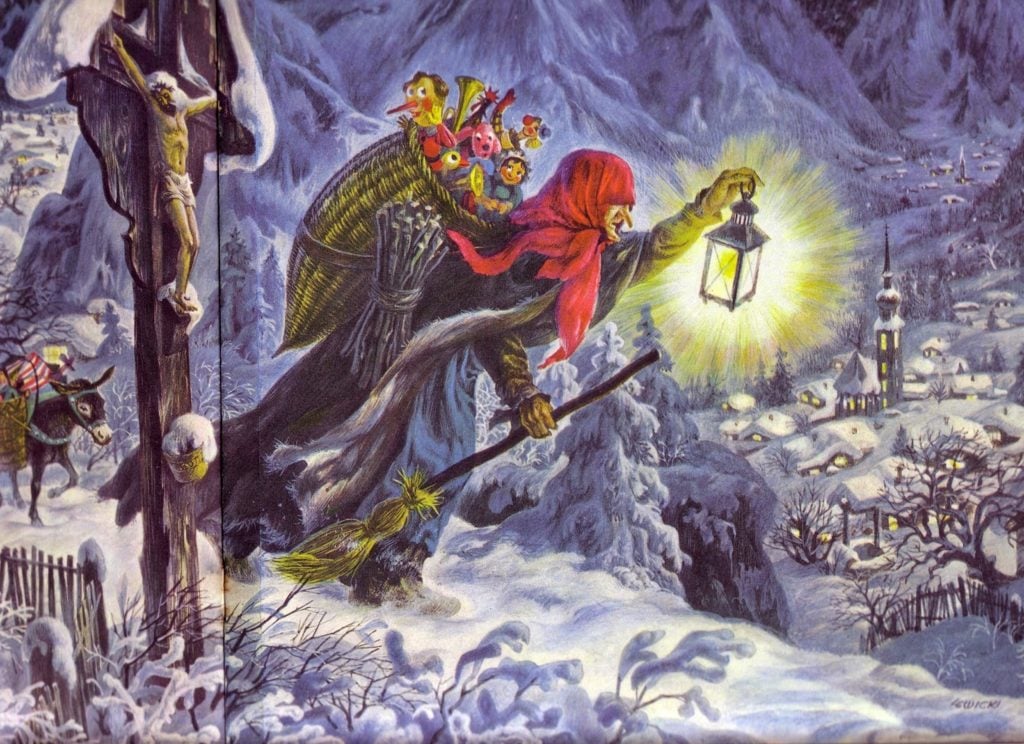
Painting by James Lewicki, from The Golden Book of Christmas Tales 1956.
Despite her classic long, hooked nose, warty skin, and soot-covered look, La Befana is Italy’s much-beloved witch. She flies on her broom on Epiphany Eve, the night of January 5, slipping candy into the stockings of good children and leaving coal or a stick for the naughty ones.
According to the legend, when the Wise Men were on their journey to find the baby Jesus, they invited this industrious old woman to join them. She declined, feeling she had too much housecleaning to do, then soon regretted the choice and set off to find them, visiting children along the way. Like St. Nicholas, La Befana is often left a treat, though she prefers cookies and a small glass of wine.
7. Hans Trapp
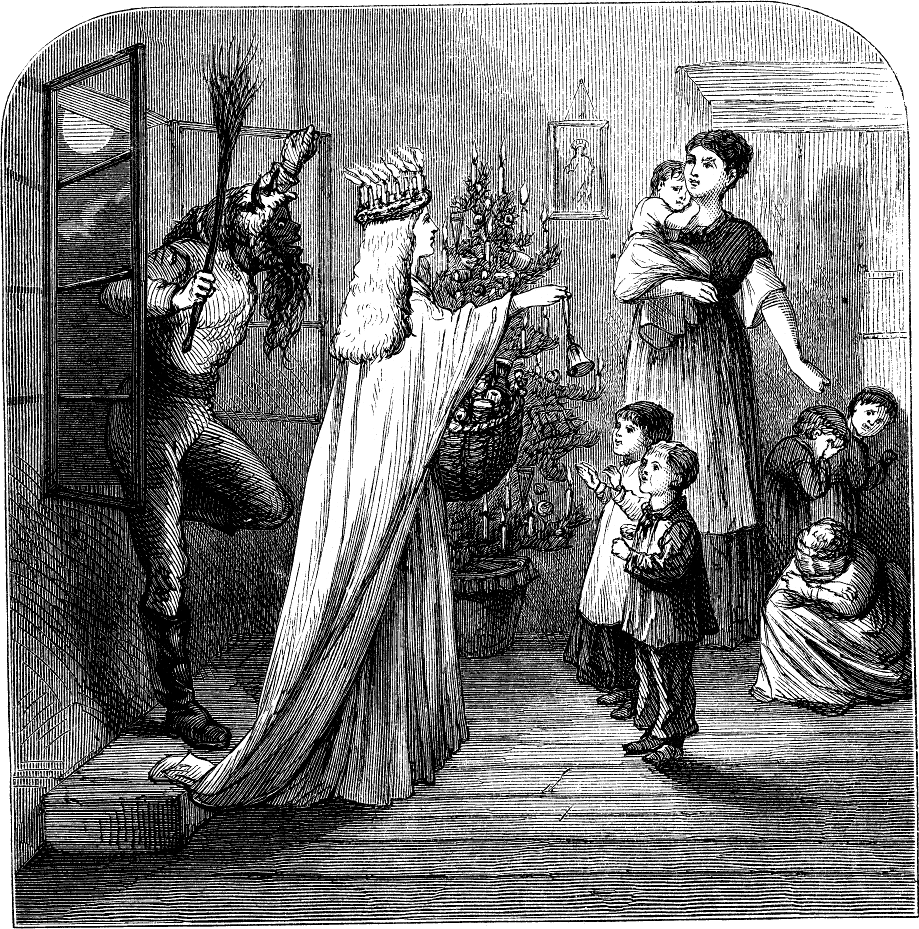
Born in the Alsace-Lorraine region of France, close to the German border, Hans Trapp was the antithesis of the modern-day Santa. According to the legend, Trapp was a cruel and greedy man who was excommunicated by the Catholic Church for being in league with the devil, and because of his misdeeds he was ultimately driven out of his town. He fled to the hills to live as a hermit, but returned during these dark days of the year to punish disobedient children. Often shown dressed as a scarecrow, he carries a sack for whisking away misbehaving rascals.
For now, we can take comfort in our own character of Santa Claus, knowing that even with his modern cohort, the Elf on the Shelf, keeping track of who is naughty and who is nice, nothing scares children into good behavior quite like these ancient holiday figures. Read them aloud by the fire, or keep them to yourself until the little ones are older, but do what feels right for your own family.

Scary Christmas Characters: Frequently Asked Questions
What are the scary Christmas characters of folklore?
They are frightening figures from European midwinter legends who punished misbehaving children while St. Nicholas rewarded the good ones. The best known are Krampus, Belsnickel, Frau Perchta, the Mari Lwyd, Grýla and the Yule Cat, La Befana, and Hans Trapp. Most predate Christianity and grew out of harvest and solstice customs.
Who is Krampus, and where does he come from?
Krampus is a half-goat, half-man creature from the Alpine folklore of Austria, Germany, and Central Europe. His name comes from the German word krampen, meaning “claw.” On December 5, St. Nicholas Eve, he follows St. Nick and doles out punishment to naughty children, and today crowds still celebrate him with the Krampuslauf, or Krampus Run.
Why do these frightening Christmas legends exist?
They served a practical purpose. During the darkest, coldest weeks of the year, a threatening visitor gave parents a memorable way to keep children close to home and on their best behavior. The stories also helped communities mark the winter solstice and the end of the harvest with feasting, costume, and a healthy dose of fear.
Are these scary Christmas characters real?
They are folklore, and what is real is the tradition. Communities across Europe still stage Krampus parades, carry the Mari Lwyd door to door, and leave treats for La Befana. The figures endure because the customs around them are genuine, festive, and centuries old.
What is the Yule Cat, and why do Icelanders give new clothes?
Jólakötturinn, the Yule Cat, is a giant cat from Icelandic legend that is said to eat anyone not wearing at least one new piece of clothing at Christmas. Because only hardworking children who finished their chores earned new clothes, the story rewarded industry. That is why giving a new garment, even a pair of socks, remains an Icelandic Christmas tradition.
How can I share these legends without frightening young children?
Lean on the gentler figures first. La Befana and the Mari Lwyd bring treats and good luck, and they make an easy introduction to the tradition. Save Krampus, Frau Perchta, and the Yule Cat for older kids who enjoy a good scare. As with any folklore, do what feels right for your own family and your own household.


Amy Grisak
Amy Grisak is a freelance writer, blogger, and photographer specializing in gardening, local food, and stories about her home state of Montana. She enjoys sharing her experiences with self-reliant living and outdoor recreation. Her article on the "hugelkultur" gardening technique appears in the 2021 Farmers' Almanac. You can follow her topics on her site, AmyGrisak.com.
- Amy Grisak

- Amy Grisak
- Amy Grisak
- Amy Grisak





” krampen” doesn’t mean ” claw” but “rotten” in german. The Krampus is only common in Southern Germany. In the Northern parts ” Knecht Ruprecht” is known as a sidekick of St. Nikolaus.
Stop the notifacations
It’s interesting to learn of the history of Christmas prior to American created Santa folklore. Interesting