

Cicadas 2026: Where They’ll Emerge, When They’ll Appear, and What to Expect
Quick Reference: Cicadas 2026
- What’s happening: No major periodical cicada brood is scheduled to emerge in 2026.
- When: Annual cicadas appear from July through early fall. A few isolated 17-year “straggler” periodical cicadas may emerge in scattered locations during late spring.
- Where: Annual cicadas are found across much of the eastern and central United States. Stragglers are uncommon and unpredictable.
- What to expect: Annual cicadas emerge every summer, but not in the overwhelming numbers seen during major periodical cicada years.
- Tool: Check the Almanac’s Best Days calendar for the best times to tackle seasonal outdoor projects.
On this page
Cicadas return every summer, but 2026 is not a major emergence year for periodical cicadas. While annual cicadas will fill the trees with their familiar buzzing from July into early fall, only a few scattered 17-year “straggler” cicadas may appear in isolated locations. This guide explains the difference between annual and periodical cicadas, where and when you’re most likely to hear them, why they sing so loudly, how their remarkable life cycles work, and what homeowners and gardeners should know during cicada season.
The 17-Year Periodical Cicada Life Cycle
Per Smithsonian Magicicada research and USDA Forest Service entomology.
- Year 0: adults emerge, mate, and lay eggs in tree twigs. All adults die within 4 to 6 weeks.
- Year 0.1: tiny nymphs hatch, drop to ground, burrow 8 to 12 inches deep, attach to tree roots and begin feeding on xylem fluid.
- Years 1 to 16: nymphs continue feeding underground. They molt through 5 instar stages, growing slowly.
- Year 17: nymphs emerge synchronously when soil temperature 8 inches down reaches 64 F (usually mid-May to early June). Climb trees, molt to adults, mate, repeat the cycle.
- Why 17 years: prime-number cycle helps avoid syncing with predator population cycles. Less predation risk = species survival.
Annual vs Periodical Cicadas: What You Actually Hear in Your Region
The 13- and 17-year Magicicada broods that make the news are only one part of the cicada picture. Most of the United States hears cicadas every single summer, they are just a different group of species with a different life cycle. Here is what emerges where.
The upshot: if you live in Arizona, California, or anywhere west of the Mississippi outside the Ozark fringe, the cicadas you hear every summer are annual species, not the periodical broods this article’s headline map is tracking. Same insect family (Cicadidae), completely different life cycle. Thank you to reader Sherri for prompting this clarification.
States Affected by Brood XIV in 2025
Per the University of Connecticut Cicada Mapping Project.
- Heavy emergence (millions per acre): Kentucky, Tennessee, parts of Ohio, southern Indiana, northern Georgia.
- Moderate emergence: western Pennsylvania, western Virginia, North Carolina, parts of Massachusetts (some Cape Cod populations).
- Light or scattered: West Virginia, parts of New York, southern Maryland.
- Stragglers in 2026: small numbers (1 to 5 percent of brood) emerging a year late are normal. Watch for limited activity in mid-late May 2026.
Cicadas 2026: FAQ, Tips, Meaning (Detail)
Below are the original detailed sections covering FAQs, noise tips, meaning + symbolism, 5 reasons to appreciate cicadas, 5 reasons not to wish them away, and the 2024 double brood.
What are cicadas?
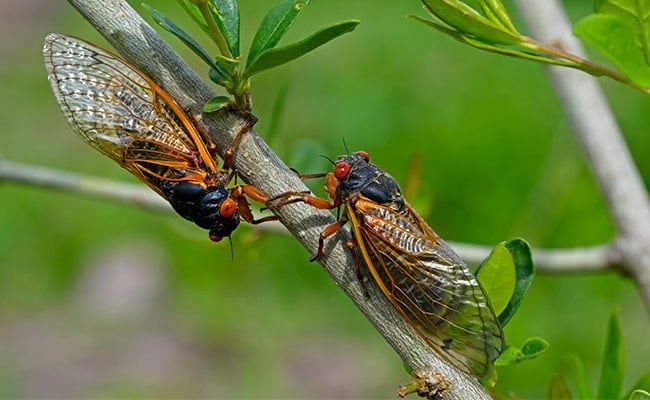
Cicadas are large insects known for two things: their incredible buzzing song and their fascinating life cycle. Imagine a bug that spends years underground as a nymph, quietly sipping on tree sap through a straw-like mouthpart. When soil temperatures reach 64 degrees Fahrenheit, they emerge in a massive wave, transforming into big-eyed, winged adults. (View your town’s soil temperatures on your FA Dashboard.)
Their loud song, produced by vibrating special organs in their abdomen, is their way of attracting mates. After a short, above-ground party (usually about four to six weeks), they lay eggs and the cycle starts again.
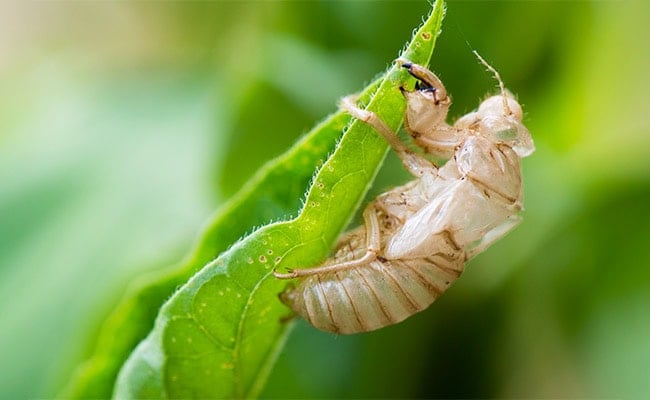
There are many different types of cicadas, ones with life cycles that overlap and appear to come out every summer and others that stay underground for several years before emerging in the spring. There are over 3,000 species of cicadas around the world. 190 species are in North America.
Annual cicadas are also called “dog day” cicadas because you often hear their high-pitched buzzing from June to August, during the Dog Days of summer. Other species, known as “periodical,” stay underground for long periods of time (either 13 or 17 years).
Are cicadas and locusts the same thing?
No, cicadas and locusts are two different bugs. Cicadas are larger than locusts. Yet, interestingly, American colonists often referred to cicadas as locusts and this misidentification persists today, especially for talking about periodical cicadas.
Jump to cicada meaning and symbolism
Will two broods emerge together in 2026?
No. Unlike 2025, 2026 is not expected to see a major emergence of multiple periodical cicada broods. There are no scheduled large-scale 13-year or 17-year brood emergences this year.
That said, a small number of “straggler” periodical cicadas may appear in scattered locations. These are cicadas that emerge one or more years earlier or later than their brood’s normal schedule. According to cicada researchers such as Dr. John Cooley, these timing mistakes are a natural part of the cicada life cycle and often occur in one- or four-year increments.
While these isolated stragglers can surprise homeowners, they won’t produce the spectacular, billions-strong emergences associated with major broods like Brood XIV in 2025. Instead, 2026 will primarily be a year for annual cicadas, which emerge every summer across much of the United States and are responsible for the familiar buzzing heard from July through early fall.
If two broods will be emerging, why is this not a “double brood” event (like in 2024)?
Dr. John Cooley says, “2024 saw a joint emergence of a 13 and 17 year brood (XIX and XIII, respectively). But two broods of the same life cycle can never co-emerge.” (Brood XIV and I have the same life cycle of 17 years.) Wherever you see Brood I stragglers this year, you’ll see a whole lot more cicadas in 2029 when the brood actually emerges.”
How many cicadas, really?
Trillions of cicadas are expected to emerge in 2025. Some estimates suggest millions per acre in some places! The highest densities will be in wooded areas, but cicadas travel far and wide into suburban and urban environments.
Is Brood XIV the largest brood of periodical cicadas?
Dr. John Cooley says, “Yes? It’s a bit hard to count. It’s certainly the largest 17-year brood, and its size is on par with 13-year Brood XIX [which emerged in 2024]. But exactly which is larger depends on exactly how you count it, given that the broods are quite patchy on a fine scale.
When will the two broods emerge?
Brood XIV (14) and I (1) are expected to emerge at some point in spring, depending on soil temperatures. Cicadas usually wait for temperatures to be consistent for about five days before making their way out. Dr. John Cooley says, “Whenever the trees are just about leafed out, that’s when the cicadas emerge.” Also, watch for irises as these flowers tend to bloom as periodical cicadas emerge.
Related: How to Plant with Cues from Nature
According to the Farmers’ Almanac Spring Weather Forecast, which calls for cool temperatures through April, periodical cicadas are expected to emerge in mid-May, which would be customary. (Note: Last year, Farmers’ Almanac forecasts called for unseasonably warm and rainy days in April, and FA predictions for an earlier emergence of a rare double brood in mid-April 2024 was correct.) Use the Farmers’ Almanac Long-Range Weather Forecast to make your own cicada predictions!
No U.S. states are expected to experience a major periodical cicada emergence in 2026. There are no scheduled 13-year or 17-year broods emerging this year.
However, small numbers of off-cycle “straggler” periodical cicadas may appear in a handful of eastern states. Researchers are watching for scattered Brood II stragglers, particularly in:
- Connecticut
- Georgia
- Maryland
- New Jersey
- New York
- North Carolina
- Oklahoma
- Pennsylvania
- Virginia
Most reports so far have come from Virginia, with smaller numbers observed in New Jersey, North Carolina, New York, Oklahoma, and other nearby states. These are isolated sightings—not the massive, synchronized emergences that occur during a true brood year.
For the vast majority of the United States, the cicadas you’ll hear in 2026 are annual cicadas, which emerge every summer from July through early fall and do not follow the famous 13- or 17-year life cycle.
Why does Brood XIV (14) seem to be “skipping” South Carolina, Washington, D.C., Connecticut, and Rhode Island?
Dr. John Cooley says, “Brood XIV is an odd one, because it is broken into several regions. The areas between the regions are filled by other broods (often Brood X) or no cicadas at all, as in New England, probably because the conditions are so marginal. The division into regions probably reflects something about the evolutionary history of these broods, and their formation in deglaciating North America, in which the climate was unstable, changing rapidly, and strongly shaped by elevation.”
Where can I read more about Brood XIV?
We highly recommend Dr. Gene Kritsky’s book, The Pilgrim’s Promise: The 2025 Emergence of the Periodical Cicada Brood XIV. This book covers the deep history of Brood XIV, going as far back as their emergence at Plymouth Colony in 1634.
What do cicadas sound like?
The loud hum of cicadas mating sound may be as loud as 100 decibels, which is similar to the noise of a motorcycle revving or loud outdoor power tools. Interestingly, the sound of lawnmowers may attract these insects. For this reason, we recommend going lawn work early in the morning or late at night, when cicadas are less active. (See more tips for reducing noise below.)
Do cicadas “sing” at night?
In most cases, cicadas do not make noise after the Sun goes down. When you hear insects at night, they are most likely crickets or katydids. However, there are a few cases when cicadas may sing at night: bright lights like streetlamps, very hot weather, or if they’re feeling crowded or disturbed. There is also a chance that a bright full Moon may be perceived as dawn.
Are cicadas pests?
Despite their overwhelming numbers and loud mating calls, cicadas are harmless to humans and beneficial to local ecology. Though they are often considered to be pests, cicadas serve as a nutritious food source for birds. They even enrich the soil!
RELATED: Gardening By The Moon Calendar
Can cicadas bite you?
No, cicadas will not bite you. If one happens to fly towards you, chances are it’s mistaking your arm for a tree branch. Don’t fret! Their feet are designed for gripping bark, so the sensation might feel a little strange, but they won’t bite. Just gently nudge them away and they’ll be on their way.
Will cicadas harm your gardens? How about your trees?
Good news! Cicadas won’t destroy your gardens. The only damage they may cause is “flagging” (cutting small v-shapes into) leaves when they lay their eggs. This won’t hurt mature trees “is a natural pruning … that results in more flowers and fruit the following year,” says Dr. Gene Kritsky, Professor Emeritus of Biology at Mount St. Joseph University.
But flagging isn’t good for the development of saplings. So we don’t recommend planting any new fruit trees or bushes if your state is indicated on our Cicada 2025 map. However if you would like to protect recently planted raspberry bushes for instance, you may cover them with netting. (Make sure that the holes in the netting are smaller than one centimeter wide.)
Are cicadas natural fertilizers?
Yes, when cicadas decompose, they add nutrients to the soil. Sodium, potassium, magnesium, calcium. But rather than scooping them into your gardens, Dr. Kritsky, says to “Let the cicadas decompose around their trees. The nutrients would then be helpful to the trees where the cicadas can return the nutrients they obtained from the trees.”
RELATED: Natural Garden Fertilizers
Can you eat cicadas?
Cicadas, traditionally eaten by Indigenous Australians, people from New Guinea, the Siamese, and Native Americans, were once highly valued as a special food in ancient Greece, Rome, and even today in Japan. Famous for being full of protein and clean for eating, cicadas only eat plant material, making them a healthy option for food.
Some compare cicadas to shrimp because they’re packed with protein and low in fat, similar to crickets, which are eaten all around the world. Even pets like dogs, creatures like squirrels, and other animals enjoy these insects as treats, while people with a taste for trying new foods experiment with their cooking possibilities. When cooked, cicadas are said to remind people of shrimp, asparagus, nuts, or popcorn, as reported by NBC.
If you’re thinking about trying cicadas as a new food idea, it’s better to choose the younger ones instead of the ones with tougher shells. But, it’s important to consider some health tips before you eat them.
Learn more about how to add cicadas to your meals: Download the PDF of recipes


Cicadas 2025 FAQ
What is Brood XIV?
One of the 12 known broods of 17-year periodical cicadas in North America. Brood XIV last emerged in 2008 and emerged again in 2025 across 13 US states. The next emergence is scheduled for 2042.
Are cicadas dangerous?
No. Cicadas do not bite, sting, or carry disease. They cannot damage humans or pets. The only meaningful harm is to young or weak trees (egg-laying slits in small twigs can cause die-back); covering small trees with bird netting prevents this.
Why are cicadas so loud?
Males produce mating calls using tymbal organs on the sides of the abdomen. Peak chorus volumes reach 90 to 100 decibels at close range, comparable to a chainsaw or motorcycle. The chorus quiets at night and increases at midday.
Will cicadas hurt my garden?
Generally no. Cicadas do not eat plants or garden vegetables. Adult feeding (xylem fluid only) is minimal. The only damage concern is egg-laying in young trees, prevented by netting trees with stems less than 1 inch in diameter.
Can you eat cicadas?
Yes. Several Indigenous American cultures historically ate cicadas as a high-protein seasonal food. People with shellfish allergies should avoid them (cicadas are arthropods, related to shrimp). Best collected just after molting when the new exoskeleton is still soft.

- Farmers' Almanac Staff

- Farmers' Almanac Staff
- Farmers' Almanac Staff
- Farmers' Almanac Staff




Cicadas in my yard ,hear them today
Just found my 3rd cicadia at my home in Mississippi, but were not on map for this year.
Why is the map only of the east coast? I live in Arizona and we have cicadas.
Hi Lorie, You’re right that cicadas are everywhere! But this map is tracking “periodical” cicadas, a special kind that only emerges every 14 or 17 years. If you have any other questions, let us know. Best wishes from all of us at FA!
In Arizona, ours are Annual Cicadas, not the periodical kind.
Correct on all counts, Sherri, thank you for reading closely. Arizona’s summer chorus comes from annual (or “dog-day”) cicadas in the genus Neotibicen and, across the Sonoran, several Diceroprocta species, none of which follow the 13- or 17-year cycle of the eastern Magicicada broods. We will update the post to make the annual-vs-periodical geography clearer for Southwest readers. Appreciate the tip.
I’ve lived through 4 17 yr broods and this dr’s dates don’t coincide the 17 yr won’t be back til 2030, the Dr is wrong