

April Birthstone: Diamond Meaning, History, and Folklore
The diamond is April's birthstone. Its name comes from the Greek word, “adamas,” meaning unconquerable and indestructible. What makes it so special? Learn about its legendary hardness, unmatched sparkle, and mysterious folklore. We explain why ancient Egyptians wore diamonds on their ring fingers and other surprising facts about this rare gem. Read on.
Quick Reference
- April birthstone: Diamond
- Symbolism: Eternal love, clarity, and strength
- Hardness: Mohs 10, the hardest natural mineral on Earth
- Chemistry: Pure crystallized carbon, formed under intense heat and pressure
- Primary source: Kimberlite pipes, brought up from 100 to 200 miles below the surface
- Zodiac fit: Aries (March 21 to April 19) and Taurus (April 20 to May 20)
If your birthday lands in April, your stone is the diamond. Plain carbon, rearranged by heat and pressure deep in the earth, then carried up by ancient volcanic plumbing. Readers come to the Almanac for the date and the rule, so here it is: April equals diamond on every modern birthstone list, including the one maintained by the American Gem Society and the Gemological Institute of America (GIA). Below, we cover what a diamond actually is, where it comes from, how to read one at the counter, and the folklore that has trailed it for two thousand years.
What Is the April Birthstone?
April’s birthstone is the diamond, a crystal of pure carbon and the hardest natural substance on Earth. Diamonds form under intense conditions, when carbon is exposed to high temperatures and crushing pressure deep within the planet over billions of years. The result is a stone that scores a perfect 10 on the Mohs hardness scale. Only a diamond can scratch a diamond, which is why jewelers cut and shape diamonds using diamond-encrusted saws and polishing wheels.
The diamond is widely recognized as the symbol of eternal love, clarity, and strength. As April’s modern birthstone, it sits with the zodiac signs Aries and Taurus, two signs the old planting calendars associate with springtime drive and steady ground. If you were born in April, the diamond is your stone in any current jeweler’s chart, including the official list maintained by the American Gem Society.
The History and Lore of Diamond
The word “diamond” comes from the Greek “adamas,” meaning unconquerable and indestructible. Ancient India was the earliest known source, with stones gathered along the Krishna River as far back as the 4th century BCE. Diamonds were used as eyes in statues of Indian gods and were believed to ward off evil and protect warriors in battle.
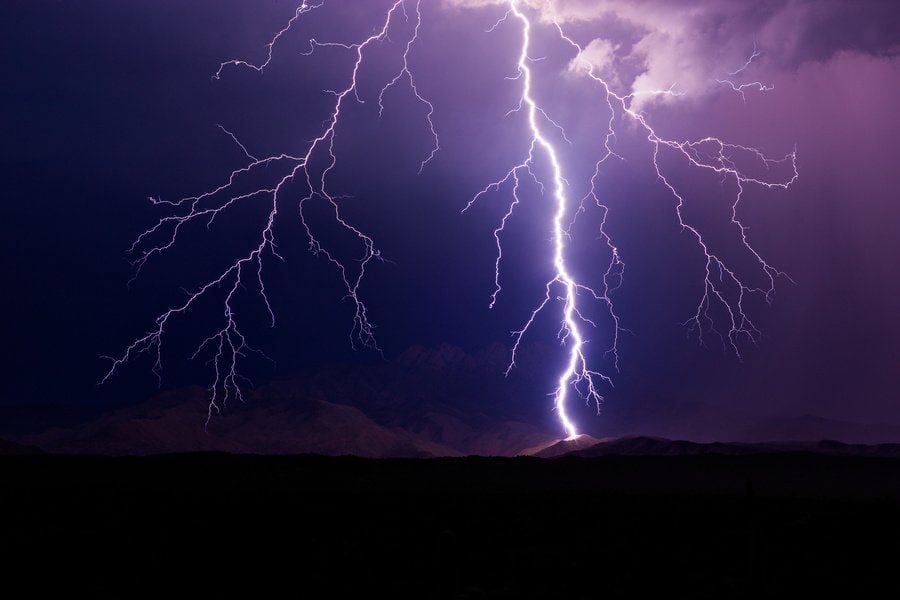
One widely told Indian story held that diamonds formed when lightning bolts struck rocks. Later science showed that is not how diamonds form. There is a stone that forms when lightning strikes sand, called fulgurite, but it is glassy silica, not carbon. The ancient Greeks and Romans believed diamonds were the tears of the gods or splinters from fallen stars. Plato wrote that each diamond contained a living being. Romans wore small uncut diamond points as amulets, believing the stone protected the wearer from poison.
In medieval Europe, the diamond became a royal seal, stamped into rings and crowns as a charm against treachery. The stone’s leap into the engagement ring tradition has a recorded date: in 1477, Archduke Maximilian of Austria gave Mary of Burgundy a gold ring set with thin, flat diamonds arranged in the shape of an “M.” That is the first documented diamond engagement ring in Western history.
The phrase couples still echo at the jewelry counter, “A Diamond Is Forever,” was not folklore. It was advertising. Copywriter Mary Frances Gerety wrote the line for De Beers in 1947, late one night at the N. W. Ayer agency in Philadelphia. Within a generation, the diamond engagement ring went from luxury to expected milestone.
The wedding-ring finger has older roots. In ancient Egypt, people believed the left ring finger contained the “vein of love,” the Vena Amoris, running directly to the heart. They wore diamonds on that finger to carry the stone’s energy straight to the heart. Anatomy does not back the vein up, but the placement stuck.

The 4 Cs of Diamond Quality
If you ever shop for a diamond, you will run into the 4 Cs. The grading framework was created by Robert M. Shipley, founder of the Gemological Institute of America, and formalized by GIA in 1953. It is the standard language every reputable jeweler uses today.
- Carat: the weight of the stone. One carat equals 0.2 grams. Carat is weight, not size, so two stones of equal carat can look different depending on cut.
- Cut: the quality of the faceting and proportions. Cut is the only one of the four Cs that depends entirely on human craft, and it has the biggest effect on how the stone catches the light.
- Clarity: the absence of internal inclusions and surface blemishes. GIA grades clarity on a scale from Flawless down to Included.
- Colour: the absence of colour in a white diamond, graded from D (colourless) through Z (light yellow or brown). Fancy coloured diamonds are graded on a separate scale.
For most buyers, cut and clarity matter more to the eye than carat weight. A well-cut one-carat stone often outshines a poorly cut two-carat one. Ask to see the GIA grading report before you pay.
Famous Diamonds Throughout History
A handful of diamonds have become as famous as the people who owned them. Each one carries a date, a discovery story, and in some cases a long quarrel over rightful ownership.
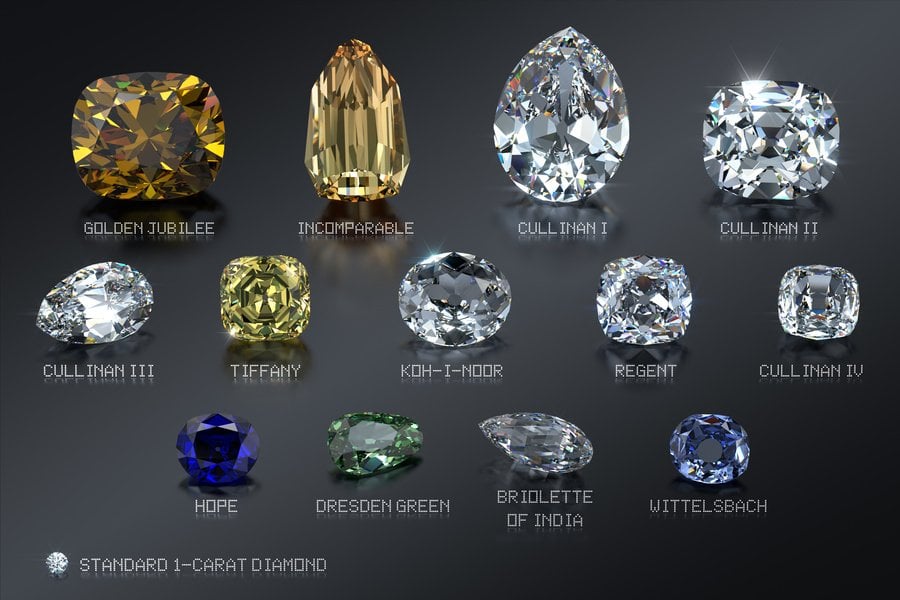
- Cullinan Diamond: the largest gem-quality diamond ever discovered, found in 1905 at the Premier Mine in South Africa. The rough stone weighed 3,106 carats. Cut down into nine major stones and dozens of smaller ones, its pieces sit in the British Crown Jewels today, including the Cullinan I in the Sovereign’s Sceptre and the Cullinan II in the Imperial State Crown.
- Hope Diamond: a 45.52-carat blue diamond originally mined in India. Famous for its rare deep blue colour and for the long string of misfortunes said to follow its owners, the Hope sits in the Smithsonian’s National Museum of Natural History in Washington, D.C.
- Koh-i-Noor: a 105.6-carat stone with a history stretching back through Mughal, Persian, Afghan, and Sikh dynasties. Today it is set in the British Crown and is the subject of ongoing repatriation requests from India, Pakistan, Afghanistan, and Iran.
- Tiffany Yellow: a 128.54-carat fancy yellow diamond cut from a 287-carat rough stone found in 1877 in South Africa. It has been worn publicly by only a handful of people, most famously by Audrey Hepburn for a 1961 promotional shoot for Breakfast at Tiffany’s.
Geology and Where Diamonds Come From
Most natural diamonds formed between one and three billion years ago, 100 to 200 miles below the surface, in the upper mantle. Carbon atoms locked into a tight cubic crystal under heat above 2,000 degrees Fahrenheit and pressures around 725,000 pounds per square inch. Fast, violent volcanic eruptions carried those crystals up through narrow chimneys of igneous rock called kimberlite pipes, where they cooled near the surface and waited to be found. A handful of countries account for the bulk of the world’s rough-diamond supply today.
- Botswana: the world’s top producer by value, with major operations at Jwaneng and Orapa.
- Russia: the largest producer by volume, mostly through the company Alrosa in Yakutia.
- Canada: a steady producer from northern mines such as Diavik and Ekati in the Northwest Territories.
- Australia: long famous for the Argyle pink diamonds, though Argyle closed in 2020.
- Democratic Republic of the Congo: a major source of industrial-grade diamonds.
- South Africa: the birthplace of the modern industry, still home to historic mines including the Cullinan (formerly Premier) Mine.
Lab-Grown vs Natural Diamonds
A growing share of diamonds sold today were grown in a laboratory rather than mined. Two methods produce them. High-pressure, high-temperature (HPHT) growth mimics natural mantle conditions inside a press. Chemical vapour deposition (CVD) builds the crystal layer by layer from carbon-rich gas in a vacuum chamber. Both methods produce stones that are chemically and optically identical to mined diamonds. A jeweler cannot tell the difference by eye. Specialised lab equipment can, and GIA grades both types.
The practical difference is price and provenance. Lab-grown diamonds typically cost 30 to 70 percent less than a comparable mined stone. Buyers who care about origin point to lab-grown as an ethical alternative to mining; defenders of natural diamonds point to the livelihoods supported by traceable, certified mining communities in Botswana, Canada, and elsewhere. Both sides have a case. Either way, ask for written certification before you buy.
Diamond Folklore and Healing Beliefs
The diamond is widely known as a symbol of purity, love, and faithfulness. It is believed to strengthen the bond between partners by uniting the intellectual mind with the spiritual mind. In traditional lore, diamonds remove fear, encourage creativity, amplify energy, and draw wealth and abundance to the wearer.
Ancient civilizations valued diamonds for their supposed healing properties as well. The stone was believed to heal ailments of the brain, including vertigo, to detoxify the body, to bring strength, and to ease chronic conditions including allergies. (Suffering from seasonal allergies? We have some plain-pantry home remedies for allergies worth a try.) Modern medicine does not support these uses, and we list them as folklore rather than treatment. The power of intention and ritual can be real for the wearer; the cure for an ailment is the doctor’s department.
Diamond and the Zodiac
April covers most of Aries (March 21 to April 19) and the start of Taurus (April 20 to May 20). The diamond pairs naturally with Aries energy: the fire sign known for drive, courage, and starting things. The stone’s clarity and unbreakable surface line up with Aries’ impulse to move forward without hesitation. For Taurus births at the end of the month, the diamond is still the modern birthstone, though Taurus is also associated traditionally with the emerald.
Different Coloured Diamonds
Most of us picture a colourless diamond, but the stone comes in a wide range of shades. Yellow, brown, and blue are the more common colours. In order of increasing rarity, you will also find green, black, pink, orange, purple, and red. The colour comes from a mix of causes: trace elements absorbed during formation, slight differences in crystal structure, and inclusions of other minerals.
- Boron: tints diamonds blue (as in the Hope Diamond).
- Nitrogen: creates yellow and brown shades.
- Irradiation: natural radiation exposure produces green diamonds.
- Inclusions: dense inclusions make “black” diamonds look dark, though the crystal itself is not truly black.
Space Diamonds
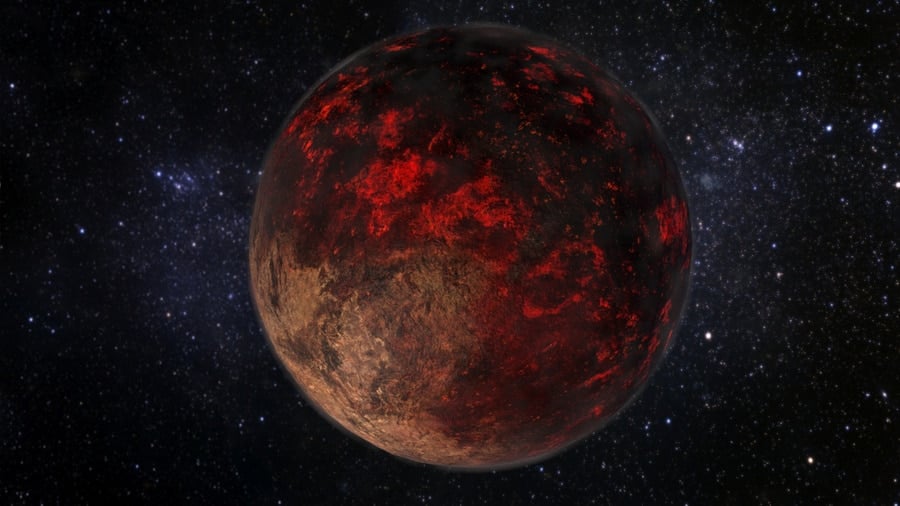
Diamonds are not only an earth-bound stone. In 2012, astronomers identified an exoplanet, called 55 Cancri e, that appears composed largely of diamond and graphite. It is roughly twice the size of Earth and lies about 40 light-years away.
The same year, researchers found tiny diamonds inside the Sutter’s Mill meteorite, which fell in California. The grains measured about 10 microns (0.010 mm) across, small to the eye but huge compared to the nanometer-scale (0.000001 mm) diamonds found in other meteorites. Scientists suspect those meteorites trace back to the beginning of our solar system and may have originated from a lost planet.
How to Care for Diamond Jewellery
A diamond is the hardest natural mineral, but the metal setting around it is not. A few simple habits keep an engagement ring or family heirloom safe for decades.
- Clean weekly: soak in warm water with a drop of mild dish soap, brush gently with a soft toothbrush, rinse. Body oil dulls the sparkle fast.
- Inspect twice a year: a jeweler can check prongs for wear and tighten any that have loosened.
- Store separately: a diamond will scratch every other stone in your jewellery box. A small pouch keeps everything safe.
- Take it off for rough work: gardening, lifting, and weight training are common ways readers lose stones. The diamond survives the impact; the prongs do not always.
- Insure it: get a written appraisal and add a rider to your homeowner’s or renter’s policy.
Choosing a Diamond
If you are buying a diamond for an April birthday, an anniversary, or a proposal, four practical points will save you money and regret.
- Set a budget first, then shop: the old “two months’ salary” rule was another piece of De Beers advertising. Spend what fits your life.
- Prioritise cut: a bright, well-cut stone will outshine a larger but dull one. Look at the stone in natural light, not just under jewellery-counter spots.
- Get the certificate: GIA and AGS reports are the most respected. They list the 4 Cs and a unique grading number you can verify online.
- Decide on natural or lab-grown before you walk in: the two markets price very differently. Knowing your preference up front keeps the conversation simple.
Diamond Anniversary Significance
The diamond is the traditional gift for the 60th wedding anniversary, sometimes called the “Diamond Jubilee” after the British royal tradition. Sixty years of marriage and the hardest natural mineral on Earth share an obvious symbol: clarity that does not crack, a bond that does not bend. Many couples also revisit the diamond at the 75th anniversary, where the modern list calls for a diamond-and-gold pairing.
Alternate April Birthstones
Diamond is the modern April stone, but there are honourable alternates. Sapphire, now the September birthstone, served as April’s stone during the Renaissance and is still associated with wisdom, peace, and calm thinking. Sapphire is a budget-friendly alternative if a diamond is out of reach for now.
The mystic birthstone for April is the opal. If you are drawn to the spiritual side of stones, opal often speaks more clearly than diamond. Opals come in many forms and are believed to intensify emotion, deepen faithfulness, and open higher levels of awareness. Clear quartz is a third alternative that we recommend for readers on a tight budget: it looks similar to a clear diamond, it amplifies energy in the same folklore tradition, and it is widely available at a fair price.
For more on April’s other birth-month traditions, including birth flowers and zodiac details, see our guide to April birth month symbols and fun facts. To compare your stone with the months on either side, our pages on the March birthstone (aquamarine) and the May birthstone (emerald) are written in the same plain-English style. The full month-by-month hub is at birthstones by month, meanings, history, and folklore.
From the Krishna River 2,400 years ago to a laboratory press today, the diamond has stayed exactly the same stone: pure carbon, four billion years of patience, light bent into something we cannot stop staring at. Pick the one that fits your hand and your budget, take care of the setting, and let the symbol carry whatever meaning you want to give it. What is your favorite thing about diamonds? Were you familiar with any of this folklore? Let us know in the comments below.

Frequently Asked Questions
What is April’s birthstone?
April’s birthstone is the diamond. It is the hardest natural mineral on Earth and symbolizes eternal love, clarity, and strength. The diamond appears as April’s stone on every modern birthstone list maintained by the American Gem Society and the Gemological Institute of America.
Why is the diamond the April birthstone?
The diamond was assigned to April when the modern birthstone list was standardized by the American National Retail Jewelers Association in 1912. Earlier lists varied. During the Renaissance, sapphire held the April slot. The diamond’s pairing with April aligns with the Aries zodiac sign and the spring associations of clarity, drive, and new beginnings.
Are lab-grown diamonds real diamonds?
Yes. Lab-grown diamonds are chemically, optically, and physically identical to mined diamonds. They are crystallized carbon produced by HPHT or CVD methods. GIA grades both lab-grown and natural diamonds, and only specialised equipment can tell them apart. Lab-grown stones typically cost 30 to 70 percent less than comparable mined diamonds.
What does the diamond symbolize?
Diamonds symbolize eternal love, clarity, strength, and faithfulness. The word “diamond” comes from the Greek “adamas,” meaning unconquerable. Folklore connects the stone with courage, creativity, and the removal of fear. It is also the traditional gift for the 60th wedding anniversary.
What are the 4 Cs of a diamond?
The 4 Cs are Carat (weight), Cut (faceting and proportions), Clarity (absence of inclusions), and Colour (lack of yellow tint in white diamonds). The framework was created by Robert M. Shipley and formalized by the Gemological Institute of America in 1953. Of the four, cut has the biggest effect on how the stone catches the light.
Where do most diamonds come from today?
Botswana is the world’s leading producer by value, followed by Russia (largest by volume), Canada, Australia, the Democratic Republic of the Congo, and South Africa. Most natural diamonds are mined from kimberlite pipes, narrow chimneys of volcanic rock that carried them up from 100 to 200 miles below the surface.
What anniversary is the diamond for?
The diamond is the traditional gift for the 60th wedding anniversary, sometimes called the Diamond Jubilee. It also appears on the modern list at the 75th anniversary, paired with gold.
This article was originally written with contributions by Amber Kanuckel and Tamra Albright-Johnson of THS Jewelry, and has been expanded and updated by the Farmers’ Almanac editors. Authoritative reference sources include the Gemological Institute of America and the Smithsonian National Museum of Natural History.


This article was published by the Staff at FarmersAlmanac.com. Any questions? Contact us at [email protected].
- Farmers' Almanac Staff

- Farmers' Almanac Staff

- Farmers' Almanac Staff

- Farmers' Almanac Staff



Man made diamonds are interesting too!
Hi Cedric! Thanks for your comment. What fascinates you about man-made diamonds? Please feel free to share your thoughts or any interesting facts that you know. One of the best parts about the Farmers’ Almanac online community is this forum, where we can all learn from each other! ?