

Parade of Planets 2023: What We Saw and Why It Was Rare
Quick Reference
- What it was: a “parade of planets” visible from the U.S. and Canada on the evening of Monday, March 27, 2023.
- Time window: roughly 20 minutes after local sunset, looking west.
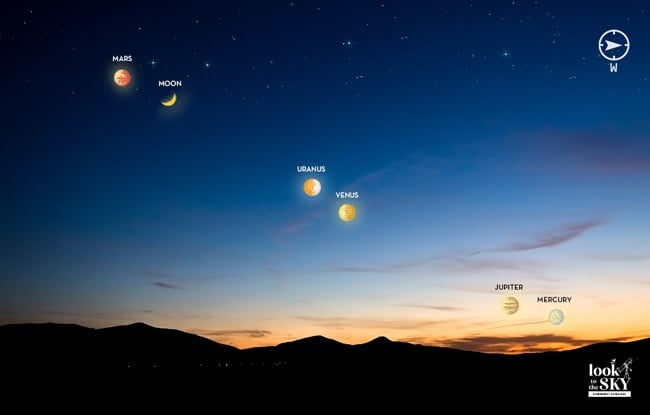
- Objects visible, left to right: star cluster Messier 35 (M35), Mars, the Moon, Uranus, Venus, Jupiter, and Mercury.
- Rarity: the previous similarly compact five-planet lineup was in the early morning hours of June 2022.
- Best gear: 7 x 35 or 7 x 50 binoculars, sometimes called “night glasses.”
- Naked eye still worked: Venus, the Moon, and Mars were bright enough to see without binoculars.
- Next comparable event: planetary parades cluster every few years, next widely-marketed U.S. lineups fell in June 2024 and early 2025.
On the evening of Monday, March 27, 2023, observers across the U.S. and Canada looked west about 20 minutes after sunset and caught a rare “parade of planets 2023”: five planets, the Moon, and a beautiful star cluster known as Messier 35 (M35) strung across the twilight sky. From left to right, the sequence was: M35, Mars, the Moon, Uranus, Venus, Jupiter, and Mercury. The article you are reading was originally published a week before the event. It now serves double duty: a record of what was actually visible that night, and an evergreen explainer of how, why, and how often a planetary parade happens.
The previous similarly compact “parade of planets” appeared in the early morning hours of June 2022, when five naked-eye planets lined up together. These arrangements are genuinely rare. According to NASA’s Skywatching program, five-planet twilight lineups where all five are within a narrow arc happen only a handful of times a decade, and only a subset of those are visible from any single location.
Up for the Parade of Planets Challenge?
In the days before March 27, 2023, viewers were told to stake out an observing site with a clear and unobstructed view of the western horizon. The best option was looking out over a water horizon that was perfectly flat and wide open with nothing to block the view. Another option was a large field with no trees or buildings. A good pair of binoculars helped immensely (more on choosing binoculars near the end of this article).
Venus: The Anchor of the Parade
Dazzling Venus, the brightest planet in the sky, was the easiest of the seven objects to spot on March 27, 2023. No binoculars necessary. Shining like a beacon through the twilight, Venus served as a guiding light for finding the other planets and celestial objects (to the lower right and upper left, as shown in the image below).
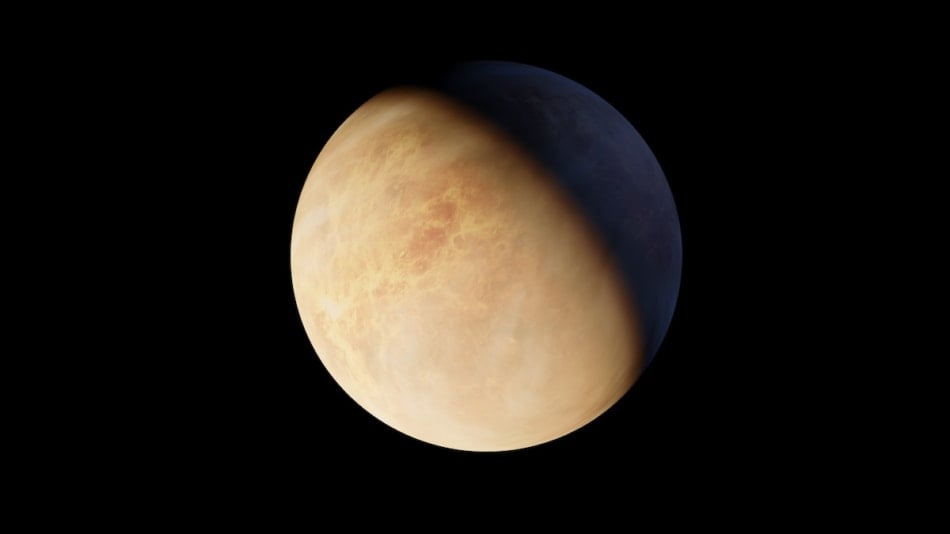
Venus did not set that night until around 10:15 p.m. local daylight time, so there was ample time to view it. The Almanac drew observers’ attention to Jupiter and Mercury to the lower right first, since those two planets would disappear over the western horizon quickly (appearing to chase after the Sun).
Jupiter and Mercury: The Hardest to Catch
Binoculars were the difference here. Looking to the lower right of Venus, towards the point on the horizon where the Sun had just set, observers found two bright “stars” nearly hanging side by side. Jupiter (left) appeared to be twice as bright as Mercury (right). They were separated by approximately 1 degree, the width of one fingertip of an outstretched arm. Jupiter shone at a magnitude of -2.1, and Mercury at magnitude -1.4, just a bit dimmer than the brightest true star in the sky, Sirius.
If you sighted them, congratulations were in order. It was no easy feat to catch two planets positioned so close to the setting Sun. Within a day or two of March 27, 2023, Jupiter disappeared into the glare of the Sun and was no longer visible in the evening sky. Mercury, on the other hand, moved away from the Sun’s vicinity and became easier to see over the following couple of weeks.
Uranus: The Faint Green One
With Jupiter and Mercury bagged, observers returned to Venus as a guide for finding Uranus. Barely visible to the unaided eye on dark, clear nights, Uranus was visible on March 27, 2023 roughly 3 degrees to the upper left of the brightest planet (Venus). Binoculars scanned this region of the sky for a faint star shining with a pale greenish tint.
Named for the father of Cronus, who was a grandfather of Zeus and great-grandfather of Ares, Uranus lies nearly two billion miles from the Sun, has a diameter of about 32,000 miles, and has 27 moons. It also has a complex of nine narrow, nearly opaque rings, which were discovered in 1978.
Uranus likely has a rocky core surrounded by a liquid mantle of water, methane, and ammonia, encased in an atmosphere of hydrogen and helium. A bizarre feature is how far over Uranus is tipped. Its north pole lies 98 degrees from being directly up and down to its orbit plane. As a result, its seasons are extreme. When the Sun rises at its north pole, it stays up for 42 Earth years. Then it sets, and the north pole is in darkness for another 42 Earth years.
Mars and the Moon: The Easy Pair
Instant identification of Mars during the parade of planets 2023 came by first finding the Moon. On this night, our natural satellite resembled a fat crescent phase. Look to the Moon’s upper left. That bright yellow-orange “star” was Mars.
Four months before, Mars had shone brilliantly because it was relatively close to Earth. On November 30, 2022, it sat 50.6 million miles away and appeared like a very bright fiery-hued star, shining with a steady glow. A week later, like two racing cars going around a track, Earth passed Mars in their respective orbits, Earth on the inside and Mars on the outside. Ever since then, Earth has left Mars far behind, in the side-view mirror.
On March 27, 2023, Mars was 131.4 million miles from Earth, more than two and a half times more distant than it had been late in the previous fall. It had correspondingly faded, appearing only 1/13 as bright compared to early in December 2022. Even so, it was still fairly bright compared to most of the other stars in the early spring evening sky.
Star Cluster Messier 35 (M35)
The seventh object in the parade was M35. Using the binoculars again and looking just off to the left of Mars, observers caught sight of Messier 35, a star cluster in the constellation of Gemini the Twins. Faint stars form curves and festoons, with a reddish star in the center.
William Lassell, a 19th-century English merchant and astronomer, called it “a marvelously striking object. No one can see it for the first time without an exclamation.”
Visit NASA.gov to see a high-resolution image of M35 and another star cluster.
How Often a Planetary Parade Happens (the Numbers)
The words “planetary parade” get used loosely. Astronomers reserve the phrase for a lineup in which multiple planets are simultaneously within roughly 30 degrees of arc along the ecliptic. By that stricter definition, and using ephemeris data from In-The-Sky.org and the Farmers’ Almanac celestial archive, twenty-first-century parades cluster like this:
Two takeaways. First, “rare” is a fair word for a five-naked-eye planetary parade, but “binoculars-assisted” parades happen every year or two. Second, the March 2023 event was noteworthy because it slipped seven celestial objects (five planets, the Moon, and an open cluster) into a single western twilight arc, on a clear-sky night for much of the eastern U.S. and southern Canada.
Choosing Binoculars for Stargazing
The best binoculars for stargazing are 7 x 35 or 7 x 50. The first number refers to magnification, in both cases “7 power.” The second number refers to the size of the objective lens (the large lens at the front of the binocular, measured in millimeters). A “35” refers to an objective lens of 35 millimeters in diameter, or roughly one and a half inches wide. A “50” refers to a 50 millimeter (two-inch) wide objective lens. The wider the objective, the more sensitive the binocular is at detecting fainter objects. That is why 7 x 50 binoculars are commonly referred to as “night glasses.”
Higher-magnification, wider-objective binoculars exist, but they are heavier and harder to scan the sky with, often requiring a tripod. The 7 x 35 and 7 x 50 configurations stay lightweight enough for hand-held use and can quickly scan large sections of the sky. They may even be repurposed for birdwatching during the day. If you do not have a pair, they are worth the investment.
What If You Don’t Have Binoculars?
You could still experience the grandeur of the March 2023 parade of planets without binoculars. Mars, the Moon, and Venus shone brightly, and observers with a clear western horizon even had a chance at catching Jupiter and Mercury with the naked eye. The same rule applies to future planetary parades: name the brightest planet in the lineup, use it as your anchor, and let your eyes adjust for at least 15 minutes.
Clear skies.
Join the Discussion
Did you catch the Parade of Planets 2023 on March 27?
Did you see the Parade of Planets in 2022?
Do you own a pair of binoculars for stargazing? If not, are you interested in a set?
Let us know and share any photos in the comments below.

Frequently Asked Questions About the Parade of Planets
What is a parade of planets?
A parade of planets is a stretch of days when multiple planets appear within roughly 30 degrees of arc along the ecliptic, all visible from the same hemisphere at the same time. The stricter version, five naked-eye planets in a single sky, is what most astronomy sites mean by the phrase.
Was the March 27, 2023 parade of planets visible everywhere?
It was visible from most of the U.S., Canada, and Europe, provided the western horizon was clear. Cloud cover and light pollution limited how many of the seven objects observers could actually pick out. Coastal viewers with an ocean horizon had the easiest time.
What was the best time to view the parade of planets on March 27, 2023?
Roughly 20 minutes after local sunset, looking west. Jupiter and Mercury set fastest, so observers who waited more than 45 minutes usually lost that pair before spotting them.
Do I need a telescope to see a parade of planets?
No. A pair of 7 x 35 or 7 x 50 binoculars, sometimes called night glasses, is enough for every planet in a typical parade including Uranus and Neptune. Venus, Jupiter, Mars, Saturn, and often Mercury are naked-eye objects.
When is the next parade of planets after March 2023?
Widely-marketed U.S. parades followed in June 2024 (six planets, binoculars required for Uranus and Neptune) and February 2025 (seven planets across the ecliptic). Binoculars-assisted parades happen every year or two.
What is Messier 35 (M35) and why was it part of the March 2023 lineup?
M35 is an open star cluster in the constellation Gemini, roughly 2,800 light-years away, spanning about the width of a full Moon. Its position off the left of Mars on March 27, 2023, made it a bonus seventh object in that night’s western twilight arc.
Are five-planet naked-eye parades really rare?
Yes. According to NASA’s Skywatching program, five-naked-eye planetary lineups where all five sit within a narrow arc happen only a handful of times a decade, and only a subset of those are visible from any single location. Binoculars-assisted parades are far more common.


Joe Rao
Joe Rao is an esteemed astronomer who writes for Space.com, Sky & Telescope, and Natural History Magazine. Mr. Rao is a regular contributor to the Farmers' Almanacand serves as an associate lecturer for the Hayden Planetarium in New York City.
- Joe Rao
- Joe Rao
- Joe Rao
- Joe Rao

If I could turn back time!
I was out looking for the “Parade” around 9:30pm. Does that mean the planets will not be in a “parade” alignment but rather at various locations of elevation from the horizon. In order to figure out what planets I am seeing is there a way to get a diagram for different times during the evening. Or am I confused about how all this works? I am guessing there is a large learning curve for matters of the night sky. (It is many years – 25 maybe? – since I went out and found the “Big Dipper” +++.).
Weather conditions affecting the view? There is an overcast where I live now/today at 1500. Forecasted to remain cloudy until 2000, then clearing up. Will this impact my view? Thank you so much!
Hi Stephanie! You will want to look as soon after sunset as possible. If you missed it last night (Monday, 3/27) you can try again tonight (Tuesday, 3/28). ? Join our newsletter to get advanced notice of events like these – https://www.farmersalmanac.com/newsletter
Picture shows moon with planets. Says look to the west? Moon rises in east…right. So will planets be aligned with moon or not? I’m all confused ?
Hi Darrell! Being confused is part of the fun. It means you’re learning! The Moon is currently in its “waxing crescent” phase. During this time it travels very close to the Sun. So as the sun sets in the west you will see the Moon nearby. Hope this helps! ⭐
i cant afford a pair of bionoculars were can i get some free ones
Try checking out a pair from your local school or library. You may have to put a deposit down and return them in good shape.
Good day sirs, I have a binoculars 10 x 50 field 6.5, what does that mean? You were recommending for star gazing binoculars 7, the highier the number like 10, the better view you can get?
I can’t seem to be able to keep a pair of good binoculars because there’s always somebody that finds mine and thinks they want them more than I do!! So, yes I am very interested in getting some more and if I do they will be kept under lock and key from now on!
I don’t have a hand help binoculars but would love some to see what is beyond us, all around us and to know there are other planets similar of Earth in some ways, but nothing can come close to our Earth.
Thank you.
Hey, so I live in Spanish fork, Utah. Will I be able to see the parade of planets?
Everyone should be able to try and look for it based on the above hints. You may need binoculars.
Every other site is saying it’s on the 28th, not the 27th. Which one is it?
Hi Misty, Thank you for your question. We recommend March 27th.