

Women’s History Month: Astro Alexandra’s Space Story
Quick Reference: Astro Alexandra at a Glance
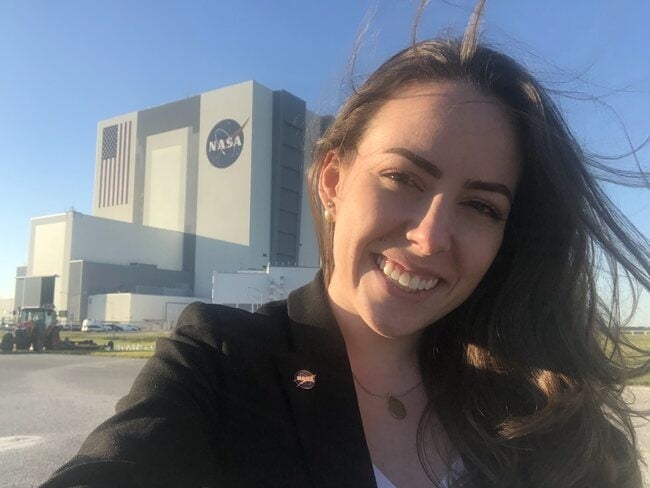
- Who: Alexandra Doten, a former NASA and US Space Force communications specialist turned full-time space communicator.
- Known for: sharing space news in plain English to inspire the next generation of women in STEM.
- Reach: 2 million followers on TikTok and over two hundred thousand on Instagram.
- Worked with the Almanac: on the 2022 Parade of Planets and the early 2023 Green Comet.
- Why now: we feature her every Women’s History Month as a working pioneer in space.
Hey FA readers. In honor of Women’s History Month, we call your attention to a newly forming star: Alexandra Doten, also known as “Astro Alexandra.” This former NASA and US Space Force employee was part of the first steps to establish GPS on the Moon, work that is still in progress. She now dedicates her life to sharing space news in accessible and digestible ways on social media, in hopes of inspiring the next generation of women in Science, Technology, Engineering, and Mathematics (STEM).
After we found plenty of her good posts, the Farmers’ Almanac (find us on Facebook and on Instagram) joined hands with Alexandra to announce a rare alignment of planets, the Parade of Planets, in 2022. In early 2023, she shared the details of when and where to view the much-talked-about Green Comet.
Over the last year alone, Alexandra has built a large following on social media, with 2 million followers on TikTok and over two hundred thousand on Instagram. Here is her story, in her own words, including how she and her close-knit community of women in space prove that out-of-this-world career aspirations really do come true.
6 Questions For Astro Alexandra
1) How did you become a Space Communicator?
I have always been interested in science, from a very young age, but I was never exposed to astronomy or space until I was in college. I took astronomy my freshman year and fell in love with it, then kept taking more astronomy classes. In my sophomore year, after a good number of classes, I got my first internship at NASA as a technical writer, making things more accessible. I loved the work so much that I went back the next year. I joined the GPS Team as a communications specialist, working specifically on GPS satellites.
Vanderbilt University, where I went to school, has a medical center with a children’s hospital. In my senior year, I got a job there developing a science and engineering curriculum for patients who were there for longer than two weeks. I tried to make learning accessible and to keep them up to date with the Tennessee and Nashville school standards, so they could resume school without being held back a grade. That curriculum was adopted by children’s hospitals around the country, and it was a fantastic, rewarding experience.
After college, I took a year off and then returned to NASA full time, back with the GPS team as a fulltime communications specialist. I represented the US with our GPS interests at the United Nations and with subject matter experts around the country, working to get GPS on the Moon.
After about a year and a half with NASA, I left for the Space Force. A lot of the GPS work had been transitioned over to the Space Force when it was created. I joined the Space Force very early on, when there were only a couple of employees. In November 2022, I left the Space Force to pursue content creation fulltime.
2) How and why did you make the leap to social media full-time?
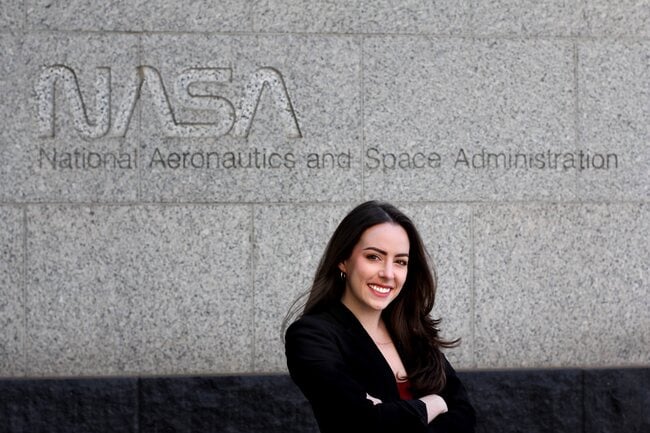
My work at NASA was very public facing. I was flying overseas, visiting schools, and talking with people. My favorite part of that job was going to elementary schools and talking with kids about space and introducing them to it.
When I transitioned from NASA to the Space Force, my job also became significantly less public. I did exciting work internally, and I loved the opportunities I had, but I did not get to have that same public-facing interaction, and I almost never worked with children. I felt like my purpose and my experience were meant for that work, to speak with young people about space and astronomy, to give them that introduction early on, and to empower them to pursue that career path.
I was feeling as though my biggest impact was through my content creation. Once I was able to set up a plan to financially sustain myself that way, I made the leap.
Support Alexandra’s mission by subscribing to her Patreon.
3) What excites you most about space?
The reason I love learning about space is that there is an infinite amount to learn. It will never end. We are never going to know everything. There is always going to be another star, another galaxy, another planet, and someday, extraterrestrial life. It is never going to become stagnant or boring.
Another thing that excites me is that there are quite a few new telescopes on the horizon. The one I am most thrilled about is the Nancy Grace Roman Space Telescope, which is in development. I believe it is launching in 2027. It is equivalent to Hubble’s visible light, but with a field of view that is thirty times that of James Webb. So it is going to be able to map the Universe.
4) Nancy Roman, known as the “Mother of Hubble,” was the first female executive and the first Chief Astronomer at NASA. In her youth, she assembled an astronomy group with friends to study the constellations. How important is community to you, and are you close with other women in space?
We have a really tight-knit community of women space creators. We all have a constant group message going. In November 2022, we all got together in Florida and met each other for the first time. There are 10-15 of us.
We all cheer each other on personally and professionally. We celebrate each other’s promotions, graduations, and engagements. We all woke up early and live streamed, and cried, as one of the women in our group message, Katya Echazarreta, became the first Mexican woman in space. (Learn more about Katya’s story here.) It is a very supportive and exciting community, full of extremely talented and brilliant women.
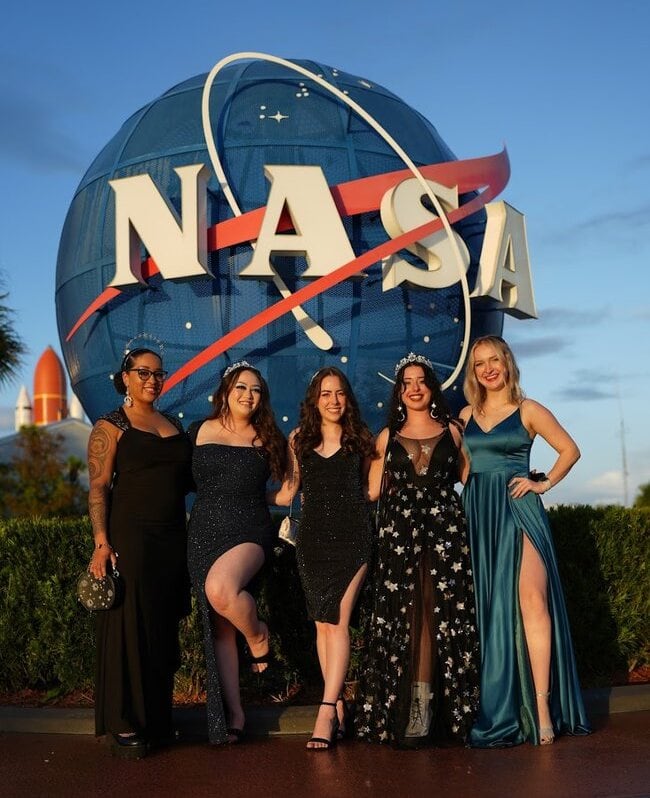
From left to right: Jessie Kolle, Asia Fee, Alexandra Doten, Susan Martinez, Camille Bergin. (Photo taken by Gus Martinez.)
5) In honor of Women’s History Month, if you were to name 4 important pioneers in space, besides Nancy Roman, who might they be?
I admire so many women in space. My particular heroes include Dr. Mae Jemison, Gwynne Shotwell, Dr. Gladys West, Col. Pam Melroy, and Sally Ride. I also think some of the most important women in space are behind the scenes, building the future of space. The National Women’s History Museum keeps a fine biography of Sally Ride if you want to read more about the first American woman in space.
6) What is next for Astro Alexandra?
My goal will always be to bring space to more people, especially people who have not felt empowered to learn about it before. I am excited to look toward new opportunities to expand that.
Bring the Sky Down to Your Calendar
Alexandra’s work is a reminder that the night sky belongs to everyone, not just the people with a telescope and a degree. That has been the Farmers’ Almanac approach for more than two centuries. We read the sky as a planning tool, not a fortune teller. The Moon’s phase and its place among the zodiac signs gave farm families a shared, repeatable calendar for the year: when to plant, when to set eggs, when to cut hair so it grows back slow, when to start a project and when to rest. None of it predicts your future. All of it helps you plan your days around the same sky Astro Alexandra studies for a living.
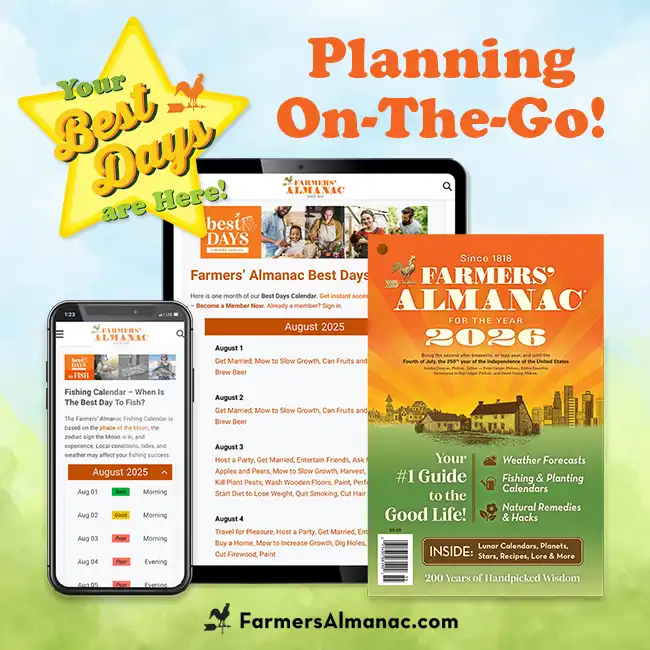
So while you are following her for the next comet or planet parade, you can use the same sky to organize your own to-do list. Our Best Days Calendar marks the favorable days each month for dozens of everyday tasks, all keyed to the Moon’s phase and zodiac sign.
Join The Discussion!
Do you follow Astro Alexandra on social media? What inspires you the most about her story? Who is one woman in space you think is important to mention during Women’s History Month? Let us know in the comments below.
Astro Alexandra: Frequently Asked Questions
Who is Astro Alexandra?
Astro Alexandra is Alexandra Doten, a former NASA and US Space Force communications specialist who now shares space news full time on social media. She helped with early work to establish GPS on the Moon, and she focuses on inspiring the next generation of women in STEM.
What did Astro Alexandra do at NASA and the Space Force?
She started at NASA as a technical writer, then joined the GPS team as a communications specialist working on GPS satellites and efforts to get GPS on the Moon. When much of that work moved to the new Space Force, she joined very early, when there were only a couple of employees. She left in November 2022 to create content full time.
How many followers does Astro Alexandra have?
Over the last year alone she has built a large audience, with 2 million followers on TikTok and over two hundred thousand on Instagram, where she explains space news in plain, accessible language.
Which women in space does Astro Alexandra admire?
She names Nancy Roman, the “Mother of Hubble,” along with Dr. Mae Jemison, Gwynne Shotwell, Dr. Gladys West, Col. Pam Melroy, and Sally Ride. She is also part of a tight-knit group of 10-15 women space creators that includes Katya Echazarreta, the first Mexican woman in space.
What is the Nancy Grace Roman Space Telescope?
It is a NASA space telescope in development that Alexandra is especially excited about. She believes it is launching in 2027. It matches Hubble’s visible-light quality but with a field of view about thirty times that of the James Webb Space Telescope, which will let it map large parts of the Universe.
How does the Farmers’ Almanac use the zodiac?
We treat the zodiac as a planning tool, not fortune-telling. The Moon’s phase and its zodiac sign give a shared calendar for timing everyday tasks, the same idea behind our Best Days Calendar. It does not predict your future, it helps you plan your days around the sky.
Related Women’s History Month Articles
- Meet Mary Anderson, The Inventor Of Windshield Wipers
- Women Who Fought For The Right To Vote
- 7 Great Female Inventors And Pioneers You Should Know

Alexandra Doten a/k/a Astro Alexandra
Astro Alexandra is a space communicator known sharing news in accessible and digestible ways on social media. Beloved by millions of people, she hopes to inspire a new generation of women in STEM (Science, Technology, Engineering, and Mathematics). Astro Alexandra is a former NASA and Space Force employee who helped establish GPS on the Moon in the future. Follow along with Alexandra on Instagram and TikTok.
This article was published by the Staff at FarmersAlmanac.com. Any questions? Contact us at [email protected].
-
Farmers' Almanac Staff

-
Farmers' Almanac Staff

-
Farmers' Almanac Staff

-
Farmers' Almanac Staff

Nice one