

Shooting Stars and Good Luck: The Astronomy, the Folklore, and When to See One
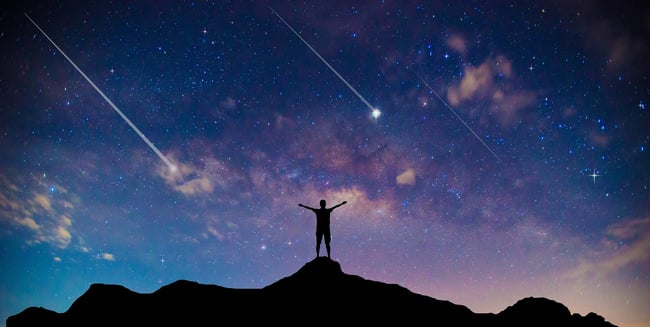
Quick Reference: Shooting Stars
- What it actually is: a meteoroid (rock or dust grain) burning up in Earth’s atmosphere at 25,000 to 160,000 mph.
- Best dates to see one in 2026: Perseids (Aug 12), Geminids (Dec 13 to 14), Quadrantids (Jan 3 to 4).
- Sporadic rate: 5 to 10 per hour on a normal dark night, far from a city.
- Why it is linked to luck: appears across Greek, Roman, English, Celtic, Native American, and East Asian folklore.
- Tool: the Almanac’s Full Moon dates (skip the brightest moon nights for best meteor viewing).
On this page
Related Almanac guides
Sources cited in this guide
A shooting star is a meteoroid (typically a sand-grain to pea-sized piece of rock) burning up in Earth’s atmosphere at speeds between 25,000 and 160,000 mph. Per NASA’s Meteoroid Environment Office, Earth sweeps up about 100 tons of this material per day. That visible streak you make a wish on is real, brief, hot, and ancient: meteoroid material is often older than Earth itself. This guide is the astronomy, the folklore from a dozen cultures, and the specific dates and times to see one in 2026.
What You Are Actually Seeing (the Science)
Per NASA and the American Meteor Society, a shooting star is a moment of friction-driven plasma generation in the upper atmosphere.
- Meteoroid: the rock/dust grain in space. Most are sand to pea sized; some larger.
- Meteor: the visible streak when it enters the atmosphere and burns. This is what you call a “shooting star.”
- Meteorite: any fragment that survives the entry and lands on Earth. Rare; only a small fraction make it.
- Why it glows: the meteoroid superheats the air in front of it. The visible streak is the ionized air column, not the rock itself.
- Altitude: most are first visible at 50 to 75 miles up, burn out around 50 miles. Some bright ones (fireballs) reach below 30 miles before extinguishing.
The Folklore of Shooting Stars (a Cross-Cultural Tour)
Per Britannica’s meteor astronomy entry and folkloric records, the wishing tradition appears in remarkably similar form across at least 6 unrelated cultures.
- Ancient Greek (Ptolemy, 2nd century CE): wrote that the gods sometimes opened the heavens to peek down, and a shooting star was the trail of their gaze. A wish made then would be heard.
- Roman: shooting stars were souls of the dead returning to earth or descending to the afterlife.
- English / Victorian: the modern “make a wish” tradition consolidated in 18th to 19th century English-speaking nurseries.
- Native American (multiple nations): meteors variously read as ancestors traveling, hunters in the sky, or warnings of significant events.
- East Asian: Chinese and Japanese traditions read meteors as messengers from heaven; the wish must be made before the trail fades.
- Celtic: meteors as souls newly departed or about to be born.
Shooting Star Science, Wishing, and Folk Beliefs (Detail)
Below are the original detail sections covering what a shooting star actually is, wishing-on-a-star tradition, more superstitions, and how to catch one.
What Is a Shooting Star?
Shooting stars are a delight to see streaking through the night sky, and while these fleeting dashes of light only last for a moment or two, they can leave a lasting impression on those who see them.
A shooting or falling star isn’t a star at all. It is a meteor, a chunk of asteroid, cometary debris, or space dust that burns up due to friction with the earth’s atmosphere. Millions of meteors skim the earth’s atmosphere every day, but the vast majority are not visible because they are too small, the sky is too bright, or they are otherwise obscured by clouds, fog, or obstacles.
RELATED: Is There A Meteor Shower Tonight? Find Out!
Prior to the 1800s, shooting stars were considered atmospheric phenomena, similar to lightning, rather than originating from the cosmos. In fact, the word meteor originates from the ancient Greek ta meteōra and medieval Latin meteorum, both of which refer to “high up” and in the sky.
In the early to mid-1800s, greater astronomical research clarified the origin of meteors as being beyond the earth’s atmosphere. Meteors may originate from different directions and sources, including cometary bodies, asteroid belts, or ejecta from impacts with the moon.
Wishing on a Shooting Star
With many people of all cultures looking to the heavens for signs, symbols, and answers for eons, it is no surprise that shooting star superstitions exist. The most prevalent superstition is that it is good luck to wish upon a star.
While some interpretations of wishing on a star can indicate any point of celestial light as the appropriate focus for a wish, a shooting star has special significance because of its rarity. The idea of wishing upon one has been around for centuries.
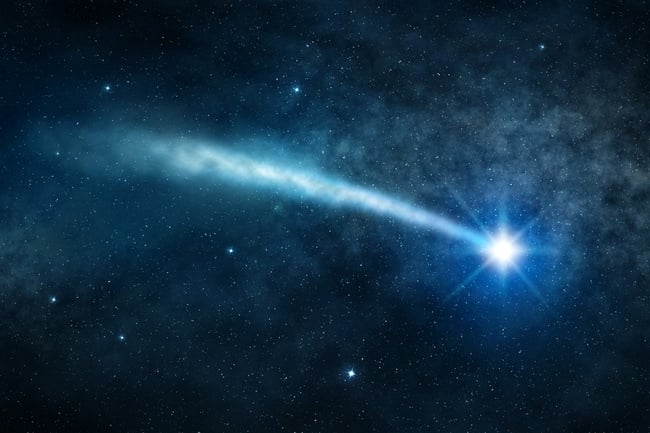
In the second century, the Greek astronomer Ptolemy hypothesized that they were a result of the gods peering down from heaven, having parted the heavens to do so and therefore dislodging a star in the process. Because a shooting star was a tangible symbol of the gods looking down at that moment, it was believed that a wish or request made upon seeing the star was more likely to be heard and granted.
In the 1830s, the idea of wishing upon stars became even more prominent in modern beliefs. Seeing a meteor was believed to be a sign of promise, luck, and good fortune, though of course individual wishes varied greatly. Whispering “money” three times while the star remained visible was believed to be the best way to ensure financial success with such a wish.
More Shooting Star Superstitions
Wishes aren’t the only superstitions associated with shooting stars. Many cultures associate the stars with controlling destiny, often linked to the afterlife.
In the sixth century, the Chinese philosopher Confucius interpreted shooting stars as manifestations of departed souls moving beyond. That journey to heaven, or the reverse, with a recently passed soul falling to the underworld, has been echoed in many cultures, including in Mongolia, Ireland, the British Isles, ancient Greece, and New Zealand.
In some beliefs, a shooting star is believed to be a new soul returning to earth to be reborn.
For sailors, they are more practical omens. When seen at sea, the direction the star travels is believed to predict the direction of the winds, which can be useful (if not scientifically valid) for navigation.
Not all shooting star superstitions are pleasant or practical, however. In Eastern Europe and Mexico, shooting stars represent evil spirits, bringing bad fortune to those below. This can be especially true if the star is brighter, stronger, and impacts the earth as a meteorite.
Ultimately, they are almost universally seen as precursors of change, whether good or bad.
How to Catch a Shooting Star
One reason why shooting stars are so associated with different superstitions is because they can be rare and difficult to see. This is especially true in our modern era, when light pollution often obscures all but the brightest and longest-lasting meteors.
To better your chances of seeing a shooting star, choose a dark location free of excess lighting that can make it harder to see these fleeting streaks of light. This includes viewing during the new moon or after the moon has set. Clouds and fog must be minimal, however, or else your view will be obstructed.
Facing east, the direction of the earth’s rotation, will position you to see shooting stars earlier in their transit, before they flame out. If you are viewing during an annual meteor shower, however, face the constellation where the meteors are known to originate in order to see them more quickly.
Watching for shooting stars closer to dawn will be most effective, when your eyes are most adjusted to the darkness and more meteors will be visible. It can take about 30 minutes for your eyes to adapt to the dark, so time your viewing accordingly.
To stay comfortable and prolong the viewing, have a light jacket or blanket available, as it can get chilly at night, even during the summer. A reclining chair or lounge chair will also help you keep your neck angled to the heavens without developing a crick.
To improve your chances of seeing the most shooting stars, check out these regular and superbly stellar annual meteor showers:
- Perseid Meteor Shower, mid-July to late August
- Leonid Meteor Shower, Most of November
- Geminid Meteor Shower, Mid-December


Shooting Stars FAQ
What is a shooting star?
A meteoroid (typically sand to pea sized rock or dust grain) burning up in Earth’s upper atmosphere at 25,000 to 160,000 mph. The visible streak is the ionized air column the meteoroid creates as it superheats. Most are first visible at 50 to 75 miles altitude.
Why do people wish on shooting stars?
The wishing tradition appears across at least 6 unrelated cultures (Greek, Roman, English, Celtic, Native American, East Asian) with a similar form: the moment of the meteor is a brief opening of communication between earth and heaven. Make the wish before the trail fades.
When can you see shooting stars?
Any clear dark night you may see 5 to 10 sporadic meteors per hour from a rural site far from city light. Three major showers significantly boost the rate in 2026: Perseids (peak Aug 12), Geminids (Dec 13 to 14), and Quadrantids (Jan 3 to 4).
What is the best meteor shower of the year?
Geminids in mid-December are objectively the most prolific, with 120+ meteors per hour at peak from a dark site. Perseids in August are the most popular because the weather is warmer. Both are visible across the entire Northern Hemisphere.
Is a shooting star the same as a meteorite?
No. A shooting star is a meteor (the visible streak of a meteoroid burning up in the atmosphere). A meteorite is the rock fragment that survives the burn and lands on Earth. Most meteors do not produce a meteorite; only the largest do.
What does it mean if you see a shooting star?
Astronomically it means Earth’s orbit has intersected a small piece of space dust. Folklorically it means an opportunity to make a wish, mark a moment, honor a passing soul, or pause and look up. All those readings can be true at once.


Melissa Mayntz
Melissa Mayntz is a writer who specializes in birds and birding, though her work spans a wide range—from folklore to healthy living. Her first book, Migration: Exploring the Remarkable Journeys of Birds was published in 2020. Mayntz also writes for National Wildlife Magazine and The Spruce. Find her at MelissaMayntz.com.
- Melissa Mayntz

- Melissa Mayntz
- Melissa Mayntz
- Melissa Mayntz




Interesting article and topical too. (UK).
Thank you, Rosemary. We appreciate your feedback!