

What Are Mooncakes? The Mid-Autumn Festival Treat With a Legendary Past
Mooncakes are a part of what many call the Mooncake Festival or Mid-Autumn Festival. These special treats are an essential part of the festivities, and their significance goes beyond just their delicious taste.
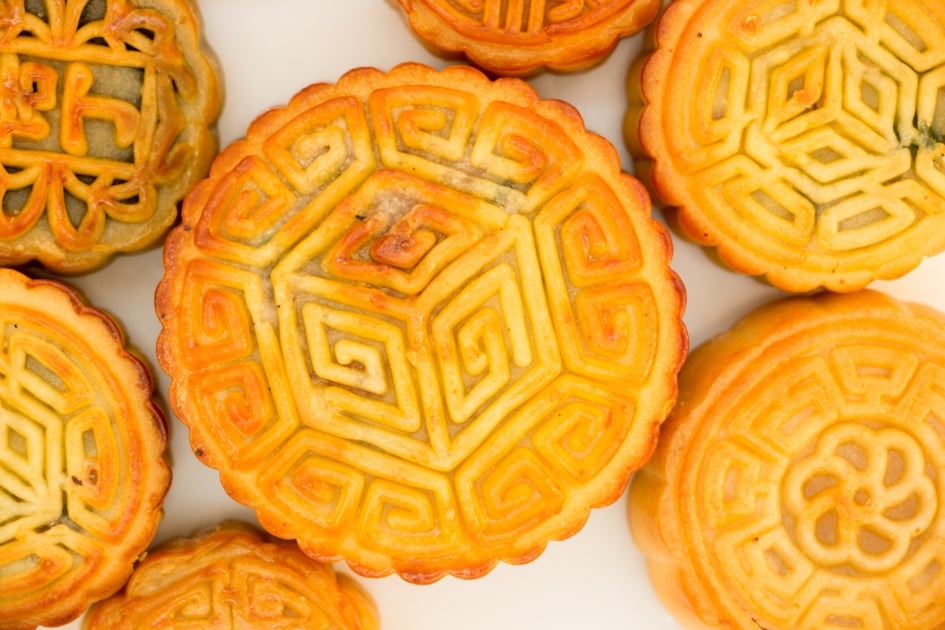
The Mid-Autumn Festival is one of the oldest holidays in the Chinese calendar, marked when the harvest moon hangs at its fullest and roundest each year. Families gather, tea is poured, and mooncakes are sliced into careful wedges so each person at the table gets a piece. The cake is dense and rich, the fillings range from sweet lotus paste to salted egg yolk, and the lattice top is stamped with characters for longevity, harmony, and harvest. They are one of the most distinctive seasonal treats in any cuisine.
Quick Reference
- What they are: dense round pastries with a golden, stamped lattice top and rich, sweet fillings.
- When eaten: Mid-Autumn Festival, also called the Moon Festival, on the 15th day of the 8th lunar month (mid-September to early October on the Western calendar).
- Classic fillings: lotus seed paste, red bean paste, mixed nuts and dried fruit, often with a salted egg yolk in the center to symbolize the full moon.
- Where eaten: China (origin), and across East Asian diaspora communities worldwide.
- The legend: the story of Chang’e, the moon goddess, who drank her husband’s elixir of immortality and ascended to the moon.
- The tradition: shared with family under the full Harvest Moon, often with tea and pomelo.
What Are Mooncakes?
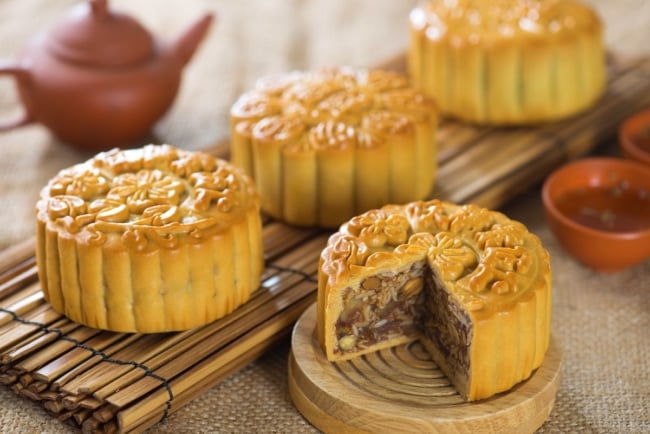
A mooncake is a small, round pastry made with a thin wheat-flour skin around a dense filling. The skin is brushed with egg wash before baking and emerges deep golden brown. The top is stamped with traditional patterns, usually a Chinese character meaning longevity, harmony, or harvest, surrounded by a decorative border. Classic fillings include:
- Lotus seed paste: smooth, sweet, the most common filling in Cantonese-style mooncakes.
- Red bean paste: sweetened azuki beans; deep flavor, slightly less sweet than lotus.
- Mixed nut and dried fruit: walnuts, almonds, cashews, dried longan, candied citron; a Northern Chinese specialty.
- Salted egg yolk: a whole salted duck-egg yolk in the center represents the full moon.
- Modern fillings: green tea, chocolate, custard, durian, ice cream (the famous “snow skin” or bingpi mooncakes).
What Is the Mid-Autumn Festival?
The Mid-Autumn Festival, also called the Moon Festival or Mooncake Festival, falls on the 15th day of the 8th lunar month. In most years that lands in mid-September to early October on the Western calendar. The festival traces back more than 3,000 years to the Shang Dynasty, when emperors performed rituals at moon altars to thank the heavens for the autumn harvest. Today it is a major family gathering across China, Taiwan, Hong Kong, Macau, Vietnam, Singapore, and Malaysia, second only to Lunar New Year in importance. Families share a meal under the full moon, light lanterns, and slice mooncakes together. Children carry red paper lanterns through the streets; cities run big public displays with paper-and-bamboo lantern installations. It connects to other lunar-calendar moments in the year, including the Harvest Moon and the festivals tied to Lunar New Year.
Mooncake Legends
The most famous legend behind the festival is the story of Chang’e, the moon goddess. In one version, her husband, the master archer Hou Yi, shot down nine of the ten suns that were scorching the Earth and saved the people. The Queen Mother of the West rewarded him with an elixir of immortality. Hou Yi hid the elixir at home, but Chang’e drank it (in some tellings to keep it from falling into the wrong hands; in others by accident or temptation) and floated up to the moon, where she lives still. Each year on the night the moon is fullest, Hou Yi sets out cakes and fruit as offerings to his beloved Chang’e. The tradition of sharing mooncakes under the full Harvest Moon began as families honored that story.
A second legend ties mooncakes to the 14th-century overthrow of the Mongol Yuan Dynasty. Rebel leader Zhu Yuanzhang is said to have used mooncakes to smuggle messages of revolt past Mongol guards, with notes baked inside the dense filling, coordinating an uprising for the night of the Mid-Autumn Festival. The Mongols, who never ate mooncakes, did not check. The Ming Dynasty rose. The story is unverified history, but every Chinese kitchen knows it.
Mooncake Traditions and Authentic Recipe
Mooncakes are not casual cooking. They take patience and a few specialty ingredients (lotus seed paste, mooncake molds, golden syrup), and the dough rests overnight for the right texture. For a full authentic walk-through, see this excellent Chinese mooncake recipe from Fine Dining Lovers. The short version of the technique:
- Make the dough from cake flour, golden syrup, alkaline water (lye water), and vegetable oil. Rest overnight.
- Roll the dough into 25g balls; roll the lotus seed paste filling into 50g balls (with or without a salted egg yolk in the center).
- Wrap each filling ball with a dough ball. The wrap is delicate; the goal is even, thin dough coverage.
- Press into a mooncake mold to imprint the lattice pattern, then unmold onto a parchment-lined sheet.
- Bake at 350°F for 5 minutes, brush with egg wash, return to oven, and bake 15 minutes more until deep golden.
- Cool completely. Mooncakes need 2 to 3 days of resting in a sealed container for the “huiyou” process, where the dough softens and the oils migrate to give the cake its signature texture.
For other autumn-month traditions and the meaning behind each, see our guide to pumpkin lore and the names of the months.
Frequently Asked Questions
When is the Mid-Autumn Festival?
The 15th day of the 8th lunar month, which falls in mid-September to early October on the Western calendar. The exact date shifts year to year with the lunar calendar.
What is the salted egg yolk inside a mooncake?
A whole salted duck egg yolk, which symbolizes the full moon at the center of the cake. The salty yolk also balances the sweetness of the lotus or red bean paste filling.
Who is Chang’e?
The Chinese moon goddess. The legend says she drank her husband Hou Yi’s elixir of immortality and ascended to the moon, where she lives still. Mooncakes are eaten each Mid-Autumn Festival in her honor.
Are mooncakes hard to make at home?
Yes. They require specialty ingredients (golden syrup, alkaline water, lotus seed paste), mooncake molds, and a 2 to 3 day resting period before they reach their proper texture. Most cooks buy them from Chinese bakeries during the festival season.
What is the difference between traditional and snow-skin mooncakes?
Traditional mooncakes have a baked, golden dough skin. Snow-skin (bingpi) mooncakes have a chilled, unbaked glutinous-rice-flour skin and are eaten cold. Snow-skin are a Hong Kong invention from the 1980s, often filled with fruit, custard, or ice cream.

This article was published by the Staff at FarmersAlmanac.com. Any questions? Contact us at [email protected].
- Farmers' Almanac Staff

- Farmers' Almanac Staff

- Farmers' Almanac Staff

- Farmers' Almanac Staff


in shock.. figured was an American book guess no.
They are lovely & I would imagine very tasty…….it is a amazing tradition and I hope it is never forgotten. We try to put aside all our long past traditions of ways we celebrate……..way to much it seems. Thank you!
It would have been nice to get a basic recipe for the mooncakes (fillings are optional) and reference to the type of pan used to bake them in, or at least where to buy mooncakes.
Amazon has montages for sale.
Moon cakes! Not montages! Darn autocorrect!
Hi MariaRose, we included the video which has instructions on how to make them. But we’ll link to an authentic recipe.