

Hummingbird Moth Facts: ID, Behavior, Range, and the Garden Flowers They Love
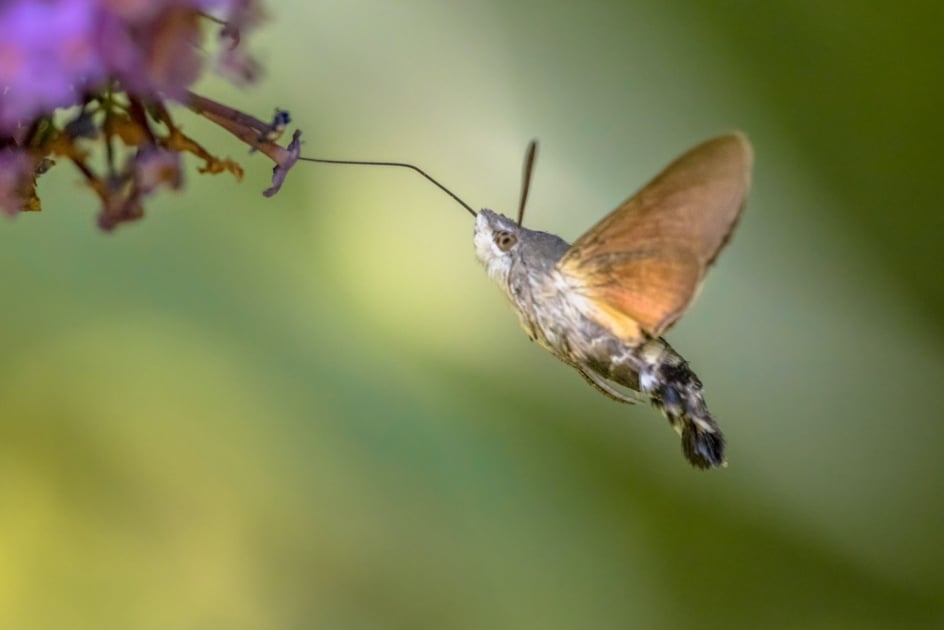
Quick Reference: Hummingbird Moth
- What it is: a moth (Hemaris genus) that flies in daylight, hovers, and drinks nectar exactly like a hummingbird.
- 4 species in North America: snowberry clearwing (most common), hummingbird clearwing, white-lined sphinx, Carolina sphinx (the adult tomato hornworm).
- Size: 1.5 to 2.5 inches wingspan. Roughly half the size of an actual hummingbird.
- Flowers they love: bee balm (Monarda), phlox, salvia, verbena, honeysuckle, butterfly bush.
- Tool: the Almanac’s companion planting guide for pollinator-friendly plantings.
On this page
Related Almanac guides
The blur of motion at your bee balm or phlox patch that looks like a small hummingbird is almost certainly NOT a hummingbird. It is a hummingbird moth (Hemaris), a day-flying moth that hovers, drinks nectar through a long proboscis, and is one of the most underrated garden pollinators in North America. This guide is what the four species look like, how to tell them apart from hummingbirds, the flowers they love most, and the simple plantings that will draw them to your garden.
Hummingbird vs Hummingbird Moth: How to Tell the Difference
Per Smithsonian NMNH entomology research and USDA Forest Service pollinator guidance, four visual cues separate the two at a glance.
- Size. Hummingbird: 3 to 5 inch length. Hummingbird moth: 1.5 to 2.5 inch wingspan, distinctly smaller.
- Body shape. Hummingbird: smooth slender bird body. Moth: stout fuzzy body with visible segmentation.
- Antennae. Hummingbird: none visible. Moth: long curved antennae projecting forward from the head, often club-tipped.
- Wings at rest. Hummingbird: folded against body when perched. Moth: never perches (continuously flies while feeding) but wings can briefly show transparent panels.
- Tail. Hummingbird: forked tail with stiff feathers. Moth: tufted dark tail similar to a hawk moth’s.
The 4 North American Hummingbird Moth Species
Per USFS hawkmoth-pollinator records, four sphinx moth species are commonly mistaken for hummingbirds in the US and Canada.
- Snowberry clearwing (Hemaris diffinis). Most common. Yellow and black body, transparent wing panels. Found across most of North America.
- Hummingbird clearwing (Hemaris thysbe). Olive-green back, reddish-brown belly, transparent wings. Northeast and Midwest US, southern Canada.
- White-lined sphinx (Hyles lineata). Larger (3 to 3.5 in wingspan). Bright pink hindwing flash visible at hover. Across all of North America.
- Carolina sphinx (Manduca sexta). Adult of the infamous tomato hornworm. 4 to 5 inch wingspan, mostly dusk-flying. Southern US and Mexico.
Garden Flowers Hummingbird Moths Love Most
Per UMN Extension’s pollinator-attracting research, hummingbird moths prefer tubular flowers, similar to hummingbirds.
- Bee balm (Monarda). The single most-attractive plant. Tubular flowers, strong scent, long bloom (June through August).
- Phlox (Phlox paniculata, P. divaricata). Tubular pastel flowers; classic hummingbird-moth attractor.
- Salvia / sage. Especially blue salvia and Mexican bush sage.
- Verbena. Especially Verbena bonariensis (tall purple flowering verbena).
- Honeysuckle (Lonicera). Native species only; non-natives can be invasive.
- Butterfly bush (Buddleia). Non-native and somewhat invasive in some states, but a magnet for both hummingbird moths and butterflies.
10 Fascinating Facts About the Hummingbird Moth (Detail)
Below are the original 10 facts covering ID, behavior, life cycle, and pollination role.
10 Fascinating Facts About The Hummingbird Moth
1) Hummingbird moth is the common name used for the genus Hemaris, which include: Hummingbird Hawk-Moth, Sphinx moth, Common Clearwing Hummingbird moth, Snowberry Clearwing Hummingbird moth, Five-Spotted Hawkmoth, and White-Lined Sphinx.
2) Loathed by gardeners, the tomato or tobacco hornworm caterpillar that you see munching on your tomato plants will eventually morph into a Hawk moth, or Sphinx moth, each a type of hummingbird moth.
3) The moths featured in the 1991 film, The Silence of the Lambs were death’s head hawk moths, a type of hummingbird moth (of the Sphingidae family of moths, in the genus Hemaris). According to IMDb, the moths were treated like celebrities. “They were flown first class… and had special living quarters.”
4) The fast-moving hummingbird moth has a rapid wingbeat up to 70 beats per second (depending on the species), enabling it to fly up to 12 mph.
5) Instead of a beak like a hummingbird, it has a long tongue-like proboscis that rolls out of its coiled tube to reach the nectar deep inside flowers. Its tongue is about double the length of the moth’s body.
6) It has large, menacing eyes that appear to warn predators to keep their distance. Also protecting it from potential predators is its close resemblance to a bird, instead of a bug.
7) They range in length from 2, 2.5 inches long and are covered in gray hair that resembles feathers, with white, rust or brown markings or variations. Their wingspan ranges from 2 to 6 inches depending on the species. The Snowberry Clearwing moth has clear wings.
8) The hummingbird moth can be found not only in North America, but in Europe, Africa, and Asia. They have a wide range in the US from Texas and Florida to Maine and Alaska.
9) After mating, the female moth lays eggs on plant leaves such as honeysuckle, cherries, hawthorns, and viburnums. The hatched caterpillar feeds on its host bush or vine.
10) These moths actively feed on flower nectar in the daytime, but you may also get a glimpse of one feeding at dusk on night-blooming flowers such as the evening primrose or night blooming jasmine.


Hummingbird Moth FAQ
Is a hummingbird moth a hummingbird?
No. A hummingbird moth is a moth (Hemaris or Hyles genus) that evolved similar hovering and nectar-feeding behavior to hummingbirds. This is a textbook case of convergent evolution: two unrelated species developing the same body plan and lifestyle independently.
When can you see hummingbird moths?
Mid-spring through late summer across most of North America. Snowberry clearwings often emerge in April or May; activity peaks June through August. Adults fly during the day (most moths are night-flyers). Best viewing is sunny mornings around blooming bee balm or phlox.
Are hummingbird moths good for the garden?
Yes. They are excellent pollinators of tubular flowers and rarely cause damage as adults. The Carolina sphinx is the one exception: its caterpillar is the tomato hornworm, which can defoliate tomatoes if uncontrolled.
What plants attract hummingbird moths?
Bee balm (Monarda) above all, followed by phlox, salvia, verbena, honeysuckle, and butterfly bush. All have tubular flowers that the moth’s long proboscis is built for. Plant clumps of 5+ rather than scattered single plants for the best draw.
Where do hummingbird moths lay eggs?
On the leaves of host plants. Snowberry clearwings lay on snowberry, dogbane, and honeysuckle. Hummingbird clearwings lay on honeysuckle and hawthorn. The caterpillars resemble small green hornworms with tail spikes.
Do hummingbird moths sting?
No. Like all moths and butterflies, they are completely harmless to humans. They have no stinger and rarely bite. The fuzzy body is just scales and hair, not a defensive structure.


Deborah Tukua
Deborah Tukua is a natural living, healthy lifestyle writer and author of 7 non-fiction books, including Pearls of Garden Wisdom: Time-Saving Tips and Techniques from a Country Home, Pearls of Country Wisdom: Hints from a Small Town on Keeping Garden and Home, and Naturally Sweet Blender Treats. Tukua has been a writer for the Farmers' Almanac since 2004.
- Deborah Tukua

- Deborah Tukua
- Deborah Tukua
- Deborah Tukua




Hi I saw my first hummingbird hawk moth today! Do I need to worry about it eating my tomato plant? It is pretty ❣️
seen in morda sy10 2lz shropshire
I live in southern Alberta, I’ve seen the hummingbird moth hovering around flowers in 2023 and then again last night, May 27, 2026.
I live in Tuscarawas County, Ohio. The clear winged hummingbird moth loves to visit my petunias at night. It’s October 6th, and he has come every night at 10 p.m. for months.
How lovely! Thanks for sharing, Andrea. If you happen to get a picture, please share it with us here! Best wishes from all of us at FA.
My first experience with the Moth Hummingbird was in Panama City, FL. At 70 years old, I’d never seen one. I reside in Alabama and was on vacation. I was at the pool of our Condo when I noticed one buzzing around the Lantana flowers. At first glimpse I thought it was a Hummingbird, then realized it wasn’t.
After doing some research I found out it was the Hummingbird Moth (aka a Bee Hummingbird), looking and flying around flowers like the Bumblebee.
Every year since, I am always excited for their arrival in the Spring and enjoy watching them coexist with the various bees on my Abelia plant.
I just witnessed one for the first time! He was feeding on my Nasturiums at around 7 p.m. in Rhinelander, Wisconsin.
How fun! Thanks for sharing with us. 🧡
I saw about 5 on my 4 o clocks Friday evening. Didn’t have my phone on me was taking dog put. I was in Sargent Tx
I live. In central Pennsylvania just this evening at sunset I saw one of these for the first time unfortunately I was not able to get a photo this little creature is amazing to watch .
My husband and I live in Pennsylvania and we noticed these hanging around our butterfly bush.
We live in southern Oregon and just saw our very first hummingbird moth recently in our backyard feeding on a butterfly plant!!