

Hummingbird Moth: How to Spot and Attract One
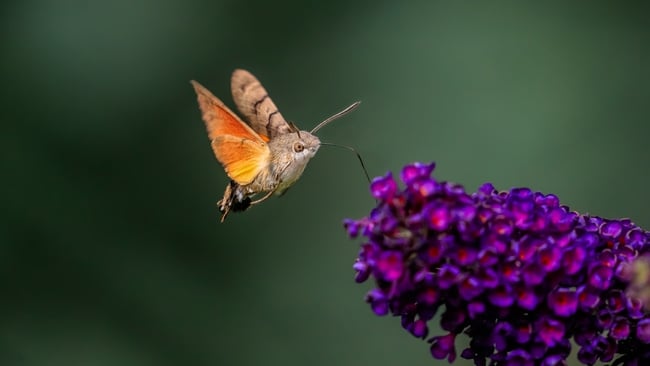
Quick Reference: The Hummingbird Moth
- What it is: a day-flying moth of the family Sphingidae, also called a hawk moth, that hovers and sips nectar like a hummingbird.
- Tell it from a bird: look for antennae, two sets of wings, six visible legs, a coiling proboscis instead of a beak, hair instead of feathers, and sometimes clear wings.
- When you will see one: from early spring through September or early October, most active at twilight when flowers are in full bloom.
- North American species: five, four of them clearwings in the genus Hemaris, plus the white-lined sphinx moth.
- Why it matters: these moths are beneficial pollinators, so a garden full of nectar flowers brings them right to you.
Dear FA Members: Your overwhelming response to our story on hummingbird moths inspired us to tell you even more about them. Read on for more fun facts about these fascinating creatures. (If you have not seen our first article on this topic, with nearly 2,000 user-submitted photos and comments, find it here.)
Please comment below with any additional questions, and include photos of your own sightings.
What Is a Hummingbird Moth?
A hummingbird moth is exactly what the name suggests: an insect that flies and feeds so much like a hummingbird that gardeners do a double take. These moths belong to the family Sphingidae, the group known as sphinx moths or hawk moths, and several of them hover at a flower, hold steady in the air, and dip a long tongue into the blossom for nectar. They are out by day, often at dusk, which is when most folks spot one and reach for the phone to ask us what on earth it was. For a closer look from the horticulture side, the University of Wisconsin-Madison Division of Extension keeps a plain-English page on hummingbird moths that lines up with what you will see in your own beds.
6 Ways To Tell The Difference Between Hummingbird Moths And Hummingbirds
At first glance, you may mistake a hummingbird moth for a hummingbird. Both winged creatures hover, buzz, and dart from flower to flower, feeding on nectar. There are several ways to tell them apart, but you will need a close look to see the physical differences. Hummingbird moths have:
1) Antennae
Since hummingbird moths are insects, it is no surprise that two prominent antennae sit at the top of the head. Hummingbirds have none.
2) Two Sets Of Wings
Hummingbird moths have two small anterior (back) wings in addition to their forewings. The birds only have one set.
3) Six Legs
The moths have six legs that are visible as they fly, while the birds have two that are kept out of sight.
4) No Beak
The moths have a long, tongue-like proboscis that coils up like a paper party horn when not feeding, as opposed to a long, firm beak.
5) No Feathers
The moths are covered with hair that resembles bird feathers.
6) Clear Wings (At Times)
Some moths, particularly the snowberry clearwing, have clear wings. The birds, on the other hand, have opaque wings, despite the fact that they move so quickly they almost appear transparent.
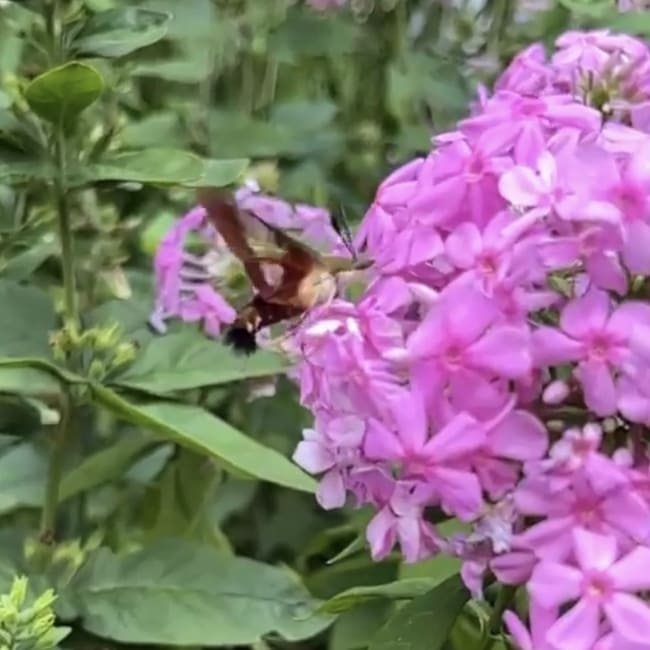
Differences In Feeding and Flight Time
The moths feed on flower nectar alone, whereas the birds also feed on small flying insects they can eat whole, such as mosquitoes, fruit flies, and gnats.
Hummingbirds typically fly and feed during the day and sleep at night. Both the bird and the moth are active during twilight.
Sphinx hummingbird moths are nocturnal creatures, pollinating flowers that open at night. Unlike the bird, which has no sense of smell, the moths are drawn to fragrant, light-colored blooms.
While hummingbirds are particularly drawn to red or orange blooms, hummingbird moths are attracted to tubular-shaped flowers of any color.
Night-blooming flowers often give off a strong scent that attracts the sphinx moth. These include four o’clocks, tuberose, night-blooming jasmine, evening primrose, night phlox, mock orange, angel’s trumpets, nicotiana, moonflowers, cereus, cactuses, and succulents.
Adult moths are best viewed when flowers are in full bloom across the landscape. Taking flight in early spring, the moths actively pollinate flowers through the month of September or early October, if warm temperatures and flowers remain present.
According to Wildlife Trusts, the hawkmoth is a summer visitor to the UK, migrating from Southern Europe in variable numbers each year.
How to Bring Hummingbird Moths to Your Garden
If you want a front-row seat, plant for the moth the way you would plant for the bird. Because hummingbird moths favor tubular blooms of any color and the night-flying sphinx moths track fragrant, light-colored flowers, a bed that mixes both will pull in the widest range. Lean on the night-blooming list above, four o’clocks, evening primrose, moonflowers, and nicotiana, and add daytime nectar plants so there is always something open. Timing helps too. Have flowers in full bloom from early spring through early fall, the same stretch when the adults are on the wing, and skip the broad-spectrum insecticides that take out caterpillars before they ever reach the chrysalis. The same nectar-rich beds bring in their feathered look-alikes, so see our roundup of amazing hummingbird facts while you plan. Our Gardening by the Moon Calendar can help you time the planting that keeps the bloom coming.

Differences In Lifecycles
Unlike hummingbirds, which live an average of 6.5 years, the moths generally live about six months. Yet some sources report that the moths can live as long as 2 to 3 years.
Although hummingbirds and moths both hatch from eggs, their lifecycles have little else in common. Hummingbirds lay eggs in tiny nests, and the infant birds stay in the nest until they mature.
The adult moth lays tiny eggs on the underside of the leaves of its host plant. Unlike birds, moths do not care for their eggs. The eggs hatch in one to two weeks, depending on the temperature. The caterpillars emerge from the eggs and live on the host plant, constantly eating for 20 to 30 days. The fully grown caterpillars go into the pupa, or chrysalis, stage. Once the adult moth emerges from the chrysalis cocoon, it begins feeding on nectar-rich flowers. And the cycle continues.
Observing these beneficial pollinators and beautiful winged creatures in your flower beds is an experience to treasure.
How To Tell Types Of Hummingbird Moths Apart From Each Other
There are five species in North America. Four of these are of the genus Hemaris (clearwing moths).
Clearwing moths are easy to recognize by their beautiful, transparent wings. These include the clearwing (Hemaris thysbe), snowberry clearwing (Hemaris diffinis), slender clearwing (Hemaris gracilis), and Rocky Mountain clearwing (Hemaris thetis).
The fifth species found in North America is the white-lined sphinx moth (Hyles lineata), otherwise known as a hawkmoth of the genus Hyles. It is brownish gray in color with white markings, and pink on its smaller set of anterior wings.
Are Hummingbird Moths Harmful?
Adult hummingbird moths are harmless to people. They do not sting, they do not bite, and that long proboscis is built for nectar, not for skin. They earn their keep as pollinators, moving from bloom to bloom the way bees and hummingbirds do. The caterpillars, often called hornworms for the soft spike on the tail end, do feed on leaves and can chew through the foliage of a host plant, so a gardener who finds them on tomatoes or other prized plants may want to move them rather than welcome them. If you would rather keep them off a moth you do want to meet again, our notes on the original hummingbird moth story cover what to plant instead. In the flower bed, though, the trade is a fair one: a little leaf for a season of hovering, jewel-bright visitors.
Keep Learning
Hummingbird Moths: 10 Facts That Will Amaze
A Winter Forecaster: Wooly Bear Caterpillars (Isabella Tiger Moth)
How To Treat A Browntail Moth Rash
10 Amazing Facts About Hummingbirds

Hummingbird Moth: Frequently Asked Questions
Is a hummingbird moth a moth or a bird?
It is a moth, an insect in the family Sphingidae, also called a sphinx moth or hawk moth. It only looks like a hummingbird because it hovers and sips nectar the same way. Up close you can see antennae, six legs, a coiling proboscis instead of a beak, and hair instead of feathers.
How do I tell a hummingbird moth from a hummingbird?
Look for six features the moth has and the bird does not: two antennae, two sets of wings, six visible legs, a tongue-like proboscis that coils up like a paper party horn rather than a firm beak, hair in place of feathers, and, in species like the snowberry clearwing, clear wings.
What flowers attract hummingbird moths?
They favor tubular-shaped flowers of any color, and the night-flying sphinx moths track fragrant, light-colored, night-blooming flowers such as four o’clocks, tuberose, night-blooming jasmine, evening primrose, night phlox, mock orange, angel’s trumpets, nicotiana, moonflowers, and cereus.
When are hummingbird moths active?
Adults take flight in early spring and pollinate through September or early October if warm temperatures and flowers hold on. Both the moth and the hummingbird are active at twilight, and the sphinx species are nocturnal, working flowers that open at night.
How long do hummingbird moths live?
Most live about six months, far shorter than a hummingbird’s average of 6.5 years, though some sources report a lifespan of 2 to 3 years. The adult lays eggs on the underside of host-plant leaves; they hatch in one to two weeks, and the caterpillars eat for 20 to 30 days before entering the chrysalis stage.
How many kinds of hummingbird moths are there in North America?
Five species. Four are clearwings in the genus Hemaris: the clearwing (Hemaris thysbe), snowberry clearwing (Hemaris diffinis), slender clearwing (Hemaris gracilis), and Rocky Mountain clearwing (Hemaris thetis). The fifth is the white-lined sphinx moth (Hyles lineata), a hawkmoth of the genus Hyles.
Are hummingbird moths harmful?
No. Adult hummingbird moths do not sting or bite, and they are valued pollinators. Their caterpillars, sometimes called hornworms, eat leaves and can damage a host plant, so a gardener may choose to relocate them off prized crops, but the adults are harmless to people.
Join The Discussion – Members Only
What else would you like to know?
Let us know in the comments below.
Please share any photos of your sightings with other FA members here.
We encourage you to get to know each other by doing so.


Deborah Tukua
Deborah Tukua is a natural living, healthy lifestyle writer and author of 7 non-fiction books, including Pearls of Garden Wisdom: Time-Saving Tips and Techniques from a Country Home, Pearls of Country Wisdom: Hints from a Small Town on Keeping Garden and Home, and Naturally Sweet Blender Treats. Tukua has been a writer for the Farmers' Almanac since 2004.
- Deborah Tukua

- Deborah Tukua
- Deborah Tukua
- Deborah Tukua




I seen the Hummingbird moth for the first time a few nights ago.i was able to take an amazing video. I’ve fallen in love with this beautiful creature.
We have them twice a year in NE Louisiana. I go out everyday at dusk to watch them enjoy our ginger lilies and white spider lilies. Have great slo-mo videos of multiple moths feeding-wish I could share here. So hard to get a good picture as they fly so fast, but here’s one. We just love them!❤️
We had one of these in our flowers on June 16th, we live in Saskatoon, Saskatchewan, Canada, and I took some good pictures, it was so nice to see and watch.
I think I’ve just seen a humming bird.moth in my garden on the Isle of wight.!!!
Fantastic! How fun! 🙌