

UFO Sighting? 20 Things People Mistake for UFOs
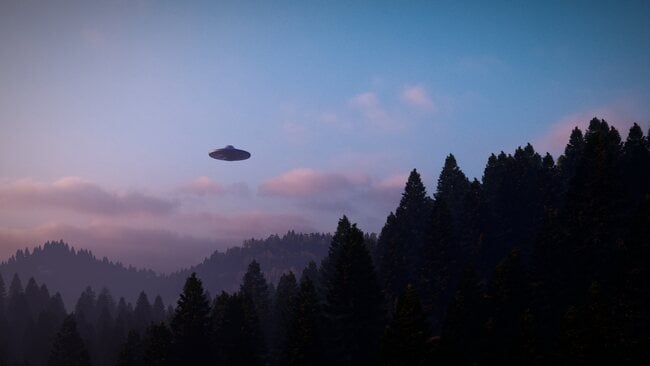
Quick Reference: UFO Sighting or Something Ordinary?
- Most common culprit: Venus, the brightest planet, tops the list of things mistaken for a UFO.
- Red, green, and white lights: almost always an aircraft’s regulation lights, not a spacecraft.
- Strange clouds: lenticular “flying saucer clouds” and hole-punch clouds fool a lot of level-headed folks.
- UFO vs UAP: UAP means unidentified anomalous, or aerial, phenomena, the term officials now use.
- Before you call anyone: run through the 20 everyday explanations below first.
You step outside on a still summer night, look up, and there it is: a bright, silent light that seems to hover where nothing should. Before you reach for the phone, take a breath. New reporting on unidentified flying objects and unidentified aerial phenomena (UAPs) has more people than ever scanning the sky, and most of what they report has a plain, Earthly explanation. Bright planets, odd clouds, and aircraft lights can all look otherworldly at the right moment. The truth is that the great majority of UFO sightings turn out to be misidentifications of perfectly ordinary things.
What is a UAP?
You have probably heard UAP used lately in place of UFO. UAP stands for unidentified aerial phenomena, sometimes given as unidentified anomalous phenomena. In plain terms, it describes something in the sky, or once in a while in the water, that does not match a known aircraft or object. It is the term government agencies and researchers now favor, in part because it drops the flying-saucer baggage that comes with UFO. Rest assured, though: whatever you saw, the odds are strong it was not a spacecraft from somewhere else.
Why Most UFO Sightings Have an Earthly Explanation
Our eyes are easy to fool after dark. With no landmarks for scale, a distant light can look close and huge, and a slow-moving object can look like it is hovering. Add a little atmosphere, a camera lens, or an unfamiliar aircraft, and the brain fills the gaps with the most dramatic answer it can find. That is not a failing on your part. It is simply how human vision works against a black sky.
Even the officials take the ordinary explanations seriously first. NASA convened an independent study team on the subject and published its findings on the agency’s UAP research page, noting that most sightings can be traced to aircraft, balloons, weather, or other known sources once better data is in hand. A clear-sky night helps you rule things out, so it is worth a glance at the Farmers’ Almanac long-range weather forecast before you plan an evening of sky-watching. Below are the 20 usual suspects, in the order they most often trip people up.

20 Things Often Misidentified As UFO Sightings
1) Venus
Venus, the brightest planet, tops our list as the object most commonly mistaken for a UFO. You can spot this dazzling planet with the naked eye on many days of the year. When it sits low near the horizon before sunrise or after sunset, its light bends through the thick air near the ground, appears to flash colors, and holds so still that it looks like it is hovering.
Related: Learn when and where to spot Venus in our Monthly Night Sky Guides.
2) Meteor “Fireballs”
Every so often a meteoroid enters the atmosphere and burns as a huge fireball for a few seconds. Some of these events even produce simultaneous electrophonic sounds, faint clicks or pops heard as the fireball streaks past. Those bright flashes and odd sounds explain plenty of UFO sightings.
Related: Meteor Shower Calendar, with dates and viewing directions.
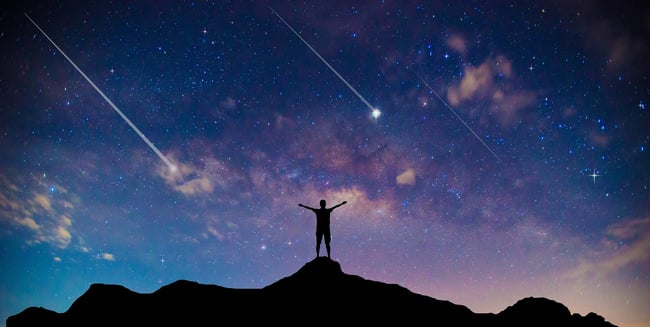
3) Lightning Sprites
Lightning from a thunderstorm can charge the air far above it, producing a faint, upward burst of light called a sprite. Sprites take the shape of balls or tendrils, a little like a jellyfish. They earned the name “sprites,” an old word for an elf or fairy, because they seem to dance high in the sky, and they turn up in more than a few UFO sightings.
4) Ball Lightning
Ball lightning is a rare form of lightning that appears as luminous spheres drifting along solid surfaces or floating in the air near the ground. These hovering balls of light are an electrical phenomenon, usually seen during thunderstorms. They come in many colors and can hold for seconds, sometimes even minutes.
Related: Important Thunder And Lightning Safety Tips.
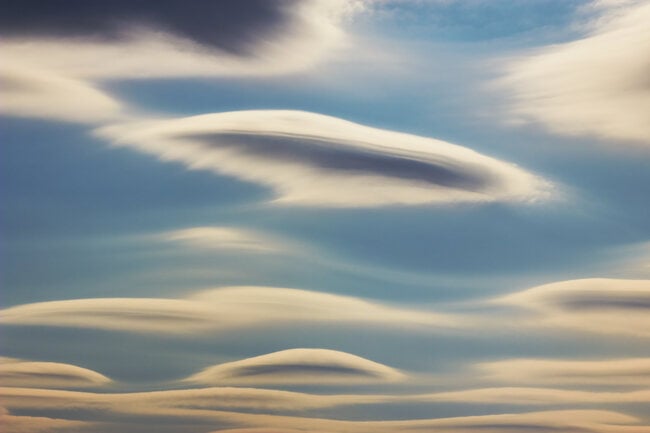
5) Lenticular Clouds
Lenticular clouds have spawned UFO reports for years. Their smooth, stacked loops hang in place, often circling a mountain peak, which is exactly why folks nicknamed them “flying saucer clouds.”
Related: Understanding Crazy Cloud Formations.
6) Hole-Punch Clouds
When sunlight strikes a cloud that has been disturbed by wind or plane traffic in just the right way, it can create an optical illusion known as a hole-punch cloud. These wide, round gaps in the cloud deck can bring black holes or something more alien to mind, but there is a good, plain scientific reason behind them.
7) Satellites
Some low-Earth satellites throw off bright, brief flashes as they catch the sun, and those flashes can become focal points in the night sky that confuse onlookers. The dimmer International Space Station is visible too. Its silent passage takes only a few minutes to cross from one horizon to the other, which is enough to startle a first-time watcher.
8) Lens Flare
Internal reflections inside a camera, known as lens flares, are often the real culprit behind a photographed UFO. Light bounces around the glass in your camera, telescope, or binoculars and leaves a bright, glowing spot on the image. People sometimes chalk that sphere up to paranormal activity, when in fact it is just the Sun.
9) The Moon
It happens more than you would think. Reports of a bright, unidentified object hovering near someone’s house have turned out to be nothing more than the Moon, low and large near the horizon.
Related: When is the next full Moon? See our Full Moon Dates, Times, And Names.
10) Unusual Aircraft Lights
Aircraft get mistaken for something far stranger all the time, especially unfamiliar or experimental planes with unusual profiles. Here is a handy rule: if the UFO or UAP you saw showed red, green, and white lights, it was almost certainly an airplane’s standard regulation lights.
11) Flares from Aircraft
A number of famous UFO sightings trace back to flares. The well-known Phoenix Lights were attributed to flares dropped by a group of planes flying in formation during a routine training exercise. Such exercises often go unnoticed, yet on a clear night flares can be seen from up to 50 km away, and if the air is mild they can hold their formation and hang in place, giving the impression of one solid object.
12) Sky Lanterns
These paper lanterns can rise up to one thousand feet and will hover when the air is calm. Folks often release them tied together, so from a distance a cluster can read as a single glowing object. That makes sky lanterns a leading cause of UFO reports today.
13) Space Debris
Inactive satellites, spent rocket parts, and fragments from missiles get left in orbit and eventually become “space junk.” Atmospheric drag slows the junk until it falls back to Earth, where it burns up as a huge fireball, often trailing colored streaks across the sky.
14) Missile Tests
Missile tests are more common than most people realize, and they have sparked real panic in unsuspecting onlookers. The plume from the rocket can glow bright, throwing long, luminous trails that light up the sky and create an eerie spectacle.
15) Rocket Launches
Plenty of unknowing witnesses to a rocket launch have logged it as a UFO sighting. A “space jellyfish” is one launch-related effect, caused by sunlight reflecting off the plume gases the rocket leaves behind, forming a glowing shape that really does look like a jellyfish drifting overhead.
16) Weather Balloons
Atmospheric balloons are reflective and appear bright against the sky, which sets off no end of UFO reports. More and more of these balloons go up for scientific and educational work, studying the upper atmosphere. When one bursts and falls to Earth, it can be mistaken for an exploding plane, a spacecraft, or a UFO.
A weather balloon is thought to be behind many famous UFO sightings, including the 1947 Roswell incident. Loose helium party balloons have caused their share of scares too. In Manhattan in 2010, thousands of people crowded the streets to gaze at a bright silver object overhead, which turned out to be a bundle of 12 helium balloons that had escaped from a party.
Related: How Do Weather Balloons Work?
17) Sun Dogs
Formally called parhelia, Sun dogs are a cold-weather optical effect: one or two colored spots of light, nicknamed “mock Suns,” that appear on either side of the Sun. They form when sunlight reflects and refracts through ice crystals in the atmosphere, the frozen cousin of the way raindrops build a rainbow.
Related: Farmers’ Almanac Extended Weather Forecast.
18) Searchlights
Giant searchlights that sweep the sky outside theme parks and festivals can be seen from miles away. On a cloudy night, those roving beams are easy to misread as mysterious objects moving overhead.
19) Hobby Drones
Over the past decade, drones have become one of the most popular explanations for UFO sightings. Their small, spaceship-like shape and blinking lights let them hover and dart in ways that easily confuse onlookers, especially after dark.
20) Contrails
Contrails are the vapor or condensation trails that high-altitude jets leave behind, and they can be confused with falling UFOs. When the setting Sun lights up a contrail from the side, a distant one can look like a slow, glowing object drifting down toward the horizon.
How to Tell a UFO Sighting From the Real Thing
Before you decide a light is truly unexplained, walk through a few plain questions. Most sightings sort themselves out in under a minute once you slow down and look again.
- Does it move like a plane? Steady red, green, and white lights on a slow, straight path point to an aircraft, not a spacecraft.
- Is it in the same spot each night? A brilliant “hovering” light that returns to the same low patch of sky is usually a planet like Venus. Our Monthly Night Sky Guides tell you what is up and where.
- Did it only show up in a photo? A glowing orb that your eyes never saw is very likely a lens flare.
- What is the weather doing? Thunderstorms bring sprites and ball lightning; cold, clear air brings Sun dogs. Check the long-range forecast so you know the conditions.
- Is the Moon up? A big, bright object near the horizon is worth checking against the Full Moon dates before anything else.
Run through that short list and you will explain the great majority of what people call a UFO sighting. What is left over, the small share that does not fit any of the 20 items above, is exactly what researchers mean when they say UAP.
How to Report a UAP Sighting
If you have honestly ruled out the ordinary explanations and still cannot place what you saw, a careful report is worth more than a rushed call to the authorities. Note the exact time, the direction you were facing, how high the object sat above the horizon, its color, and how it moved. A steady phone video with a fixed landmark in frame, a rooftop or a tree line, gives anyone reviewing it a way to judge speed and size.
Government interest in the subject is real and growing. NASA and the Department of Defense both study these events, and NASA has said openly that better, cleaner data is the path to real answers. You can read where the science stands on the agency’s UAP research page. Whatever you decide to do with your sighting, do what feels right to you, and keep good notes so the next clear night gives you something to compare against.
A Final Thought
We hope this list settled your nerves and taught you something new about the night sky. There is real wonder up there without needing visitors from another world, and knowing what you are looking at only makes the view better.
If you ever have a question about what you are seeing overhead, join our community discussion below and find us on social media.
Join The Discussion
After reading our list, are you still convinced you experienced a UAP or UFO sighting?
Share your thoughts, and your photos, with your community in the comments below.
Related
Sun Dogs, Sun Pillars, And Sun Halos Explained
Full Moon Dates, Times, And Names

UFO Sightings: Frequently Asked Questions
What is the most common cause of a UFO sighting?
Venus, the brightest planet, is the single most common object mistaken for a UFO. Low on the horizon before sunrise or after sunset, its light flashes colors through the atmosphere and it holds so still that it looks like it is hovering. Bright satellites, aircraft lights, and drones round out the usual suspects.
What is the difference between a UFO and a UAP?
UFO means unidentified flying object, while UAP means unidentified aerial, or anomalous, phenomena. Officials and researchers now favor UAP because it covers things seen in the sky or even in the water and it drops the flying-saucer baggage that comes with UFO. Both terms simply mean something not yet identified, not proof of anything from another world.
How can I tell if the lights I saw were just an airplane?
Look at the colors and the motion. Steady red, green, and white lights on a slow, straight path are almost always an aircraft’s standard regulation lights. Unfamiliar or experimental planes can look strange, and flares dropped in formation during training can hang in place, as they did in the famous Phoenix Lights.
Are UFO sightings ever caused by the weather?
Often. Thunderstorms produce lightning sprites and rare ball lightning, both of which glow and drift. Cold, clear air creates Sun dogs, the colored “mock Suns” beside the real one, and stacked lenticular clouds earn the nickname “flying saucer clouds.” Checking the forecast helps you match a sighting to the conditions.
Was the Roswell incident really a weather balloon?
A weather balloon is thought to be responsible for the 1947 Roswell incident, one of the most famous UFO sightings on record. Balloons are reflective, bright, and hard to judge for size against an open sky, which is why they set off so many reports. Even a bundle of 12 escaped party balloons drew crowds in Manhattan in 2010.
What should I do if I cannot explain what I saw?
Write down the time, direction, height above the horizon, color, and movement, and capture steady video with a fixed landmark in frame. NASA and the Department of Defense study these events and say better data is the key to real answers. Do what feels right to you, and keep good notes to compare against the next clear night.


Natalie LaVolpe
Natalie LaVolpe is a freelance writer and former special education teacher. She is dedicated to healthy living through body and mind. She currently resides on Long Island, New York, with her husband, children, and dog.
-
Farmers' Almanac Staff

-
Farmers' Almanac Staff
-
Farmers' Almanac Staff
-
Farmers' Almanac Staff



This is a good list with one major exception. The Phoenix Lights flares were dropped a long time after the initial sighting. Most consider them an all advised attempt by the air force to once again change the narrative. Look up Governor Fife Symington, the Governor of Arizona at the time of the sighting. He too made a joke of the lights only to apologize to his constituents 10 years later. Symington said he saw a large triangular “craft of unknown origin” with lights, moving slowly. “It was dramatic. And it couldn’t have been flares because it was too symmetrical,” he says. “It had a geometric outline, a constant shape.”