

Persimmon Seed Weather Prediction: How to Read the Winter Forecast
Quick Reference
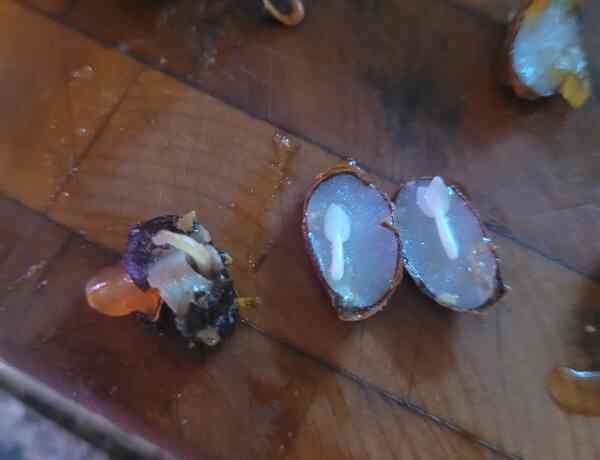
- The rule: split a ripe persimmon seed in half. The white shape inside is one of three: a fork (mild winter), a spoon (heavy snow), or a knife (cold and icy).
- Origin: Appalachian and Southern U.S. folk tradition, recorded since at least the early 1800s. Specific to American persimmon (Diospyros virginiana), not Asian persimmons.
- How to try it: pick 10 ripe seeds from a tree near you, split them, count how many of each shape appear. Each seed represents one week of winter, in order.
- Range: the prediction is local. The Persimmon Lady reads North Carolina seeds and predicts North Carolina winters.
- 2025-2026 reading (completed): Melissa Bunker’s seeds gave a string of spoons (heavy snow) with one knife at the end (ice). The 2025-2026 winter season tracked closer to that read across much of the East than to the standard climate forecast.
The persimmon seed is the strangest American weather forecast that survives in active use. Each fall, families across the Appalachian and Southern U.S. cut open the dark seeds inside a ripe American persimmon, look for one of three shapes (fork, spoon, or knife), and read the result as the winter forecast for their area. The tradition dates back to the early 1800s, possibly earlier among Cherokee and other Eastern Woodland peoples. Modern climate science has not validated it. The Farmers’ Almanac has been publishing the Persimmon Lady’s annual reading since 2018, and the track record is enough to keep readers (and a small but committed corner of the meteorology community) interested. Here is how the prediction works, where it comes from, what it called for the 2025-2026 winter, and how to read your own.
The Rule: What the Three Shapes Mean
Split a ripe persimmon seed lengthwise (along the long axis, not across) and the white kernel inside takes one of three shapes. The folklore reads each shape as a different winter signal:
- Fork: a mild winter. The fork is read as the easiest of the three signals. Some readings interpret the multiple tines as a “plenty” or “abundance” symbol that points to a forgiving season.
- Spoon: a heavy-snow winter. The spoon shape is read as a shovel. The folklore says the more spoons in your sample, the more shoveling.
- Knife: a cold, icy winter. The knife is read as wind sharp enough to cut. The folklore associates the knife with ice events more than snow.
The reading is meant to be week-by-week. The first seed split represents the first week of winter, the second represents the second week, and so on through ten seeds. A bag of nine forks and one knife predicts a mild winter punctuated by a single ice event. A bag dominated by spoons predicts a long, snowy stretch. The position of each seed in the sequence is meant to match the position of the predicted weather in the calendar.
Where the Tradition Comes From
The persimmon-seed reading is American, not European, and almost certainly older than the written record. The tradition is most strongly associated with Appalachia, the Ozarks, and the rural South, where the American persimmon (Diospyros virginiana) is native. The earliest published references appear in 19th-century farm almanacs and Southern newspapers, but the practice was clearly in informal use long before that. Some references credit Cherokee and other Eastern Woodland peoples with originating the reading; it has remained, at minimum, a custom that traveled across cultural lines and stayed widely used in the rural South into the 21st century.
The Asian persimmon (Diospyros kaki), the variety that shows up most often in U.S. supermarkets, does not produce the same readable seed shapes. The folklore is specific to the American native species, which is why a usable persimmon-seed prediction has to come from a tree growing near you, not from store-bought fruit. Anyone in the Eastern U.S. who has access to a wild or backyard D. virginiana tree is in range. Anyone west of the Mississippi or outside the native range is generally out of luck for the genuine reading.

How to Read Your Own Persimmon Seeds
Reading persimmon seeds is straightforward, but several details have to be right. Get them wrong and the reading either falls apart or produces unreadable seeds.
- Wait until the persimmons are fully ripe. An unripe persimmon is mouth-puckeringly bitter and the seeds inside are not fully developed. Ripe persimmons are soft, slightly translucent, and often look almost overripe. The first hard frost helps; many readers wait for it.
- Use locally grown fruit. Forecasts are read for the location of the tree. North Carolina seeds predict North Carolina weather, Tennessee seeds predict Tennessee weather. Fruit trucked in from another region defeats the purpose.
- Pick 10 seeds. The standard sample is ten, one per week of winter. Some readers use fewer for a quick read; the more seeds, the more reliable the count.
- Soak if needed. Persimmon seeds are tough. Soaking them in warm water for an hour softens them enough to split. A small craft knife or a single-edge razor blade works for the cut.
- Split lengthwise, not crosswise. The shape only appears when the seed is cut along the long axis. A crosswise cut produces a useless oval.
- Record the sequence. Note each shape in the order you cut: seed 1 = week 1, seed 2 = week 2, and so on through seed 10. The pattern is what produces the rolling forecast, not just the totals.
Two cautions worth noting. First, the prediction is folk weather, not a scientific forecast. Second, the seeds inside a single tree tend to favor one shape across most of the fruit, which means a single-tree sample can be biased. Several readers split seeds from multiple trees in the same area and average the result.
The Persimmon Lady: Melissa Bunker’s Annual Reading
Melissa Bunker, known across Farmers’ Almanac coverage as The Persimmon Lady, has been making annual persimmon-seed predictions for the publication since 2018. Bunker is based in central North Carolina and has access to multiple wild and backyard D. virginiana trees, which gives her readings a multi-tree sample that single backyard readings cannot match. Her readings are specific to North Carolina but tend to track the broader Mid-Atlantic and Southeast pattern reasonably well, because the climate signals that produce a hard or mild season in central North Carolina often cover a wider zone.
Bunker’s process layers several traditional indicators. She reads the persimmon seeds first, then cross-checks against wasp and hornet nesting (high in the trees signals harsh weather, low or in-the-ground signals mild). The two together give her enough to file an annual reading by mid-October, well ahead of the climate models’ winter outlook.
The 2026–2027 Persimmon Reading: Coming October 2026
Persimmon seeds are read in early fall after the fruit has ripened. Melissa Bunker (the Persimmon Lady) will file her 2026–2027 winter weather reading in October 2026. Check back then for her prediction on what the coming winter holds.
Curious what she predicted for last winter? See the 2025–2026 reading below. And for the official long-range winter outlook, see our 2026–2027 Winter Weather Forecast.
The 2025-2026 Persimmon Reading: Snow, Chill, Repeat
The 2025-2026 reading from the Persimmon Lady arrived in October 2025 and was the heaviest spoon-dominated reading she had filed since 2018. Bunker’s report:
- Weeks 1-2: forks. A mild start to the winter season.
- Weeks 3-5: spoon, spoon, fork. A burst of snow with one mild week between systems.
- Weeks 6-8: spoon, spoon, spoon. The heart of the winter, dominated by snow events.
- Weeks 9-10: fork, spoon (with a pointed tip almost reading as a knife). A late-winter mix of rain, snow, and possibly an ice event to close.
Bunker also flagged an unusual sign at the start of the season: the persimmons themselves were dropping unripe and rotting on the ground in the early fall. She wrote that the last time she had seen that pattern was in 2018, the year of an unusually icy and snow-heavy Carolinas winter. She read the early drop as a confirmation of the seed reading: heavy precipitation, with ice as the wildcard.
How the 2025-2026 Reading Played Out
By April 2026, with the winter season effectively over across the contiguous U.S., the persimmon reading has a partial verdict. The Mid-Atlantic and parts of the Southeast did see a snow-heavy mid-winter, with above-average accumulation in central North Carolina, Virginia, and parts of Tennessee from late January through mid-February. The late-winter ice event Bunker hinted at arrived as a regional ice storm in early March. The standard climate-model winter outlook had called for a milder, drier winter across much of the same zone, weighted toward the developing ENSO-neutral signal.
The persimmon reading does not score perfectly across all ten weeks. Week 1 (mild) and weeks 6-8 (heavy snow) hit. Some of the fork-dominated stretches read more spoon-like in actual conditions, especially across the Carolinas. The closing knife-like read produced an ice event that did appear, in March rather than in the final week of meteorological winter. As folklore goes, that is closer to a hit than a miss. The Farmers’ Almanac long-range outlook for the same zone called for a similar pattern, which gave readers two independent signals (one folk, one analog-based) pointing in the same direction.
Does the Persimmon-Seed Method Actually Work?
The honest answer: there is no peer-reviewed mechanism that connects the cotyledon shape inside a persimmon seed to the climate pattern of the coming winter. The shape is genetically determined, with environmental factors during fruit development (heat, drought, soil conditions) producing some variation between trees. Climate research has not produced a study showing that the cotyledon shape predicts the December-March weather any better than chance.
That said, several layered effects can make the reading appear to track real conditions. A drought summer often produces more seeds with sharper, more knife-like shapes, and a drought summer is sometimes a marker for a colder-than-average winter. A wet summer often produces fuller, more spoon-like seeds, and a wet summer can correlate with a snowier winter in the same zone. Those summer-to-winter correlations are weak but non-zero. The persimmon reading may be capturing a real, low-grade signal at the upstream climate level, even though the kernel itself is not “predicting” anything.
The honest reader-agency framing: the persimmon seed is folk weather. It is one input. The other inputs are the climate-model outlook, the analog-year history, and the long-range outlook. Read all of them, weigh them, and prepare for the winter the consensus calls for. If three of the four say snow, prepare for snow. If they disagree, the persimmon reading tells you something about local lore but not necessarily about your December.
Other Folk Weather Signs Worth Reading
The persimmon seed is one of several folk indicators that have stuck around in active rural use. Most have a similar status: real signal somewhere in the chain, no clean scientific mechanism, useful as one input among several.
- Woolly bear caterpillars: the band-thickness rule. The wider the rusty-brown middle band, the milder the winter.
- Wasp and hornet nests: nests built high in trees signal a hard winter; nests in the ground signal a mild one.
- Animal behavior: thicker-than-usual coats on cattle and horses, squirrels building nests in low branches, geese flying south unusually early.
- Onion skins: thick papery skins are read as a sign of a hard winter; thin skins, a mild one.
- Acorn drop: a heavy acorn fall is read as a sign that nature is provisioning for a cold winter ahead.
None of these is a forecast on its own. Read alongside the Farmers’ Almanac long-range outlook, they layer up into a richer picture than any single source provides. The folk readings give a regional, personal angle. The climate models give a continental, statistical one. Both pointing the same direction is the strongest signal you can get this far ahead of the season. For the side-by-side seasonal forecast, see the Farmers’ Almanac long-range forecast.
Cut a seed. Read the shape. Pair it with the forecast. The winter will tell you which one was right. For the folklore’s other side (the science of persimmon ripening, traditional uses across Appalachian foodways, and the regional record of the prediction), see the in-depth persimmon-seed reference at The Old Farmer’s Almanac.

Frequently Asked Questions
Is the persimmon-seed weather prediction backed by science?
No. The cotyledon shape inside a persimmon seed is genetically determined and not a peer-reviewed indicator of winter weather. There is some weak correlation between summer growing conditions (drought versus wet) and the resulting seed shape, and summer conditions do correlate weakly with following-winter patterns, but the chain is not strong enough to function as a forecast.
How accurate has the Persimmon Lady’s reading been?
The track record since 2018 has been mixed but not random. Bunker’s readings have called specific patterns (heavy snow weeks, ice events, mild stretches) that have lined up with the eventual season more often than chance would predict. The reading is local to North Carolina but tends to track the broader Mid-Atlantic and Southeast.
Can I read persimmon seeds for my own region?
If you live in the native range of the American persimmon (Diospyros virginiana) (most of the Eastern and Southern U.S.) yes. Pick ten ripe seeds from a tree near you, split them lengthwise, count the shapes. The reading is for the area of the tree.
What if my seeds all show the same shape?
A single tree often produces seeds with the same dominant shape across most of its fruit. To get a more reliable reading, pull seeds from two or three trees in the same area and average the result.
Why does each seed represent a week of winter?
Folk tradition. The pairing of “ten seeds, ten weeks of winter” is the version that became dominant in 19th-century Southern almanacs. Other versions read the dominant shape across the full sample as the season-long forecast. The week-by-week reading is the one most popular today.
When are persimmons ripe enough to read?
After the first hard frost in your area, generally late October to mid-November in the South and Mid-Atlantic. The fruit should be soft and almost overripe before the seeds inside are fully developed. Picking too early produces under-developed seeds with no readable shape.
Does the persimmon reading work for places like California or Texas?
Less reliably. The American persimmon native range covers most of the Eastern U.S. but not the Pacific or most of the Mountain West. Asian persimmons (the kind in supermarkets) do not produce the same readable shapes. If you can find a backyard D. virginiana in Texas, the reading would technically work for that location.


Peter Geiger
Peter Geiger is the Editor Emeritus of the Farmers' Almanac. Read his full biography.
This article was published by the Staff at FarmersAlmanac.com. Any questions? Contact us at [email protected].
-
Farmers' Almanac Staff

-
Farmers' Almanac Staff

-
Farmers' Almanac Staff

-
Farmers' Almanac Staff

Persimmon seed perdition for 2011 in Bartlesville oklahoma
2011 persimmon perdition